Greetings · Small Talk
Small talk and introductions
Greeting people, introducing yourself, talking about hobbies and weekends, and keeping the conversation going.
- Nice to meet you. I work in marketing.
- What do you usually do on weekends?

EVERYDAY ENGLISH, EVERY OPPORTUNITY.
Designed for everyday situations, from greetings, shopping, and travel to workplace communication,
so you can speak English naturally in daily life and handle every moment with confidence!
 Where is the
WHAT YOU WILL PRACTISE
Everyday English is English for day-to-day communication. The point is not how many words you memorise or what score you get, but whether you can understand people in real situations, say clearly what you need and keep the conversation going naturally.
Ambitious Learner's Everyday English course is taught online, one-on-one, by foreign teachers. Through role-play, situational Q&A and live speaking practice, the words and sentence patterns you learn become English you can actually use. Complete beginners can start with the most common short phrases; the teacher adjusts speed and vocabulary to your level.
Greetings · Small Talk
Greeting people, introducing yourself, talking about hobbies and weekends, and keeping the conversation going.
Dining · Shopping
Reading menus, ordering, asking about sizes and prices, paying, and returns or exchanges.
Travel · Transportation
Airport check-in, immigration questions, hotel check-in, asking for directions and taking transport.
Workplace Conversation
Small talk with colleagues, hosting foreign visitors, asking about progress and confirming details.
Living Abroad
Renting a place, opening a bank account, seeing a doctor and asking for help when something goes wrong.
Speaking · Listening
Understanding questions, asking people to repeat when you miss something, and answering on the spot.
From skills assessment and course planning to progress tracking, professional teachers support you every step of the way, helping you steadily improve your English.
Lessons tailored to your level and goals for more efficient learning.
International materials and a well-structured curriculum build your English step by step.
Real situations from daily life, travel, and work help you actually speak English.
Regular reviews and course adjustments make sure every step brings clear progress.
HOW THE COURSE WORKS
Everyday English is Ambitious Learner's online one-on-one English conversation course. Lessons are taught entirely in English by foreign teachers, last 25 or 45–50 minutes, and cover topics chosen for your level and the situations where you use English most, such as travel, work, parenting, and life overseas.
| Format | Online and one-on-one, taught entirely in English by foreign teachers |
|---|---|
| Lesson Length | 25 minutes or 45–50 minutes |
| Best for | English beginners, and adults and students who want stronger everyday conversation |
| Topics | Small talk, restaurants and shopping, travel and transport, workplace communication, living abroad, speaking and listening |
| Teacher Assignment | A regular teacher, or flexible arrangements as needed |
| After Each Lesson | Teacher's notes and feedback summarizing the lesson's key points and what to work on next |
| Learning Tracking | A dedicated advisor and the student platform |
| Fees | Depends on the number of lessons and the plan. After your free level test, an advisor will suggest a plan and total price based on your goals and the time you have for lessons each week |
| Getting Started | Start by booking a free one-on-one level test of about 20 minutes |
Actual teachers, scheduling, absence, and refund terms are governed by your enrollment plan and written contract.
In about 20 minutes, a live teacher assesses your English one-on-one and gives you a skills analysis and personalized learning recommendations.
Pick a convenient date and time, fill in your details, and you're booked.
Through speaking and scenario-based conversation, we get a full picture of your English.
Based on the international CEFR standard, we analyze your vocabulary, grammar, fluency, pronunciation, and comprehension.
We recommend the courses and direction best suited to your level and goals.
A live teacher analyzes your English based on the international CEFR standard, giving you a clear level assessment and personalized learning advice.

Sample Report
You can handle familiar everyday topics, but there's room to improve sentence completeness and speaking on the spot.

REAL STUDENT STORY
Lynn, a mother of two, takes Everyday English lessons at Ambitious Learner. She isn't learning English for an exam or a new job: she uses it when teaching her kids, and hopes that on her next trip abroad she can explore more freely and chat with the people she meets.
Everyday English can start with the question “What do I want to use English for?” Then begin practicing with the situations you're most likely to face, such as asking for directions, ordering food, shopping, and introducing yourself.
Read Lynn's Full StorySee clearly what you can achieve at each level based on real communication ability, along with the matching CEFR, IELTS, and TOEFL iBT benchmarks.
| English level | Everyday English ability | Suggested goals |
|---|---|---|
| A1 Beginner | Can understand and use simple everyday expressions | Introducing yourself, greetings, simple ordering |
| A2 Elementary | Can handle familiar everyday situations | Shopping, asking for directions, describing daily activities |
| B1 Intermediate | Can deal with most common everyday communication | Travel, sharing experiences, giving opinions |
| B2 Upper intermediate | Can take part in everyday conversation fairly fluently | In-depth discussion, explaining your point of view |
| C1 Advanced | Can use English flexibly and fluently | Complex situations, nuanced expression |
This is a general CEFR reference and does not mean Ambitious Learner's Level 0–10 maps one-to-one onto CEFR levels; your actual level is set by the free level check.
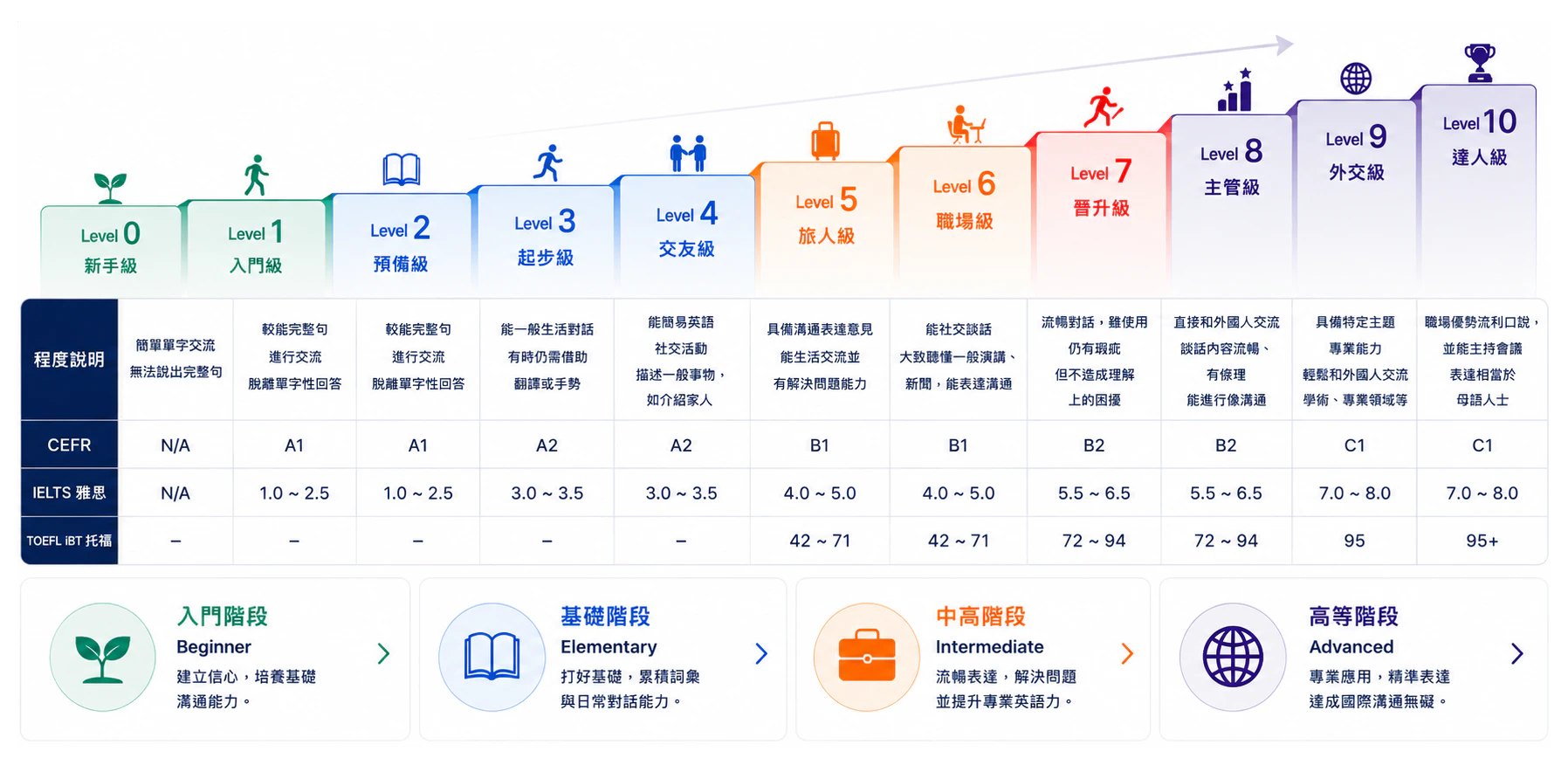
Level 0Novice
Communicates with simple words but can't form complete sentencesLevel 1Beginner
Communicates more in complete sentences, moving beyond one-word answersLevel 2Preparatory
Communicates more in complete sentences, moving beyond one-word answersLevel 3Starter
Can hold everyday conversations but sometimes still needs translation or gesturesLevel 4Social
Can take part in simple social activities in English and describe everyday things, such as introducing family membersLevel 5Traveler
Can express opinions, handle everyday interactions, and solve problemsLevel 6Workplace
Can make social conversation, broadly follows general talks and the news, and can express themselvesLevel 7Promotion-Ready
Converses fluently; still makes some mistakes, but they don't get in the way of understandingLevel 8Manager
Communicates directly with people from other countries, speaking fluently and coherently, and can hold in-depth conversationsLevel 9Diplomat
Has expertise in specific subjects and comfortably discusses academic and professional topics with people from other countriesLevel 10Master
Speaks fluently enough to be an asset at work, can lead meetings, and expresses themselves at a level comparable to a native speakerSince January 2026, TOEFL iBT has used a 1–6 score scale; the table shows the previous 0–120 scale. According to ETS's concordance, a new-scale score of 3–3.5 is roughly CEFR B1, 4–4.5 roughly B2 (about 72 or above on the old scale), and 5–5.5 roughly C1 (about 95 or above on the old scale).
Want to practise everyday English before your lessons start? Ambitious Learner has put together guides on everyday conversation, speaking, restaurant English and travel situations to help you build your English from simple phrases.
FREQUENTLY ASKED QUESTIONS
The Everyday English course is for adults and students who want to communicate better in everyday English, including beginners, people who haven't used English in years, those who understand English but are afraid to speak, and anyone who wants stronger English for travel, work, socializing, or life overseas. Lessons are planned around each student's current level, goals, and real-life situations, helping you improve step by step from the right starting point.
The cost depends on how many lessons you buy and which plan you choose. After your free level test, an advisor will recommend a number of lessons based on your level, learning goals, and the time you have for lessons each week, and explain the plan's total price and validity period. Teacher arrangements, rescheduling, and refund rules are also explained clearly before you enroll.
Yes. Lessons are taught entirely in English, but English-only doesn't mean difficult or fast: your teacher adjusts their speaking speed, word choice, and sentence length to your level, and uses pictures, gestures and demonstrations, example sentences, and repeated practice to help you understand. Beginners start with the most common words, short phrases, and everyday situations. The point isn't to understand everything from the start, but to gradually get used to understanding English from context and key words, and then to respond.
In a group English conversation class, one teacher works with several students, so each person gets limited time to speak. This English conversation course is one-on-one online, taught fully in English by a foreign teacher: every 25 or 45–50 minute lesson is a conversation between you and the teacher, who adjusts speaking speed, wording and practice situations to your level and leaves notes and feedback after each lesson. If you are looking for a speaking class to finally open up, start with a free one-on-one level check of about 20 minutes, then decide whether to begin lessons.
Everyday English is English for day-to-day communication: understanding people in real situations, saying clearly what you need and keeping the conversation going. Regular English courses often focus on grammar rules, vocabulary memorization, or exam content. The Everyday English course puts more emphasis on real communication and practical use. Lessons revolve around everyday situations such as shopping, dining, transportation, accommodation, travel, work, socializing, and life overseas, so you don't just learn words and sentence patterns, but also practice understanding others, answering questions, and speaking up in real situations.
Everyday English focuses on speaking for daily life, travel, socializing, and life overseas. Business & Workplace English focuses on meetings, presentations, Email, negotiations, and job interviews in English. Test Preparation targets the question types and score goals of IELTS, TOEIC, TOEFL, and GEPT. If you're not sure which to choose, take the free level test first, and your teacher and advisor will recommend one based on your goals.
Content is arranged around each student's level and needs. Common topics include self-introductions, everyday greetings, times and dates, ordering at restaurants, shopping and paying, using transportation, hotel check-in, airport English, asking for directions, seeing a doctor, renting a home, workplace conversations, social chat, and everyday English for life overseas. Beyond vocabulary and sentence patterns, you'll also practice asking questions, answering, confirming information, and keeping conversations going.
Yes. Through English-only Q&A, role-plays, situational dialogues, and real expression practice, you get more chances to listen to and speak English. Teachers give guidance where you tend to mishear, misspeak, or get stuck, helping you get familiar with common pronunciation, intonation, and expressions, and gradually improve your comprehension, response speed, and fluency.
Yes. If you are travelling soon, you can practise airport check-in, immigration questions, hotel check-in, ordering food, paying in shops, asking for directions, taking transport and asking for help in an emergency. If you use English at work, lessons can add self-introductions, hosting foreign clients, phone calls, asking about progress and confirming details. If you are moving abroad, topics can include renting, banking, seeing a doctor and everyday shopping. Tell your advisor which situations you meet most often and the teacher will plan practice around them.
You can choose a regular teacher or have teachers arranged flexibly, depending on your needs. If you'd like to keep learning with a teacher who knows your level, you can choose a fixed arrangement; if your work or schedule isn't regular, you can talk with your advisor about suitable teachers and time slots. Please check the rules on rescheduling, substitute teachers, and changing teachers with your advisor before you enroll.
Every student has a different starting point, lesson frequency, practice time, and goal, so the pace of progress varies. With regular lessons and consistent review, most students first notice that common sentence patterns feel more familiar, they understand more, and they feel less nervous about English. As practice builds up, response speed, sentence completeness, and fluency improve step by step.
The test takes about 20 minutes and is conducted one-on-one by a live teacher. Through spoken interaction and scenario-based conversation, the teacher analyzes your vocabulary, grammar, fluency, pronunciation, and comprehension against the international CEFR standard, then gives you a skills analysis and learning recommendations. After that, you decide whether to start lessons.