Meetings
English for Meetings
Give your view, answer questions, add information, then confirm what was agreed and the next steps.
- Can I add something to that point?
- So we're agreed on the timeline, right?

EMPOWERING YOUR GLOBAL CAREER.
Designed for real workplace needs, from emails and meetings to presentations and cross-border collaboration,
so you can speak English naturally at work and meet every international challenge with confidence!

WHERE YOU WILL USE IT
Business English (also called workplace English) is the English used at work and in international business: meetings, business email, presentations and proposals, client conversations, negotiation and job interviews. Everyday English focuses on daily conversation, travel and socialising; Business English puts more weight on professional vocabulary, workplace etiquette and a clear line of reasoning, so you can state your view at work clearly and appropriately.
Ambitious Learner's Business English course is taught online, one-on-one and entirely in English by foreign teachers, with practice planned around your role, industry, English level and career goals. Professionals with a weaker base can start by introducing themselves and explaining their work; managers who run international meetings can go straight to chairing meetings, presenting and negotiating.
Meetings
Give your view, answer questions, add information, then confirm what was agreed and the next steps.
Business Email
Client correspondence, quotes, progress follow-ups, and explaining a delay or apologising appropriately.
Presentations
Openings, explaining data, transitions between sections, and handling Q&A afterwards.
Job Interviews
Introduce yourself in English, explain your experience and why you are changing jobs, and practise with mock interviews.
Negotiation
Negotiate terms, handle objections, and keep different cultural communication styles in mind.
Global Clients
Present products, win new clients, and work with overseas teams and suppliers.
From meetings and presentations to business negotiations and cross-border collaboration, practice with real workplace scenarios helps you express yourself more precisely and handle every work challenge with confidence.
HOW THE COURSE WORKS
The Business English course is Ambitious Learner's online one-on-one English course: foreign teachers teach entirely in English, your consultant arranges the number and timing of lessons around your needs, and topics such as meetings, presentations, email, negotiation and job interviews are chosen for your role, industry and goals.
| Format | Online and one-on-one, taught entirely in English by foreign teachers |
|---|---|
| Lessons & Schedule | Arranged by your dedicated advisor around your needs and availability; your advisor confirms the details |
| Lesson Content | Planned around your role, industry and goals; you can bring your own work emails, presentations or interview answers to practise in class |
| Teacher Assignment | Matched to your level, work background and each teacher's strengths; you can keep a regular teacher or talk to your advisor about changes |
| After Each Lesson | Teacher's notes and feedback summarizing the lesson's key points and what to work on next |
| Learning Tracking | A dedicated advisor and the student platform |
| Fees | Depends on the number of lessons and the plan. After your free level test, an advisor will suggest a plan and total price based on your goals and the time you have for lessons each week |
| Getting Started | Start by booking a free one-on-one level test of about 20 minutes |
Actual teachers, scheduling, absence, and refund terms are governed by your enrollment plan and written contract.
HOW TO GET STARTED
About 20 minutes, one-on-one with a real teacher, who gets to know your English level through speaking and role-play conversation.
Using the CEFR international standard, the teacher assesses your vocabulary, grammar, fluency, pronunciation and comprehension, and explains which workplace topics to start with.
Based on your level, work goals and weekly availability, your consultant recommends a number of lessons and explains the total price, validity period, teacher arrangements, and rescheduling and refund rules. Then you decide whether to start.
 01
 02
 03
 04
 05
 06

Get your ideas across clearly, present your value precisely, and come across as composed and persuasive in meetings, presentations, and proposals.

Build cross-cultural communication and collaboration skills, transition smoothly into overseas workplaces, and broaden your career horizons.

Engage confidently in international exchanges, build trust and professional networks, and let every conversation open up new opportunities.

REAL STUDENT STORY
Roseline studied abroad in Baguio, Philippines, to improve English skills. Back in Taiwan, Roseline kept learning through Ambitious Learner's one-on-one online English lessons, focusing on business English and gradually bringing English into work communication and long-term learning.
For many working learners, business English isn't about memorizing a word list in a short time. It's about steadily building skills in meetings, self-expression, emails, presentations, and cross-cultural communication.
Read Roseline's Full StorySee clearly what you can achieve at each level based on real communication ability, along with the matching CEFR, IELTS, and TOEFL iBT benchmarks.
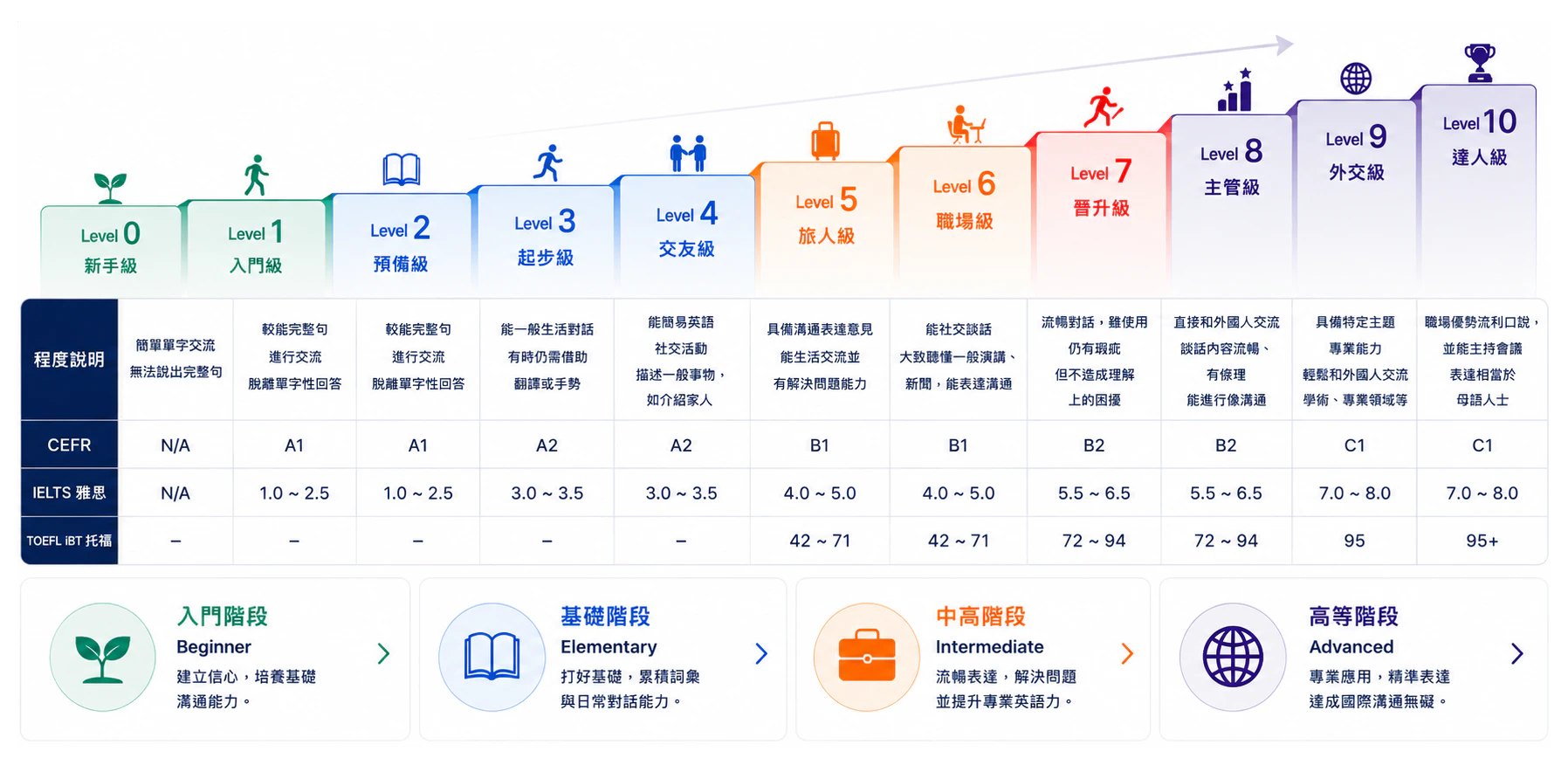
Level 0Novice
Communicates with simple words but can't form complete sentencesLevel 1Beginner
Communicates more in complete sentences, moving beyond one-word answersLevel 2Preparatory
Communicates more in complete sentences, moving beyond one-word answersLevel 3Starter
Can hold everyday conversations but sometimes still needs translation or gesturesLevel 4Social
Can take part in simple social activities in English and describe everyday things, such as introducing family membersLevel 5Traveler
Can express opinions, handle everyday interactions, and solve problemsLevel 6Workplace
Can make social conversation, broadly follows general talks and the news, and can express themselvesLevel 7Promotion-Ready
Converses fluently; still makes some mistakes, but they don't get in the way of understandingLevel 8Manager
Communicates directly with people from other countries, speaking fluently and coherently, and can hold in-depth conversationsLevel 9Diplomat
Has expertise in specific subjects and comfortably discusses academic and professional topics with people from other countriesLevel 10Master
Speaks fluently enough to be an asset at work, can lead meetings, and expresses themselves at a level comparable to a native speakerSince January 2026, TOEFL iBT has used a 1–6 score scale; the table shows the previous 0–120 scale. According to ETS's concordance, a new-scale score of 3–3.5 is roughly CEFR B1, 4–4.5 roughly B2 (about 72 or above on the old scale), and 5–5.5 roughly C1 (about 95 or above on the old scale).
FREQUENTLY ASKED QUESTIONS
Whether you're preparing for an English job interview, joining international meetings, or communicating with overseas clients, Ambitious Learner plans business English content around your level, career goals, and real work situations.
The Business English course suits working professionals, job seekers and managers who want to communicate better in English at work.
Whether you're preparing for an English interview, planning to move to an international company, or need to join English meetings, give presentations, receive clients, and work with international teams, you can shape your lessons around your needs.
We start from your role, industry, English level, and real-life situations to plan a learning path that truly fits your work needs.
The cost depends on how many lessons you buy and which plan you choose. After your free level test, an advisor will recommend a number of lessons based on your level, work goals, and the time you have for lessons each week, and explain the plan's total price and validity period. Teacher arrangements, rescheduling, and refund rules are also explained clearly before you enroll.
Yes. You don't need to wait until your English is good to start learning Business English.
Our lessons are built mainly around English-only interaction, helping students gradually get used to understanding, thinking, and responding in English in class.
Teachers adjust their pace, sentence patterns, and guidance to each student's level. Teaching in English only never means using material far beyond your level.
If you can only use simple sentences right now, the course will start with self-introductions, describing your job, common workplace conversations, and basic business expressions, building your skills step by step.
What matters to us isn't how difficult your vocabulary is. It's helping you express your ideas clearly first, then gradually improving your grammar, word choice, tone, and professionalism.
Business English is the English used at work and in international business, covering meetings, presentations, business email, negotiation and job interviews. Compared with everyday English, it puts more weight on professional vocabulary, workplace etiquette and a clear line of reasoning.
Everyday English focuses on speaking for daily life, travel, socialising and living abroad; Business English focuses on meetings, presentations, email, negotiation and job interviews; test preparation targets the question types and score goals of IELTS, TOEIC, TOEFL and GEPT. If you're not sure which to choose, take the free level test first and the teacher and consultant will recommend one based on your goals.
TOEIC scores can serve as a reference for job applications, promotions, or recruitment, but even a good score doesn't necessarily mean you can comfortably join English meetings, give presentations, or respond to overseas clients on the spot.
If your goal is a higher test score, a TOEIC prep course is a good choice. If you want to actually use English at work, you'll need to build your speaking, listening, and workplace scenario skills. You can also pursue both at the same time.
Lessons are planned around your job and goals. Common topics include English interviews, business emails, meetings, presentations and proposals, client communication, phone and video calls, progress reports, and working with international teams.
We use materials suited to each student's level, but we don't just follow a fixed textbook.
Your teacher will add workplace scenarios, role-plays, speaking practice, and real cases based on your goals and work needs. Students preparing for a career change can focus on English interviews, while those working with overseas clients can practice meetings, business emails, and client communication.
Yes. Different industries use different vocabulary and communication styles, so we start by understanding your work background, role, and how you use English.
Whether you work in tech, software, manufacturing, trade, marketing, sales, or management, your teacher can help you practice the English expressions you use most in your role.
For more specialized industry content, the lessons still center on communication, helping you turn the expertise you know well into clear, natural, easy-to-understand English.
Yes. We can arrange personalized English interview training based on your résumé, target role, and the job description.
You'll practice your self-introduction, work experience, reasons for changing jobs, personal strengths, career plans, and common behavioral and situational interview questions. Your teacher will also help refine the logic, grammar, tone, and delivery of your answers, and sharpen your on-the-spot responses through mock interviews.
We don't want you to just memorize a set of scripted answers. We want you to be able to truly talk about your experience, skills, and value in English.
Yes. Meetings and presentations in English are among the most common goals in the Business English course.
In class, you can practice giving updates, sharing opinions, answering questions, adding information, agreeing or disagreeing, and confirming meeting outcomes.
If you need to give presentations, you can also practice openings, transitions, explaining data, proposal content, and Q&A, so you can speak in a more organized and confident way in real work settings.
Yes. Real work content is often the most valuable learning material.
You can bring business emails, English presentations, meeting content, or interview answers that need work, and your teacher will help you refine the grammar, word choice, tone, and logic.
If a document contains confidential or sensitive information, we recommend removing company names, client details, and key figures before using it for practice.
Yes. We teach online one-on-one, so your teacher can tailor each lesson to your English level, learning pace, work needs, and career goals.
Compared with group classes, one-on-one lessons give you more speaking time and allow instant corrections to your grammar, pronunciation, word choice, and expression.
If you have an upcoming English interview, an important presentation, or overseas meetings, you can also focus on the skills you need most right now.
Yes. Online one-on-one lessons need no commute, and your consultant plans the number of lessons per week and the time slots around your work schedule. Before lessons start, we learn about your English level, goals, work background and the skills you want to strengthen, then match you with a suitable teacher.
You can choose a regular teacher or have teachers arranged flexibly, depending on your needs. If you'd like to keep learning with a teacher who knows your level, you can choose a fixed arrangement; if your work or schedule isn't regular, you can talk with your advisor about suitable teachers and time slots. Please check the rules on rescheduling, substitute teachers, and changing teachers with your advisor before you enroll.
If you find the teaching style isn't right for you after lessons start, you can talk with your dedicated advisor about making adjustments.
Yes. What matters to us isn't just how many lessons you complete, but whether you're truly making steady progress.
After every lesson, your teacher leaves a learning record and feedback so you can see what you covered, how you did in class, and what to work on. As these records build up, it becomes easier to see your progress and where to go next.
Your dedicated advisor will also help adjust your plan based on your goals and actual progress, so every lesson keeps moving you toward your goal.
There is no fixed timeframe that fits everyone: progress depends on your starting level, how often you have lessons, and how much you practise afterwards.
Start with a concrete work goal, such as describing your job in English, giving a progress update or taking part in an English meeting. The teacher's notes after each lesson and your consultant's follow-up then track your progress and adjust the plan step by step.
Compare a few things: whether lessons are one-on-one, whether content can follow your role and industry, whether you practise real work situations such as meetings, presentations and email, whether the teacher gives feedback after each lesson, how flexible scheduling is, and whether fees, rescheduling and refund rules are explained before you sign up.
If you're not sure which course suits you, take the free level test first and then talk it over with a consultant.
The test takes about 20 minutes and is conducted one-on-one by a live teacher. Through spoken interaction and scenario-based conversation, the teacher analyzes your vocabulary, grammar, fluency, pronunciation, and comprehension against the international CEFR standard, then gives you a skills analysis and learning recommendations. After that, you decide whether to start lessons.