

If you asked me today, “Can learning English really change someone's life?” my answer would be: yes, it can.
But if you'd asked me that question many years ago, I probably wouldn't have believed it. Back then, I couldn't even score 300 on the TOEIC, and I had to retake high school English several times. To me, English wasn't something I was good at — it felt more like something that, ever since I was little, kept reminding me that “I just can't learn this.”
I had no particular gift for languages, and I wasn't someone who loved English growing up. For a long time, I even thought English was a wall I'd never get over. Whenever I had to use English, my first thought usually wasn't “How do I say this?” but “What if I get it wrong?”, “Is my grammar right?”, “Will my pronunciation sound weird?”, “What if they don't understand me?”
不要因為你現在的程度,決定你未來可以走到哪裡。
Sometimes I knew exactly what I wanted to say, but the moment I switched to English, the words just vanished. Over time, I got used to saying less — because if you don't speak, you can't make mistakes.
But I later realized that it was precisely because I never spoke up that my English stayed stuck in the same place.
Why did I choose to study in the Philippines?
Gradually, I realized that what I was really missing probably wasn't another vocabulary book or more grammar exercises, but an environment where I'd actually use English every day.
That's how I discovered studying in the Philippines. What drew me most at the time was the large number of one-on-one lessons at Philippine language schools. For someone who was already afraid to speak English, one-on-one is very direct: you can't hide in the back row, and you can't stay silent for a whole lesson. The teacher is right in front of you — you have to answer, you have to express yourself, and you will definitely make mistakes.
Looking back now, I think that was exactly the kind of learning I needed most at the time.
When their English isn't strong, many people wonder whether they should improve it in Taiwan first before studying abroad. I had the same worries back then — afraid the teachers would talk too fast, that I wouldn't understand, and that the other students would all be better than me.
But once I got there, I realized you don't need to wait until your English is good to start. Often, it's precisely because your English isn't good and you lack the environment that you need a place where you can practise a lot.
When I arrived at PINES, I was only at Level 2
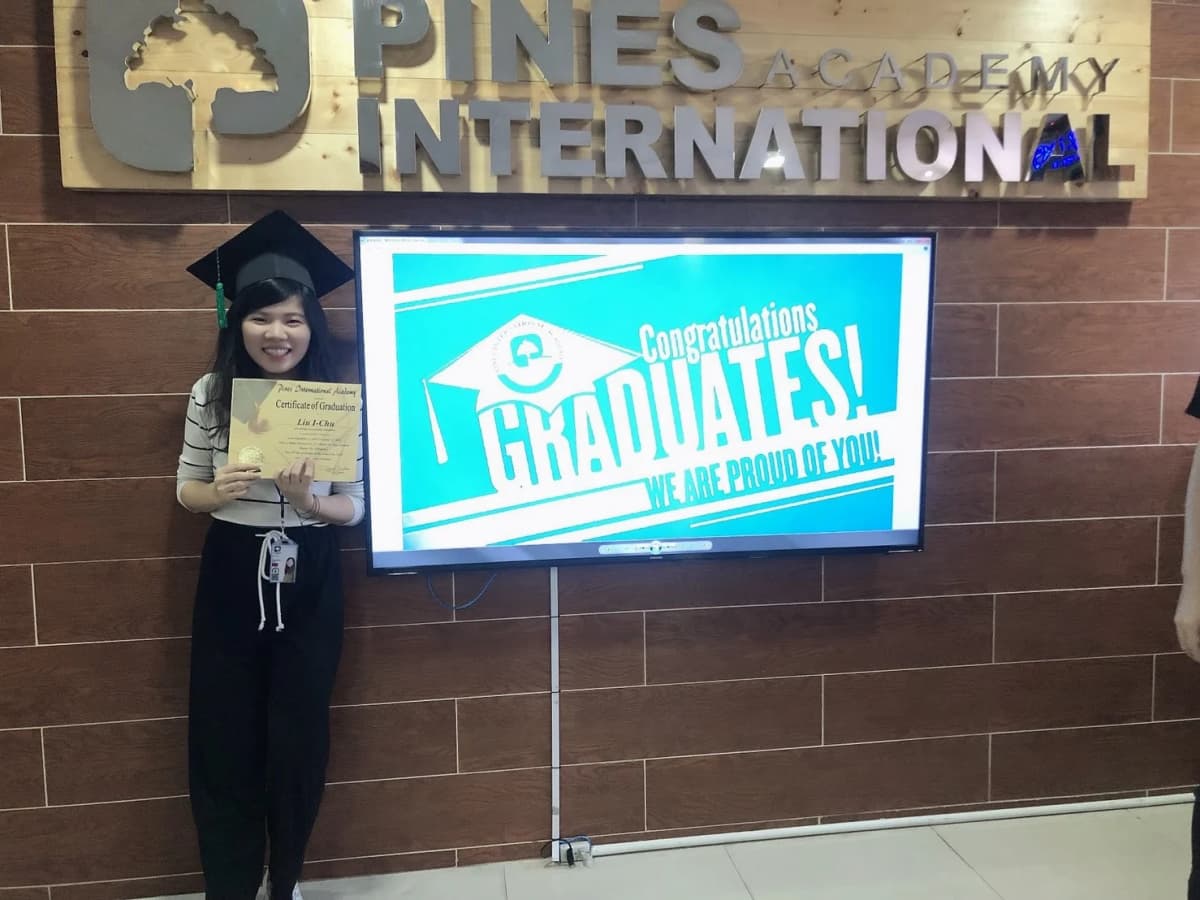
Later, I went to PINES International Academy in Baguio, Philippines. After the placement test, I started at Level 2.
It was a very real starting point. No sudden breakthrough, no dramatic turning point. I simply started as someone with a limited vocabulary and weak listening, who needed a long time to put English sentences together and was reluctant to speak.
But at PINES, for the first time I felt that English was no longer just a test subject in a textbook — it had become a tool I needed every day. I spoke English in class, answered questions in English, and chatted with students from other countries in English. So much pushed me to stop retreating into Chinese.
Back in Taiwan, I might have spoken English for only a few minutes a day, or even less. But in the Philippines, English became part of everyday life.
It was also the first time I truly understood that you don't wait until you've mastered English to use it — it gets better because you keep using it.
One-on-one lessons helped me stop being so afraid of mistakes
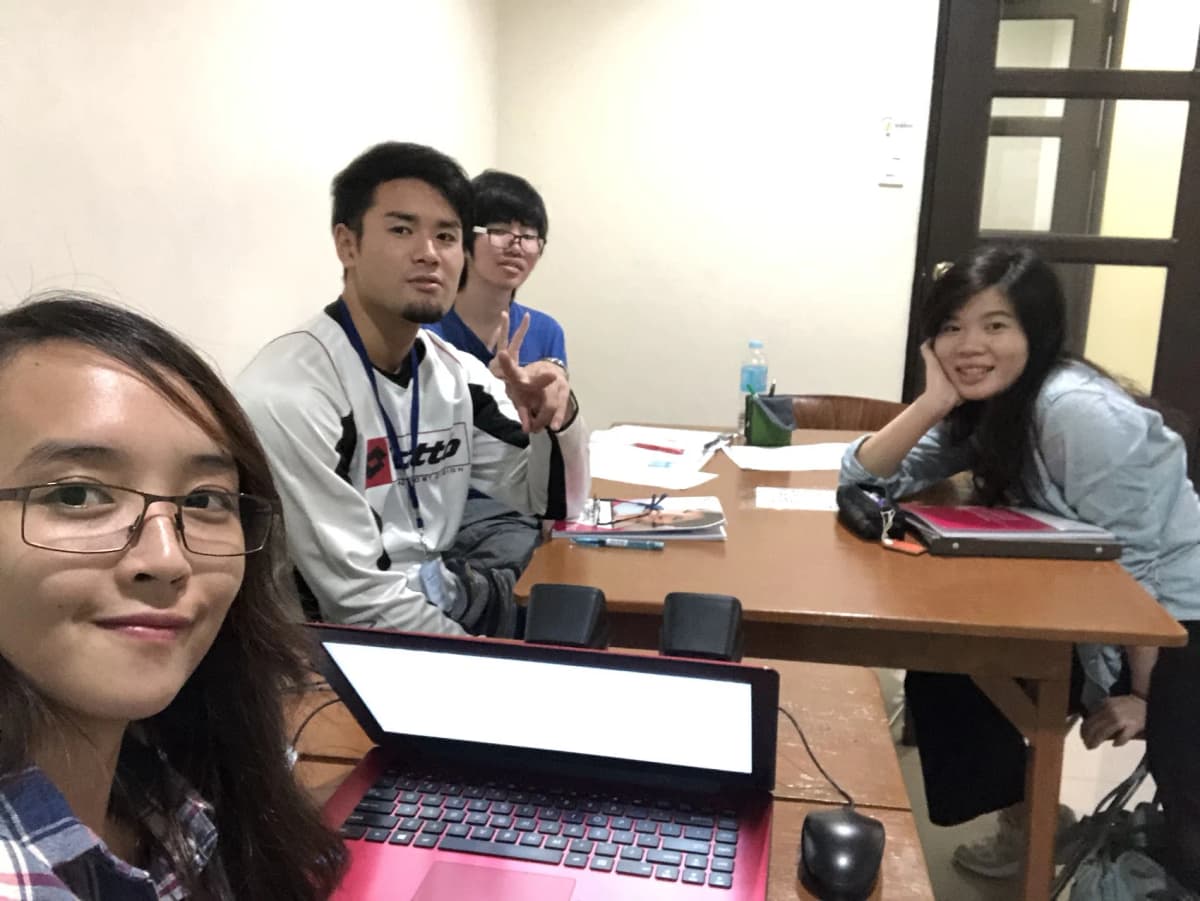
One of the biggest ways studying in the Philippines helped me was the sheer number of one-on-one lessons. With the teacher right in front of you, you can't pretend you didn't hear a question or stay silent — you just have to find a way to answer.
At first, I really struggled. Sometimes a simple sentence took me ages to put together; sometimes I knew what I wanted to say in Chinese but not how to say it in English; and sometimes I'd realize halfway through that my grammar was wrong and have to start over.
But it was through this process — getting it wrong, being corrected, and trying again, over and over — that I slowly realized making mistakes isn't that scary. Teachers don't dismiss you for a grammar mistake; if they don't understand, they simply ask you to say it again. Many things I used to find embarrassing became a perfectly normal part of that environment.
Little by little, I stopped being so afraid of getting things wrong.
For me, this change mattered even more than how many words I memorized. Because only when you stop fearing mistakes do you truly get the chance to start using English.
My PINES Study Abroad Results in the Philippines: From Level 2 to Level 5
When I started at PINES, I was at Level 2. By the time I left, I had completed Level 5.
Going from Level 2 to Level 5 might look like just a change in numbers, but to me it meant a lot. It was the first time I truly felt that I wasn't someone who would “never be good at English” — I just hadn't found the right way to learn yet, or given myself enough chances to use it.
During my time at PINES, I gradually began to understand what my teachers were saying, and I no longer had to translate every sentence into Chinese before answering. I still got stuck and still made mistakes, but compared with when I first arrived, I could express my thoughts much more comfortably.
What really struck me wasn't suddenly feeling one day that my English was great — it was looking back one day and realizing I was no longer as afraid to speak as I'd been at the start.
For me, that was a huge change.
Can studying in the Philippines really improve your English?
Yes — but it isn't magic. In my experience, what really improves your English is using it extensively every day, intensive one-on-one lessons, and an environment where you keep speaking and getting corrected.
Your English won't automatically improve just because you bought a plane ticket and moved into a language school. What creates change is how much practice you build up every day during that time.
If you used to speak English for only a few minutes a day, and in the Philippines you spend several hours every day listening, speaking, reading, and writing in English, the difference naturally starts to show over weeks and months.
For me, the most important value of studying in the Philippines wasn't turning me into someone with great English overnight — it was helping me clear the most important hurdle: going from being afraid to use English to finally daring to use it.
After the Philippines, I made English a long-term part of my life
When my study abroad ended, I didn't feel my English learning was finished. If anything, that's when one thing became clearer: if I went back to my old life and stopped using English completely, the feel for the language, the quick responses, and the speaking habit I'd worked so hard to build could easily fade away.
So after returning to Taiwan, I kept taking online one-on-one English lessons, and I still take regular classes with Ambitious Learner today. For me, online English stopped being a short-term sprint long ago; it's a way to keep up my English output and speaking habits over the long run.
I set aside regular time each week for lessons with a teacher, so I keep speaking English, keep getting corrected, and keep a steady environment for using English.
These years of learning haven't been as intensive as studying in the Philippines, and I don't always feel I'm making obvious progress every day. Sometimes it even feels like I'm just showing up for class and chatting, without any big changes.
But when you look back over several years, you see that what really steadies your English is often this kind of ordinary, uninterrupted accumulation.
PINES helped me over the first hurdle of being “afraid to speak English,” and the one-on-one lessons I've kept up ever since have made sure my English didn't stall the moment I left the Philippines.
For me, being able to keep learning all the way until now means a lot. I used to think learning English had a “finish line” — maybe reaching a certain score or level, or one day finally becoming good at speaking English, and then you'd be done.
But having kept learning all this time, I've come to feel more and more that there's no real graduation from a language.
Even now that I can communicate with people from other countries, host events, take part in international exchanges, and stand in front of a crowd to share my ideas in English, I still run into unfamiliar words, still have moments when I don't know how to say something, and still find plenty of room to improve.
So these days, I keep taking online English lessons not because “my English is bad and needs fixing,” but because it has become a long-term habit.
Sometimes I chat with my teacher about daily life, sometimes we talk about work, sometimes we practise different topics — and sometimes I simply want a fixed slot each week where I think and express myself entirely in English.
Learning this way has kept English a part of my life.
I think this has been one of the most important things on my journey: my English didn’t suddenly become great after one study-abroad trip. It started with studying in the Philippines, and I never really stopped after that.
Then I found Toastmasters
Later on, I joined Toastmasters International, the public-speaking organisation.
My reason was actually simple at first: I wanted more chances to keep using English, and I wanted to see whether I could go beyond one-on-one conversations with a teacher and really stand in front of a crowd to share my ideas.
The first time I went on stage, I was nervous. The first time I gave an impromptu speech, my mind went blank. The first time I hosted a meeting, I worried about saying something wrong.
But that feeling was a lot like my first one-on-one English lessons in the Philippines years ago. You’re scared, but once you actually do it the first time, there’ll be a second; the more you do it, the more you realise you’re far more capable than you thought.
Little by little, I was learning more than just English. I learned how to organise my thoughts, how to tell a story, how to make my point clearly in limited time, and how to stand in front of people and speak with more confidence.
From Afraid to Speak English to Club President of an English Speaking Club
After joining Toastmasters, I took on more and more roles — from member to Vice President Education, and later Club President.
Back then, I had to take part in events, chair meetings and communicate with all kinds of people, and I also had the chance to join international exchanges. English was no longer just something I “practised” — it had truly become a tool connecting me to the world.
One day it suddenly hit me: I could now stand in front of a crowd and speak fluently in English.
That moment felt surreal.
Because I thought of myself many years ago — scoring under 300 on the TOEIC, afraid of making mistakes and of not being understood, and so simply saying as little as possible.
If I could show this scene to my younger self, I’m sure I wouldn’t have believed it.

What English Really Changed Was More Than My English
Many people might read my story as “my English was bad, and then it got good.” But for me, what really changed was much more than English.
English gradually changed the way I see myself.
In the past, whenever I faced something I couldn’t do, my first thought was “I can’t do this,” “This isn’t my thing,” or “I probably won’t manage.”
But learning English has slowly taught me that many things aren’t “I can’t,” but “I can’t yet.”
The two sound alike, but they’re worlds apart.
Because when you believe you just “can’t yet,” you’re willing to try one more time.
PINES Was a Major Turning Point in My Life
If someone asked me whether there was one decision in my life that truly changed who I became, studying abroad at PINES in the Philippines would definitely be on the list.
Because it was the first time I really left my comfort zone, and the first time I made myself face something I was scared of, every single day.
More importantly, that experience made me believe, for the first time, that a person really can change, step by step.
Poor English is not a permanent label, a TOEIC score under 300 is not the limit of your ability, and Level 2 is certainly not the finish line.
It’s just where you are right now.
If I Could Go Back, Here’s What I’d Tell My Level 2 Self
If I could go back and meet myself just arriving at PINES at Level 2, what I’d most want to say is: “Don’t let where you are now decide how far you can go.”
It’s okay if you can’t speak well yet, it’s okay if you don’t understand, and it’s more than okay to make mistakes. What really matters is whether you’re willing to say the next sentence.
Back then, I could never have imagined that one day I’d keep connecting with people from different countries in English, step onto English speaking stages, host events, and even become a Toastmasters Club President.
But most change doesn’t suddenly happen on a single day.
It might simply be the first time you work up the courage to answer a teacher’s question, the first time you start a chat with a classmate from another country, your first online English lesson, your first time on stage, your first time hosting — the first time you realise you can actually do it.
Once, twice, ten times, hundreds of times.
And when you finally look back, you realise how far you’ve come.
Is studying abroad in the Philippines a good fit if my English is weak?
Yes — the key is choosing a school that suits your level and learning style. When I went to PINES, I also started at Level 2.
If your English is very basic right now — or if, like me back then, you even get nervous just opening your mouth — I really hope you’ll read my story.
Because you don’t need to wait until your English is good to earn the right to start.
There will definitely be times when you don’t understand, when you forget words, get the grammar wrong, and even wonder whether you’re improving at all.
But all of that is completely normal.
Don’t wait until you stop making mistakes to start speaking English. Real English ability is usually built up, bit by bit, through mistake after mistake.
How long do I need to study in the Philippines to improve my English?
There’s no set number of weeks. More than how long you stay, the long-term results depend on how much English you actually use each day, how intensive your course is, and whether you keep using English after you return home.
This is also one of the most common questions people ask when considering studying in the Philippines. In my experience, what really matters isn’t just how long you go, but how much English you actually use while you’re there.
Take two people who both study for four weeks: if one speaks a lot every day, engages with the teachers and keeps using English after class, while the other only touches English during lessons, their results will never be the same.
The advantage of studying in the Philippines is that it creates a very intensive English environment in a short time. But if you want those skills to really stick, my experience is that you still need to keep using English after you return home.
For me, studying in the Philippines was a breakthrough. But it was the online English lessons I’ve kept up ever since, and using English again and again at Toastmasters, that gradually made English a real part of my life.
From Under 300 on the TOEIC to Speaking with Ease in Front of a Crowd
Looking back now, it’s hard to say which day the change began.
Maybe it was the first time I managed to finish an English sentence at PINES, or the first time I realised I actually understood a teacher’s question, or the first time I stepped onto a Toastmasters stage and found that, nervous as I was, I could still finish what I had to say.
There was no miracle along the way.
If there’s one thing they all had in common, it’s that, time after time, I chose to keep speaking.
I spoke up at PINES, in my online English lessons after returning to Taiwan, in my one-on-one lessons with Ambitious Learner, at Toastmasters, and in one international exchange after another.
From under 300 on the TOEIC to PINES Level 2; from Level 2 to Level 5; and from being too afraid to speak English to standing in front of a crowd today, sharing my thoughts with ease.
English, too, went from a subject I had always feared to a tool that accompanies me through travel, work, speeches and exchanges — and lets me see more of the world.
Today I can stand in front of a crowd and express my ideas comfortably in English, but my English learning hasn’t ended there. To this day, I still take regular online one-on-one English lessons with Ambitious Learner, picking up new ways of expressing myself and keeping English a daily habit.
Looking back, PINES didn’t make my English better overnight. What it really changed was that I became willing to speak up, and for the first time I believed I could do it. It’s the years of continuous learning since then that, step by step, turned that early change into who I am today.
My English Learning Timeline
Starting Point
Under 300 on the TOEIC, retook high school English several times, and too afraid to speak up in English.
PINES Study Abroad in the Philippines
Went to PINES International Academy in Baguio, Philippines, for intensive English study.
Level 2
My English level when I first arrived at PINES.
Level 5
Reached Level 5 by the end of my time at PINES.
Back in Taiwan
Kept up English input and speaking practice through online one-on-one lessons.
Toastmasters
Joined an English speaking club and began taking on public speaking, hosting and English expression.
Toastmasters Club President
From member to Vice President Education, then Club President.
English in Life and Work
English is no longer just a subject to practise — it’s put to real use in speeches, hosting, international exchanges and work.
Now
Still taking regular online one-on-one English lessons with Ambitious Learner, currently focusing on Business English.
常見問題
Can I study in the Philippines if my English isn't good?
Yes. When I went to PINES, I also started at Level 2. For people with a weaker foundation or who are afraid to speak, plenty of one-on-one lessons means more chances to actually use English. Weak English doesn’t mean you can’t study abroad — the key is choosing a school that suits your level and learning style.
Is PINES suitable for English beginners?
PINES offers an intensive English learning environment, but whether it’s right for you depends on your English level, your learning goals, and whether you can handle a more demanding schedule. In my case, I started at Level 2 and left having completed Level 5.
How long do I need to study in the Philippines to improve my English?
There’s no single answer. More important than simply counting weeks is how much time you actually spend using English each day, how intensive your course is, and how committed you are. In my experience, studying in the Philippines can help you make a short-term breakthrough, but whether you keep using English after you return home matters just as much.
How can I maintain my English after studying in the Philippines?
After returning to Taiwan, I kept taking regular online one-on-one English lessons and kept using English through Toastmasters, international exchanges and everyday life. To this day, I still take online English lessons with Ambitious Learner so English stays part of my life.
Your English Story Can Start with a Single Sentence
If, like me back then, you know you want to get better at English but don’t know where to start, begin by finding the learning approach that suits you. Whether you build an intensive English environment by studying in the Philippines or start with online one-on-one English, the most important thing is to take that first step.