
How the Ebbinghaus forgetting curve works and how memory fades, how repetition and spaced learning slow forgetting, and how to apply them to learning English vocabulary and grammar.
Introduction
Introduction
In today's fast-paced world, effectively remembering what we've learned is a challenge for many people. Whether you're a student preparing for exams or a professional learning new skills, how long and how accurately you remember is key. This is where the forgetting curve theory, proposed by the 19th-century German psychologist Ebbinghaus, offers a powerful tool. The Ebbinghaus forgetting curve describes how memory gradually fades over time and shows that well-timed repetition can significantly slow this process. In this article, we'll take an in-depth look at how to apply the Ebbinghaus forgetting curve to learn more effectively, so you can get more out of your study time and remember things longer.
What Is the Ebbinghaus Forgetting Curve?
Introduce Hermann Ebbinghaus and his research background
Hermann Ebbinghaus was a German psychologist, born in 1850 and died in 1909. A pioneer of modern experimental psychology, he made major contributions to the study of memory. In the late 19th century, Ebbinghaus conducted a series of experiments to uncover the patterns of memory and forgetting. He was the first to study memory using experimental methods and developed many experimental techniques still in use today.
Ebbinghaus's research focused mainly on the quantity and quality of memory. To rule out the influence of meaning, he used nonsense syllables (such as "ZUF" and "QAX") to test how well people remembered and forgot them over different periods of time. Through these experiments, he discovered how fast and in what pattern we forget, and proposed his famous theory of the forgetting curve.
Explain the basic concepts and principles of the forgetting curve
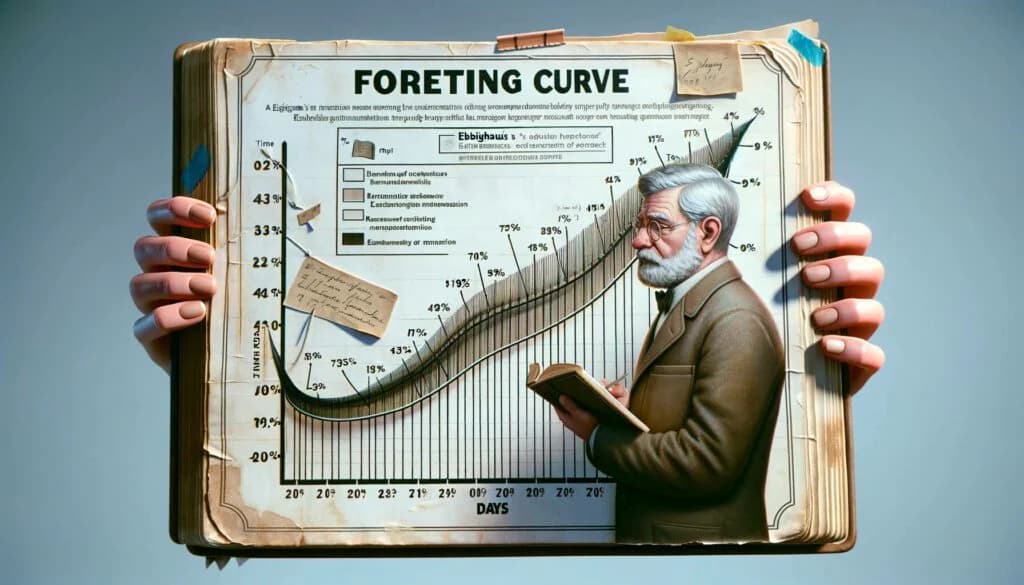
The Forgetting Curve is one of the key results of Ebbinghaus's research. It shows the rate at which memory is lost over time. Its basic concepts are as follows:
- Forgetting is a nonlinear process over time: Forgetting is fastest right after a memory forms and gradually slows as time passes.
- Memory strength affects the rate of forgetting: The stronger a memory (for example, one reinforced through repeated review), the more slowly it fades.
- The shape of the forgetting curve: The curve shows memory retention decreasing exponentially over time. Retention drops fastest in the first few minutes to days, and the decline then gradually slows.
Specifically, Ebbinghaus found that without any repetition or reinforcement, people forget about 42% of what they've learned within 20 minutes, 56% within 1 hour, 67% within a day, and about 75% within a week.
The Relationship Between the Forgetting Curve and Memory
Analyze how the forgetting curve affects memory retention and forgetting
The forgetting curve shows how quickly memory fades over time, revealing patterns of retention and forgetting. According to Ebbinghaus's research, forgetting is fastest right after a memory is formed and gradually slows as time passes. In other words, memory retention isn't fixed; it weakens gradually over time.
- Early forgetting: In the first few minutes to hours after a memory forms, forgetting happens fastest and memory loss is most noticeable.
- Later forgetting: Over time, forgetting slows down, but memory continues to weaken.
This shows that memory after a single study session is poorly retained and needs to be consolidated through repetition and reinforcement.
Give real-life examples of how the forgetting curve applies to daily life
The forgetting curve theory has wide-ranging applications in daily life. Here are a few examples:
- Students preparing for exams: Students who only cram right before an exam tend to forget most of the material. Reviewing regularly throughout the semester, especially practicing again within a few days of learning something new, helps them retain it much better. For example, after learning a new math formula, they can practice it again on the second day, the third day, and a week later.
- Language learning: Language learners who only study new words in class without reviewing them afterward will quickly forget most of them. Spaced learning can significantly improve retention. For example, after learning new words, learners can review them the next day, a week later, and a month later to reinforce them.
- Workplace training: If a training course is held only once, employees will quickly forget most of it. Companies should design ongoing training programs that include regular review and refresher sessions. For example, when introducing new software, a company should schedule regular review and hands-on practice for employees after the initial training.
Discuss ways to strengthen memory, such as repetition and spaced learning
To effectively counter the memory decline shown by the forgetting curve, you need ways to strengthen memory, such as repetition and spaced learning:
- Repetition: Repetition is the most basic way to strengthen memory. Studying and practicing repeatedly reinforces memory traces and slows forgetting. For example, regularly go over what you learned each day.
- Spaced learning: Spaced learning means repeating study at different points in time rather than packing it into one session. Based on the shape of the forgetting curve, this method strengthens memory more effectively. For example, after first learning something, learners can review it 1 day, 3 days, 1 week, and 1 month later to make the memory last longer.
Grounded in scientific learning strategies, these methods effectively counter the natural decline of memory and help people retain and consolidate what they've learned.
How to Use the Forgetting Curve to Improve Your English Learning
Explore how to apply the forgetting curve to English learning
Ebbinghaus's forgetting curve shows that after learning something new, people gradually forget it unless they review it regularly. In English learning, understanding and applying the forgetting curve can significantly improve retention and learning efficiency. Below are several practical ways to apply it.
Offer concrete strategies
- Repeated practice
- How it works: Repetition means studying the same material again at different points in time, which strengthens memory traces and delays forgetting.
- Application: Students can set a review schedule, revisiting new words or grammar 1 day, 3 days, 7 days, and 30 days after learning them. This helps them consolidate what they've learned and reduce forgetting.
- Testing effect
- Principle: The testing effect means that learning and reinforcing knowledge through tests is more effective than simply reading. Testing encourages active recall and strengthens memory.
- Application: In English learning, students can check how well they have mastered vocabulary, phrases, and grammar through self-testing or quiz tools. For example, they can use online quiz tools for vocabulary tests, or test themselves on applying grammar rules after studying.
- Spaced learning
- How it works: Spaced learning means breaking material into smaller chunks and studying them multiple times over a longer period, rather than cramming it all at once. This helps form long-term memories.
- Application: Students can divide their daily study time into several short blocks, each focused on different content. For example, vocabulary in the morning, listening practice in the afternoon, and grammar review in the evening. This spaced approach helps them remember and understand the material better.
Analyze how these methods help students remember and understand English vocabulary and grammar more effectively
- Repetition: By encountering and using what they've learned many times, students can embed new knowledge more firmly in long-term memory and slow down forgetting. This is especially effective for memorizing large numbers of English words and complex grammar rules.
- Testing effect: Testing not only checks how well students have learned but also promotes active recall, which strengthens memory. Self-testing helps students identify their weak spots and focus their study accordingly.
- Spaced learning: Spaced learning helps prevent study fatigue and improves efficiency. By spreading material across multiple sessions, students can focus on a small portion each time and understand and remember it more effectively.
By combining these strategies, students can systematically apply the forgetting curve theory, build an effective study plan, and improve their overall English learning. This not only helps with memorizing vocabulary and grammar but also strengthens practical language skills for more efficient results.
For more ways to memorize vocabulary, see Science-Based Methods for Memorizing English Vocabulary.
Effective Memory Strategies
Introduce several scientifically proven memory strategies
- The association method
- How it works: The association method strengthens memory by linking new information to what you already know. It draws on the brain's ability to make associations, making memories more vivid and easier to recall.
- Application: For example, when learning a new word, connect its meaning to something familiar. When learning "apple," think of your favorite kind of apple, so you'll recall the meaning as soon as you see the word.
- The story method
- Principle: The story method turns the material you need to remember into an interesting or meaningful story, giving the information more structure and coherence so it is easier to remember.
- Application: For example, when learning several new words, you can weave them into a short story so each word becomes part of it, making them easier and more fun to remember.
Discuss how these strategies work together with the forgetting curve theory
- The Association Method and the Forgetting Curve
- Association makes memories more vivid and emotionally connected, which helps slow down forgetting. Regularly reviewing the associations you've built strengthens memory even further. For example, when learning vocabulary, you can revisit these associations every few days to reactivate the memory before it drops off along the forgetting curve.
- The Story Method and the Forgetting Curve
- The story method provides a structured framework that ties multiple pieces of information closely together, helping create stronger memory traces. Regularly retelling or rereading these stories effectively consolidates memory and delays forgetting.
Offer practical tips and examples
- Association method tips
- Tip: Use concrete, vivid images to build connections. For example, when learning "banana," picture a monkey holding a giant banana.
- Example: When learning "cat" and "dog," picture a cat and a dog playing together. That way, whenever you see these two words, you'll quickly recall what they mean.
- Story method tips
- Tip: Turn the words you need to remember into a fun story where each word plays a role. For example, when learning "tree," "bird," and "sun," you could make up a story: a bird perches in a tree, watching the sun rise.
- Example: When learning "river," "fish," and "boat," you could make up a story: on a river, a fish swims by and sees a boat.
By combining the forgetting curve theory with the memory strategies above, students can create more effective study plans. These strategies not only strengthen memory but also make learning more enjoyable and productive. In short, applying scientifically proven memory strategies together with the forgetting curve theory can significantly improve English learning outcomes.
Case Studies and Practical Experience
Share examples of successfully using the forgetting curve to improve English learning
Case Study: Student A's English Vocabulary Learning
Student A, a high school student, had long struggled with English, especially with memorizing vocabulary. Her teacher suggested she apply the Ebbinghaus forgetting curve to improve her study methods.
- Initial learning: Every Monday, Student A started learning 50 new words, noting each word's meaning, usage, and example sentences.
- First review: On the second day, Tuesday, she reviewed the 50 words again and checked her memory with a self-test.
- Spaced review: In the days that followed, she reviewed again on the third, seventh, and fourteenth days.
- Final test: A month later, she took a comprehensive test and found she could recall most of the words with ease.
The results showed that by applying the forgetting curve theory, Student A's vocabulary retention improved significantly, and her score on the vocabulary section of the end-of-semester English test rose noticeably.
Discuss challenges and solutions in real-world application
- Challenge 1: Managing study time
- Challenge: Students and other learners often neglect their review plans when their workload is heavy.
- Solution: Use time-management tools such as phone reminders and study schedules to help learners remember when to review and keep reviewing regularly.
- Challenge 2: Review can feel tedious
- Challenge: Reviewing the same material over and over can feel dull and tedious.
- Solution: Use a variety of review methods, such as different learning resources (videos, audio, images) and interactive learning tools (like Quizlet), to make studying more fun.
- Challenge 3: Test pressure
- Challenge: Frequent testing can make some learners feel stressed.
- Solution: Make tests more relaxed and fun, and emphasize that their purpose is to aid memory rather than to grade performance. Group quizzes, where learners help one another, can also reduce pressure.
Give readers concrete steps and tips for putting the forgetting curve theory into practice
- Create a study plan
- Decide what you'll study and when you'll review each day, and break tasks into smaller pieces to avoid taking on too much at once.
- Apply spaced learning
- After first learning new material, review it again 1 day, 3 days, 7 days, and 14 days later to consolidate your memory.
- Self-testing
- Use the testing effect by creating self-test questions and checking your memory regularly. You can use flashcards, online quiz tools, or questions you write yourself.
- Diversify your learning methods
- Use a variety of learning methods, such as visual learning (charts and images), auditory learning (recordings and audio lessons), and interactive learning (group discussions and role-play).
- Adjust your learning strategies
- Keep adjusting and refining your learning strategies based on test results and progress to get the best results.
With these concrete steps and tips, readers can effectively apply the forgetting curve theory to improve their English learning, study more efficiently, and build lasting long-term memory.
Conclusion
By understanding and applying Ebbinghaus's forgetting curve theory, we can significantly improve our English learning. The theory reveals the relationship between memory and forgetting and points to effective learning strategies such as repetition, the testing effect, and spaced learning. Combined with scientifically proven memory techniques like the association method and the story method, students can better remember and understand English vocabulary and grammar and build long-term memory. Real-world case studies show that applying the forgetting curve theory not only boosts learning efficiency but also helps students overcome challenges along the way. We hope the tips and steps in this article give you practical guidance and help you make greater progress on your English learning journey. Remember, the key to success is applying these strategies consistently and continually refining your methods until you achieve a breakthrough in language learning.
If you would like someone to plan your review schedule and practise active recall with you in class, see our one-on-one online English courses.
Frequently Asked Questions
If you're preparing for IELTS, pair this with The Complete IELTS Vocabulary Guide and Memory Techniques.
FREQUENTLY ASKED QUESTIONS
FAQ
Q01Question 1: What is the Ebbinghaus forgetting curve?+
Answer: The Ebbinghaus forgetting curve is a theory proposed by German psychologist Hermann Ebbinghaus that describes how human memory declines over time. According to this theory, people quickly forget most of what they learn unless they review it regularly. The forgetting curve shows the speed and degree of forgetting, helping us understand how to consolidate memory more effectively.
Q02Question 2: How can I apply the forgetting curve theory to improve my English learning?+
Answer: 1. Repetition: study the same material again at different points in time to consolidate memory. 2. Testing effect: use self-tests or online quizzes to check and strengthen memory. 3. Spaced learning: break material into smaller chunks and study them multiple times over a longer period. These methods help students remember and understand English vocabulary and grammar more effectively and learn more efficiently.
Q03Question 3: What scientifically proven memory strategies can be applied to English learning?+
The association method: strengthen memory by linking new information to what you already know. For example, when learning a new word, connect its meaning to something familiar. The story method: turn what you need to remember into a fun or meaningful story, giving the information more structure and flow so it's easier to remember. Combined with the forgetting curve theory, these strategies can significantly improve retention and make English learning more efficient and enjoyable. We hope these FAQs help readers better understand the Ebbinghaus forgetting curve and how it applies to English learning.