
English tenses combine time and aspect. This guide lays out the 12 tenses in one chart, recommends that beginners learn 6 first, and gives a 3-step method for choosing between past simple, present perfect, continuous forms and will / be going to, with common mistakes and a short quiz.
Quick answer: what is the best way to learn English tenses?
You do not need to memorise all 12 formulas at once. What matters most is to decide when something happens and whether the action is a habit, in progress, finished, or continuing up to now. This guide first sets out the 12 English tenses in one chart, then shows the 6 to master first, and finally gives you 3 steps for choosing between past simple, present perfect, continuous forms and future expressions.
- English tenses combine time and aspect: for time, think present, past or future; for aspect, think simple, continuous, perfect or perfect continuous.
- Beginners do not need to learn all 12 together: start with present simple, past simple, present continuous, present perfect, future expressions (will / be going to) and past continuous, then add the others gradually.
- Choose a tense by checking 3 things: ① When does it happen? ② What stage is the action at? ③ Is there a specific past time word? If you see yesterday, last week, ago or in 2024, you usually need the past simple, not the present perfect.
English tenses chart: the 12 tenses with formulas and examples
All the examples use the verb work, so the differences are easy to compare.
| Tense | Formula | Example | Meaning / use |
|---|---|---|---|
| Present simple | S + V (add -s for he / she / it) | I work from home on Fridays. | a regular habit or routine |
| Present continuous | am/is/are + V-ing | I'm working on the report now. | happening right now |
| Present perfect | have/has + p.p. | I've worked here for three years. | a state that started in the past and continues; experience |
| Present perfect continuous | have/has been + V-ing | I've been working on this since 9 a.m. | an activity continuing up to now, with a focus on duration |
| Past simple | V-ed (or irregular form) | I worked late yesterday. | a finished action at a specific past time |
| Past continuous | was/were + V-ing | I was working when you called. | in progress at a past moment |
| Past perfect | had + p.p. | I had finished the report before the meeting started. | finished before another past event |
| Past perfect continuous | had been + V-ing | I had been working for two hours when the power went out. | in progress for a period before a past event |
| Future simple | will + V | I'll send it to you tomorrow. | a decision or promise about the future |
| Future continuous | will be + V-ing | I'll be working at 3 p.m. tomorrow. | in progress at a future moment |
| Future perfect | will have + p.p. | I'll have finished it by Friday. | finished before a future time |
| Future perfect continuous | will have been + V-ing | By June, I'll have been working here for five years. | duration up to a future point |
Note: be going to, and using the present continuous to talk about the future, are usually not counted among the 12 tenses in teaching materials, but they are very common in everyday English, so they are covered below.
Which tenses should beginners learn first?
If you are a beginner, master the 6 most useful tenses and future expressions first, then move on to the advanced tenses. This order is meant to help you understand and speak as soon as possible. It is not a formal linguistic classification or a ranking by frequency:
- Present simple: habits, facts, introducing yourself. I work in marketing.
- Past simple: finished events at a specific time. I met her last week.
- Present continuous: happening right now, or a future plan that is already arranged. I'm meeting a client at 2.
- Future with will / be going to: plans, decisions and predictions.
- Present perfect: experience, states that continue up to now, and past actions that matter now.
- Past continuous: what was in progress at that time, often used together with the past simple.
Add the perfect continuous forms, the future perfect and the rest once these 6 feel secure. The learning load will be much lighter.
How to choose a tense: 3 steps
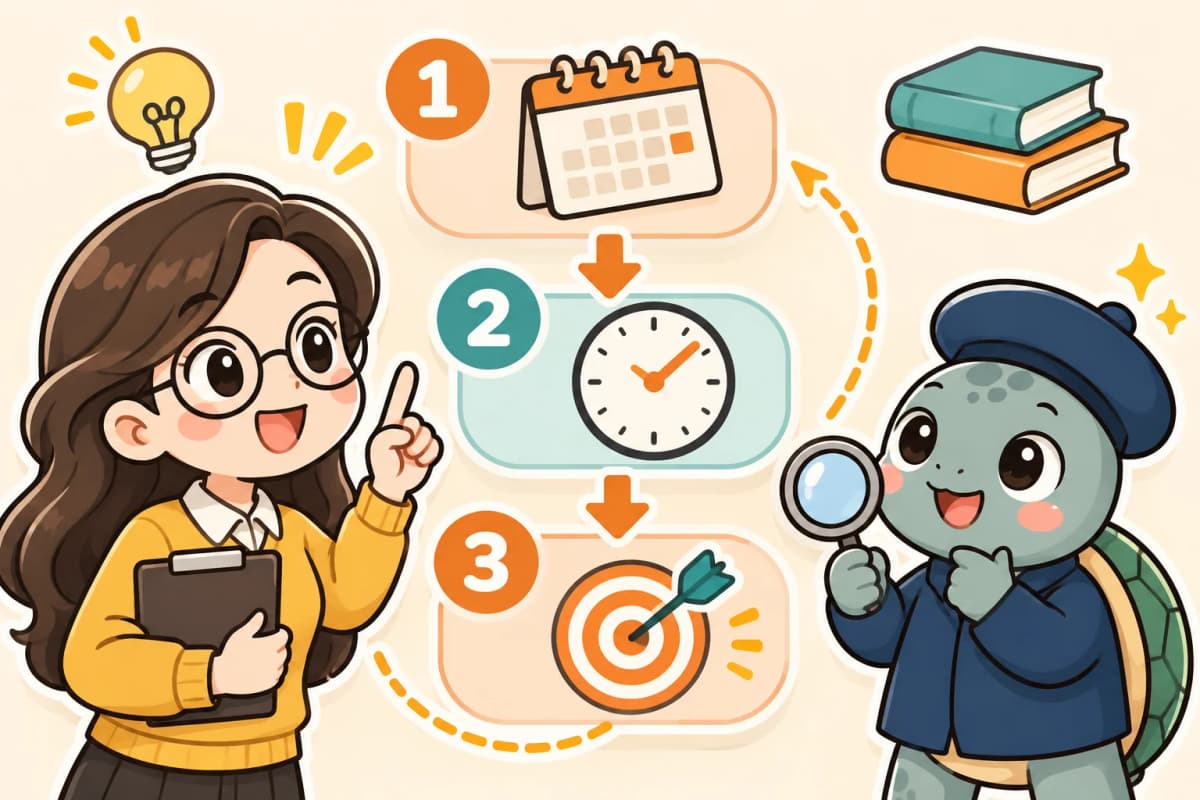
Step 1: When does it happen?
First decide whether it is present, past or future. In English, the tense shows up in the verb form (work, worked, will work), so look for time clues first: yesterday, now, next week, since 2020 and so on. Time expressions often come with prepositions, such as in 2024 or on Friday. If you often mix up at, in and on, read our complete guide to English prepositions as well.
Step 2: Is it a habit, in progress, or finished?
- A habit or a fact → simple: She takes the MRT to work.
- In progress at a point in time → continuous: She was taking the MRT when it started raining.
- Completed by a point in time → perfect: She has taken the MRT many times.
Step 3: Is there a specific past time?
This is the key to choosing between the past simple and the present perfect. As the British Council's grammar explanation points out, once you say when something happened, use the past simple.
- ✅ I finished the report yesterday.
- ✅ I've already finished the report. (The focus is that it is finished now.)
- ❌ I have finished the report yesterday.
A quick chart: which tense should you use?
| What you want to say | Tense to think of first | Example |
|---|---|---|
| A habit, a fact or a permanent state | Present simple | I work from home on Fridays. |
| Happening right now | Present continuous | I'm talking to a client now. |
| Finished, with a specific past time | Past simple | I finished it yesterday. |
| In progress at a point in the past | Past continuous | I was driving when you called. |
| Happened in the past, but it matters now | Present perfect | I've finished the report. |
| A decision made at the moment of speaking | will + V | I'll call her now. |
| A future plan already decided | be going to + V | I'm going to study tonight. |
| A fixed future arrangement | Present continuous | I'm meeting my teacher at 7. |
This chart helps you narrow down the options. If the pair you mix up most is the past simple and the present perfect, read the comparison in the next section.
What is the difference between the present perfect and the past simple?
Short answer: the past simple points to a specific time in the past; the present perfect points to a link with the present.

| Comparison | Past simple | Present perfect |
|---|---|---|
| Focus | A finished period of time in the past | Experience, continuing up to now, or a result that affects the present |
| Common time words | yesterday, last year, ago, in 2023 | ever, never, already, yet, for, since, so far |
| Example | I visited Japan in 2023. | I've visited Japan twice. |
In real conversations people often "open with the present perfect, then add details in the past simple":
- A: Have you ever been to Australia?
- B: Yes, I went there last year.
What is the difference between will and be going to?
According to the British Council, you can distinguish them like this:
- will: a decision made at the moment of speaking. The phone's ringing. I'll get it.
- be going to: a plan decided before you speak. I'm going to take the TOEIC in March.
- Present continuous: an arrangement already made with other people, with the time and place fixed. I'm meeting Jane at 8 o'clock on Saturday.
In practice: how are tenses used at work and in daily life?
Job interview self-introduction (present simple + present perfect + past simple)
I'm a project coordinator at a logistics company. I've worked there for three years. Before that, I worked as a sales assistant.
Progress report in a meeting (present perfect + present continuous + future)
We've finished the first draft, and we're reviewing the numbers now. We'll send you the final version by Friday.
Travel situation (present continuous for arrangements)
We're staying at a hotel near the station, and we're flying back on Sunday.
Common mistakes and how to fix them
| Mistake | Correct | Explanation |
|---|---|---|
| ❌ I have finished it yesterday. | ✅ I finished it yesterday. | With a specific past time (yesterday), use the past simple. |
| ❌ I'm knowing the answer. | ✅ I know the answer. | Stative verbs such as know, like, want and believe are usually not used in continuous forms. |
| ❌ I live in Taipei since 2020. | ✅ I've lived in Taipei since 2020. | For something that started in the past and continues now, use the present perfect with since / for. |
| ❌ She work in finance. | ✅ She works in finance. | In the present simple, add -s for he / she / it. |
| ❌ I am here since 2020. | ✅ I've been here since 2020. | Translating word for word from your first language often gives the wrong tense. English uses the present perfect for a state that began in the past and continues now. |
Note: some verbs change their use depending on meaning. For example, I think it's a good idea. (an opinion) is not used in the continuous, but I'm thinking about it. (an action in progress) can be. The British Council also notes similar cases with have, see and taste.
How to improve
- After writing a sentence, circle the time words first, then check that the verb form matches.
- Write 3 sentences a day using 3 tenses: what you did today (past simple), what you are doing now (continuous), and what you have finished so far (present perfect). To fit regular practice into your week, see our English study plan for busy professionals.
- When speaking, record yourself and listen back, especially for a missing third-person -s or past -ed. For fuller output practice, combine this with our guide to practising English speaking and our guide to intensive listening and shadowing.
Quick quiz: choose the correct tense
Look for the time clues first, then choose your answer; an explanation appears once you have chosen.
Further reading
- English prepositions: differences and rules for at, in, on, to, by and with
- How to practise English speaking: combining self-study apps, speaking websites and real one-on-one lessons
- How to practise English listening: a 4-week intensive listening and shadowing method
- How can busy professionals keep learning English? Scheduling and practice rhythm
Sources

Want to move from understanding tenses to using them in speech?
The hard part of tenses is not memorising formulas but choosing quickly while you are speaking. If you often get stuck on tenses in interviews, meetings or emails, try Ambitious Learner's online one-on-one English lessons, where a teacher plans practice around your level and goals and corrects tense mistakes as they happen in conversation. If you would like to find out which way of learning suits you first, you can also message our official WhatsApp account.
Book a Free Level Test →20-minute online one-on-one · A real teacher assesses your level and gives advice
FREQUENTLY ASKED QUESTIONS
FAQ
Q01How many tenses are there in English?+
The common teaching framework has 12 (present / past / future × simple / continuous / perfect / perfect continuous). Linguists also use other ways of classifying them, but for learners the 12-tense framework is enough.
Q02Do I have to memorise all 12 tenses?+
Not necessarily. Start by getting comfortable with the 6 most useful tenses, and add the others once you can choose correctly. If you memorise formulas but cannot decide which tense to use, you will still make mistakes when speaking and writing.
Q03Can the present perfect be used with yesterday?+
Usually not. Specific past times such as yesterday, last week, ago and in 2023 go with the past simple.
Q04What are stative verbs, and why can't they be used in the continuous?+
Stative verbs describe states rather than actions, for example know, like, want, believe and own, and they are usually not used in continuous forms. Some verbs (such as think, have and see) can be used in the continuous when they describe an action.
Q05Does the TOEIC test tenses?+
Part 5 (Incomplete Sentences) in the TOEIC Reading section includes questions about verb forms, and the skill of spotting time clues applies there too. For the exact proportion of question types, check the official TOEIC information.