

While learning English grammar, have you ever mixed up "beside" and "besides"? They look alike but have completely different meanings and uses, often tripping people up in writing or speaking. Whether you're preparing for an English exam (such as TOEIC or IELTS), strengthening your workplace English, or making your everyday English more fluent, understanding the difference between beside and besides will help you avoid common mistakes and sharpen your logical expression. With clear comparisons and worked examples, this article will help you sort out this commonly confused pair once and for all, so you can express yourself more professionally and clearly. Let's clarify how "beside" and "besides" are really used!
Introduction
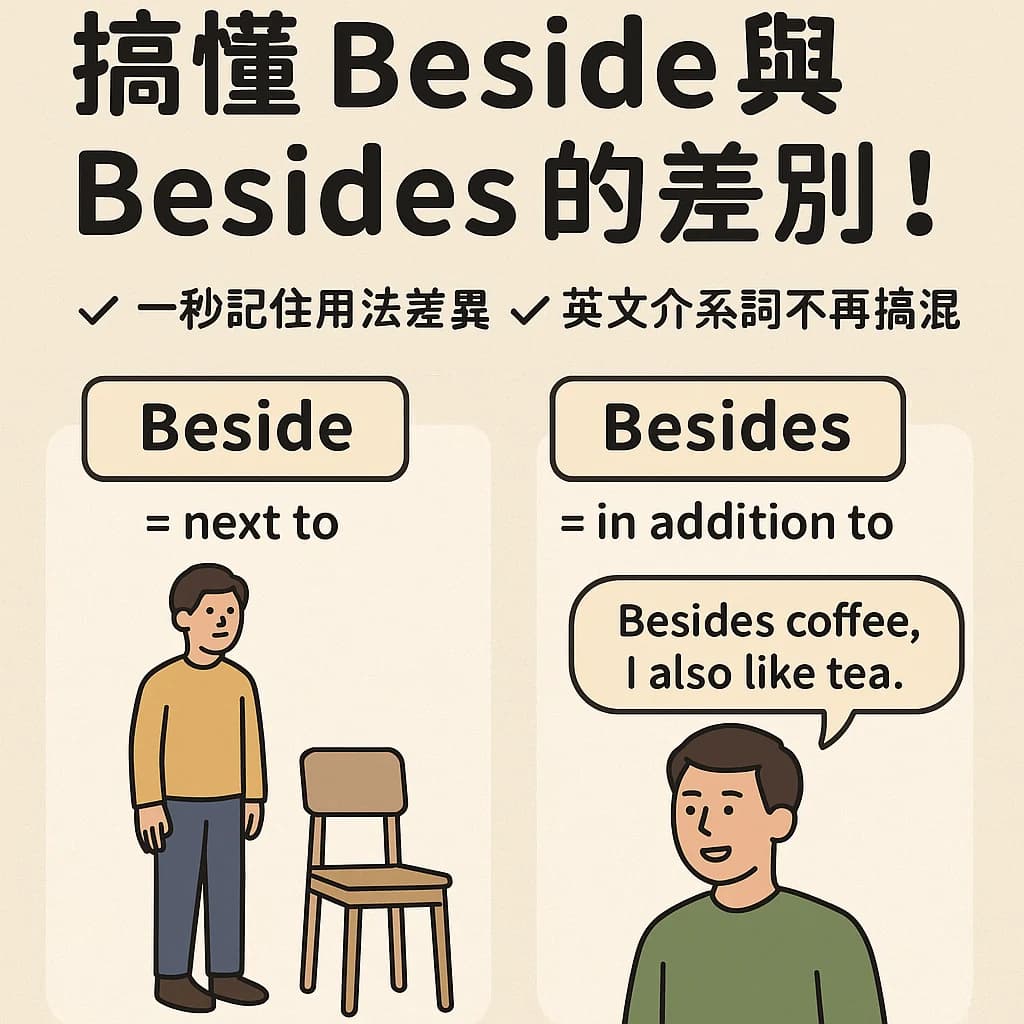
What Is Beside? Common Uses and Examples
In English, "beside" is a very basic yet often misused preposition. Its main meaning is "next to," and it describes a position in space. It often appears in sentences describing where people or things are relative to each other, making it an essential word for expressing location in English.
If you're also learning similar prepositions, such as the difference between at, in and on, check out our 👉 complete guide to English prepositions (internal link) to master how English describes position.
Beside: Basic Definition and Grammar Rules (English Grammar Explained)
(Beside's grammar rules) are fairly simple: it usually comes directly before a noun or pronoun, indicating a position alongside or next to that noun.
📌 Structure:
[Subject] + verb + beside + [noun/pronoun]
✅ Common contexts:
- Where people are relative to each other
- Where objects are placed in space
- Figurative: someone or something compared with others
Beside in Practice: Example Sentences and Situations (English Writing Tips)
Here are some common, practical examples of how to use beside, so you can use it confidently in everyday writing and speaking:
🔹 She sat beside her best friend during the ceremony.
(At the ceremony, she sat next to her best friend.)
🔹 There’s a coffee shop beside the bank.
(There's a café next to the bank.)
🔹 Beside him, I feel like I still have so much to learn.
(Compared with him, I feel I still have a lot to learn.)
👉 Want to get better at using beside correctly in sentences? Pair this with our online course for hands-on practice: Book an English writing trial lesson now
What Is Besides? Common Uses and Examples
"Besides" is one of the most common words in English and can be either a preposition or an adverb. Its basic meanings are "apart from… (also)" and "moreover." It's used to add information or explanation, and is key to stronger logic and smoother links between ideas.
In English writing, besides is often used as a transition word, making it a highly practical word in business reports, email communication and academic writing. If you'd like to learn more about how common English connectors are categorised and used, see Grammarly's guide to transition words (external link) to learn how to fluently connect your ideas.
The Many Uses of Besides (Adverb vs. Preposition)
1. As a preposition:
Means "apart from… (also)," and introduces a noun or noun phrase.
✅ Example: Besides English, she also speaks French.
(Apart from English, she can also speak French.)
2. As an adverb:
Means "also" or "moreover," and is mostly used to link two complete sentences and add extra information.
✅ Example: I’m not interested in the job. Besides, the pay is too low.
(I'm not interested in this job, and besides, the pay is too low.)
📌 Quick tip: As an adverb, besides often appears at the start of a sentence to follow on from the previous one. It's a key tool for linking ideas in English.
Common Examples of Besides at Work (Besides Is Common in Business English Too)
In business letters or meeting presentations, besides helps you add points clearly and present advantages, making what you say more complete and logical.
🔸 Besides improving efficiency, this solution will also reduce costs.
(Not only will this solution improve efficiency, it will also cut costs.)
🔸 We don’t have the budget for that. Besides, it’s not our priority right now.
(We don't have the budget. Besides, it isn't a priority for us at the moment.)
🔸 Besides her academic background, she has 5 years of hands-on experience in the industry.
(In addition to her academic background, she has five years of practical experience.)
💡 Want to communicate more effectively at work in English? Check out our 👉 Business English Communication Skills course
What's the Difference Between Beside and Besides? (Beside vs. Besides Compared)
Although "beside" and "besides" differ by just one letter, they play completely different roles in English, making them a classic common English mistake. Whether you're a beginner or preparing for an English proficiency exam, it's easy to confuse these two words when writing or reading.
Mastering these two words not only sharpens your feel for the language and your logical thinking, but also helps you avoid losing marks in English exams. It's an essential skill in comparing English grammar points.
Comparison Table: Usage, Part of Speech and Examples at a Glance
Here's a clear comparison table to help you quickly grasp the core difference between beside and besides:
| Comparison item | Beside | Besides |
|---|---|---|
| Part of speech | Preposition | Preposition / adverb |
| Meaning | Next to… | Apart from… (also); moreover |
| Key usage | Describes physical position | Adds information or an extra point |
| Common contexts | She stood beside me. | Besides English, I speak Spanish. |
| Grammar risk | Misuse causes confusion about location | Misuse makes the meaning awkward or illogical |
📌 Quick tip: In writing tasks and multiple-choice questions, examiners often design "mixed-use" scenarios to test your eye for grammatical detail. This is especially common in exams such as IELTS, TOEIC and Taiwan's GSAT (university entrance exam).
Memory Tricks and Common Mistakes (Avoid Grammar Errors in English Exams)
To help you remember the difference for good, here are two practical memory tricks:
🔹 Memory trick 1: Use the word's root
- beside: contains "side," meaning "next to"
- besides: the extra "s" stands for "something extra," meaning "moreover" or "also"
🔹 Memory trick 2: Judge by context
- If you're describing "a position in space" → use beside
- If you're adding another sentence or point → use besides
❌ Common mistakes:
- ✘ I’m tired. Beside, I have a lot to do.
(Wrong! It should be Besides) - ✘ The park is besides the school.
(Wrong! It should be beside)
✅ Correct usage:
- ✔ Besides being tired, I have a lot to do.
- ✔ The park is beside the school.
More Learning Resources | Strengthen Your English Writing Skills and Logical Expression
Understanding the difference between "beside" and "besides" is only the first step toward better English writing. If you want to master linking sentences, express yourself more logically and avoid common mistakes, these two hand-picked resources will help take your English communication to the next level:
📘 English Writing and Connectors: Master Logical Linking for Smoother Writing
👉 Read now: The complete guide to logic and transition words in English writing
In this article, you'll learn how to use transition words such as besides, however, moreover, therefore to make your paragraphs flow logically and make your English sound more professional.
📘 Prepositions of Place at / in / on: Write Professional English Sentences with Basic Grammar
👉 Further reading: A complete guide to prepositions of place
If the spatial idea behind beside still isn't clear, this guide to at / in / on will help you get prepositions right from the ground up. It's especially useful for beginners and anyone preparing for an English exam.
🎯 Take Action
Want your English writing to be more logical and better structured?
Message our advisors on LINE now for a one-on-one consultation 👉 https://lin.ee/aY0dUH7
Frequently Asked Questions
To help you fully master how beside and besides work in practice, we've gathered the three questions students and English learners ask most, covering grammar, meaning and exam use.
1. Does beside mean the same as next to?
Yes, beside and next to are interchangeable in most cases. Both describe the spatial relationship of being "next to" something.
✅ Example comparison:
- She sat beside me.
- She sat next to me.
Both sentences are correct and mean almost the same thing, but beside sounds slightly more written and formal, while next to is more common in everyday conversation. If you want to describe position in academic writing or an English presentation, beside is the better choice.
2. What's the difference between besides and in addition?
"Besides" and "in addition" can both mean "also" or "moreover," but they differ slightly in tone and register:
| Word | Formality | Typical position | Example usage |
|---|---|---|---|
| besides | Neutral to conversational | Start or middle of a sentence | Besides, I already told her the truth. |
| in addition | More formal | Mostly at the start of a sentence | In addition, this plan saves more time. |
If you're writing formal documents such as business correspondence or application letters, use in addition (an English writing tip). In meetings, emails and everyday conversation, besides sounds more natural.
3. Do IELTS and TOEIC test beside and besides?
Yes, especially in grammar and reading comprehension questions.
In the TOEIC Reading test, beside and besides are often used to test how well you understand subtle meaning, especially transitions and descriptions of position.
In the IELTS Writing and Listening tests, you may also need to distinguish the logical structure of sentences, which is when the ability to use besides as an adverb correctly becomes crucial.
🎯 Want to prepare for English proficiency exams more systematically? Try our 👉 English test strategy course
Conclusion | Use Beside and Besides Correctly for More Precise English
Through this English grammar comparison, you should now understand the real difference between "beside" and "besides." Whether you're describing a position in space or adding extra information, these two similar-looking words play very different roles in practice. Using them correctly will make your English writing more logical and your expression clearer, and help you avoid losing unnecessary marks in exams.
If you'd like to strengthen your English writing skills further or prepare for an English exam, we warmly recommend:
🎯 Online English Grammar Booster Course 👉 Learn more about the course
🎧 Book a free trial lesson / One-on-one planning with an advisor 👉 Click here to add our Official WhatsApp Account
It's not just about memorising vocabulary and grammar. We help you level up your feel for the language, your logic and your real-world expression, so you can speak with confidence at school, at work or in international communication!

Want to turn this into an action plan that fits you?
Start with a free trial lesson to pin down your level and next steps.
Book a Free Level Test →20-minute online one-on-one · A real teacher assesses your level and gives advice

