

besides, however, moreover and therefore are four of the most common transition words in English writing: besides and moreover add information, however signals contrast, and therefore signals a result or conclusion. This article compares their meaning, formality and position in a table, explains how however differs from but and therefore from so, and covers the comma-splice mistakes learners make most often, with practice questions.
besides, however, moreover, therefore: the differences at a glance
These four words are common transition words in English writing. Their job is to tell the reader how the next sentence relates to the last one. The quickest way to sort them is by relationship: besides and moreover add information, however signals contrast, and therefore signals a result. Of the two that add information, besides is more informal and moreover is more formal.
| Transition word | Meaning | Logical relationship | Formality | Most common position |
|---|---|---|---|---|
| besides | what's more, anyway; apart from... also | Addition | Informal to semi-formal | Start of a sentence (adverb) / before a noun (preposition) |
| however | but, yet, on the other hand | Contrast | Neutral to formal | Start of a sentence, or inserted mid-sentence |
| moreover | in addition, and more importantly | Addition (reinforcing) | Formal | Start of a sentence |
| therefore | as a result, so | Cause and result, conclusion | Formal | Start of a sentence, after a semicolon, before the verb |
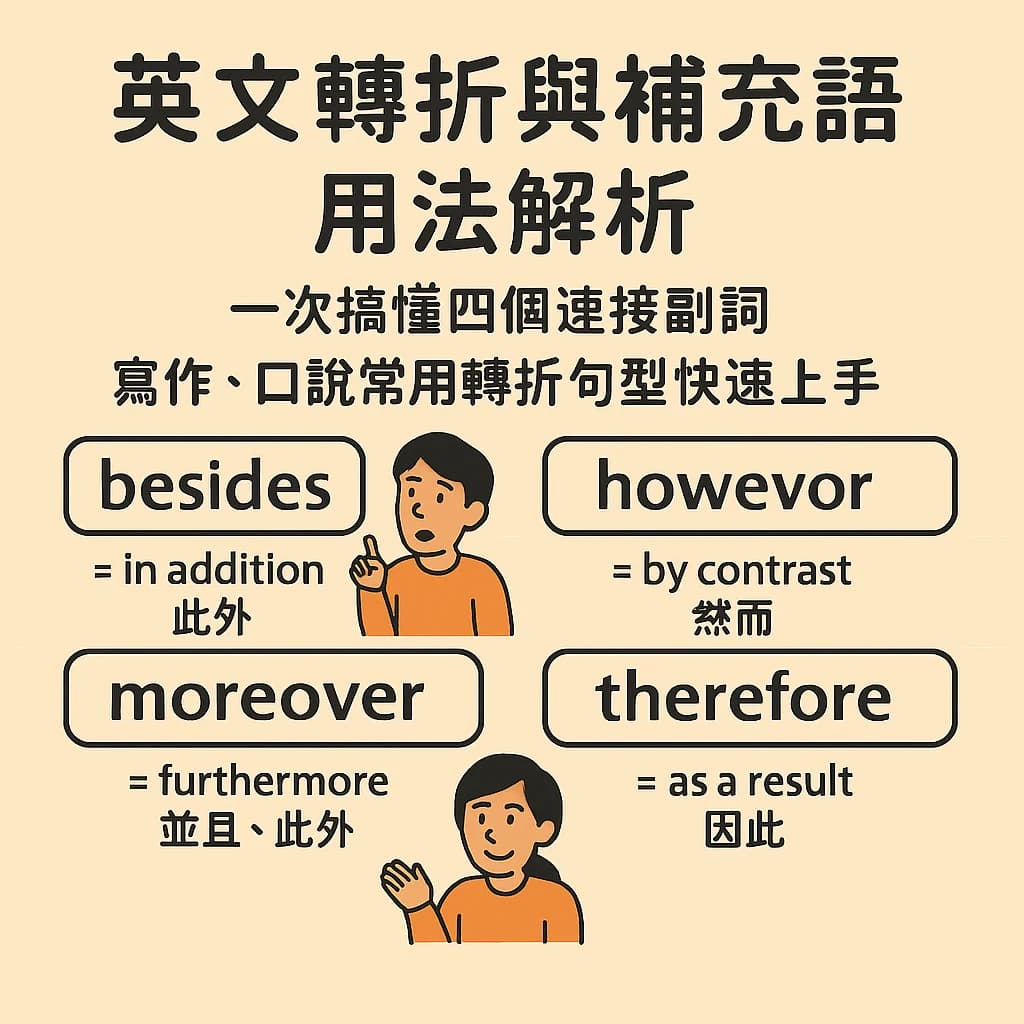
Grammatically, all four are adverbs (besides can also be a preposition). They are not conjunctions like and, but or so, so a single comma cannot join two complete sentences with them. This is where learners most often lose marks, and section 07 sets out the correct punctuation.
What are transition words, and why do they affect your writing score?
Transition words are also called linking words or cohesive devices. They sit between sentences or paragraphs and mark the logical relationship. When readers see however, they expect a contrast; when they see therefore, they expect a conclusion. They do not have to guess how your ideas connect.
Three jobs transition words do
- Mark the relationship: addition, contrast, cause and result, example, summary. The reader knows what role the next sentence plays.
- Connect paragraphs: a transition word at the start of a paragraph links the previous point to the next one.
- Set the tone: both mean "and what's more", but besides sounds like conversation and moreover sounds like a report.
Three common positions
| Position | Punctuation | Example |
|---|---|---|
| Start of a sentence | Comma after it | However, this solution is not practical. |
| Inserted mid-sentence | Commas before and after | This product, however, is more expensive. |
| After a semicolon | Semicolon before, comma after | The test was hard; however, most students passed. |
In exams, using them correctly matters more than using many
The official IELTS writing criteria list Coherence and Cohesion as one of four criteria, and the descriptors mention that over-use or under-use of linking devices and mechanical cohesion can affect the score. In other words, starting every sentence with Moreover or Furthermore earns no extra marks and can look like a memorised template. To see how Task 2 paragraphs can handle contrast naturally, see IELTS writing templates and paragraph structure.
How to use besides: "apart from... also" and "what's more"
besides has two roles. As a preposition, it is followed by a noun or V-ing and means "apart from... (also)". As an adverb, it goes at the start of a sentence followed by a comma and means "what's more", adding one more reason.
besides as a preposition: apart from... also
Besides English, I also speak Japanese.
I speak English, and Japanese as well.
Besides being affordable, the service is convenient.
The service is cheap, and it is also easy to use.
Pattern: besides + noun / V-ing. When a verb follows besides, use the -ing form, not the base form.
besides as an adverb: what's more
I'm not interested in that idea. Besides, it's not feasible.
I don't like the idea, and there is another reason against it: it can't be done.
The course is too expensive. Besides, the schedule doesn't fit my availability.
The price is one problem; the timetable is a second one.
The adverb besides often sounds like "here's one more reason, and it may be the key one". It suits conversation, personal messages and relaxed emails. It is less common in academic papers or formal reports, where moreover or in addition is the safer choice.
besides vs except: one adds, one subtracts
Learners often translate both as "apart from", but English uses two different words:
| besides | except | |
|---|---|---|
| Meaning | Apart from A, there is also B (A is counted too) | Everything apart from A (A is left out) |
| Example | Besides Tom, three people came. (Tom came too: four people in total) | Everyone came except Tom. (Tom did not come) |
Also don't confuse beside (next to) with besides. For the full comparison, see the difference between beside and besides.
How to use however: contrast, and how it differs from but
however means "but, yet" and introduces information that contrasts with, or is unexpected after, the previous sentence. It is an adverb, so it can go at the start of a sentence, in the middle, or after a semicolon.
Three correct ways to write however
| Pattern | Example |
|---|---|
| Full stop + However, | She is talented. However, she lacks experience. |
| Semicolon + however, | She is talented; however, she lacks experience. |
| Inserted mid-sentence , however, | Her lack of experience, however, is a concern. |
Using it at the end of a sentence (It may be biased, however.) is grammatical but less common, so in writing prefer the first three patterns.
How does however differ from but?
| Comparison | however | but |
|---|---|---|
| Part of speech | Adverb | Coordinating conjunction |
| How it joins two sentences | Needs a full stop or semicolon before it | A comma is enough: …, but … |
| Tone | Neutral to formal; common in reports, papers and essays | Common in everyday speech and all kinds of writing |
She is talented, but she lacks experience.
Same meaning, joined with a comma (a comma is enough with but).
She is talented. However, she lacks experience.
Same meaning, as two sentences (however needs a full stop before it).
Why must However be followed by a comma?
Without the comma, however followed directly by an adjective or adverb means "no matter how": However hard I try, I can't remember the word. (It doesn't matter how hard I try, I still can't recall it.) So when you mean contrast, write However, to avoid confusing the reader.
How to use moreover: a formal "in addition, and more importantly"
moreover means "in addition" and introduces a reason that supports the same point and carries more weight. It is more formal than besides and is common in reports, papers, proposals and IELTS/TOEFL essays.
The project is cost-effective. Moreover, it boosts team morale.
Good value is one benefit; better morale is a further one.
The candidate has strong qualifications. Moreover, she brings international experience.
Her qualifications are strong, and her international experience adds to that.
Key point: what moreover adds must go in the same direction as the previous sentence. If the previous sentence is an advantage, what follows moreover should be an advantage too; if the direction reverses, use however.
moreover, besides, furthermore or in addition: which to choose?
| Transition word | Formality | Feel | Best for |
|---|---|---|---|
| besides | Informal to semi-formal | what's more (often a personal tone) | Conversation, messages, everyday email |
| in addition | Neutral | also, plainest of the four | Email, reports and essays |
| moreover | Formal | and more importantly | Reports, papers, argument essays |
| furthermore | Formal | takes the argument one step further | Reports, papers, argument essays |
Don't use the same addition word in several paragraphs in a row. Alternating in addition, moreover and also, or linking ideas through the meaning of the sentences, reads far more naturally.
How to use therefore: cause and result, and how it differs from so and thus
therefore means "as a result". The previous sentence gives a reason or evidence, and the next gives the result or conclusion. It is an adverb and sounds more formal than so.
Common therefore patterns
| Pattern | Example |
|---|---|
| Full stop + Therefore, | She worked hard. Therefore, she passed the exam. |
| Semicolon + therefore, | The product failed quality testing; therefore, it will not be launched. |
| and therefore | The data was incomplete and therefore unreliable. |
| Before the verb (mid-sentence) | The results are therefore inconclusive. |
In short sentences the comma after Therefore is sometimes dropped, but in writing and exams it is safest to always include it.
therefore, so or thus: which to choose?
| Comparison | so | therefore | thus |
|---|---|---|---|
| Part of speech | Coordinating conjunction | Adverb | Adverb |
| Joining two sentences | …, so … a single comma is enough | Needs a full stop or semicolon before it | Needs a full stop or semicolon before it |
| Tone | Informal, everyday | Formal | More formal, academic |
| Example | It was raining, so we stayed home. | It was raining. Therefore, the match was cancelled. | Costs rose; thus, prices increased. |
In a CV, report, paper or exam essay, therefore or as a result is more suitable than so; in everyday conversation and messages, so is fine.
Punctuation and common mistakes: comma splices cost the most marks
however, therefore and moreover are adverbs, not conjunctions like but, so and and. If you join two complete sentences with just a comma, you make a common writing error called a comma splice.
| Common version | Problem | Corrected |
|---|---|---|
| It is cheap, however it is slow. | A comma joins two complete sentences | It is cheap. However, it is slow. It is cheap; however, it is slow. |
| She studied hard, therefore she passed. | A comma joins two complete sentences | She studied hard; therefore, she passed. She studied hard, so she passed. |
| However she is tired, she keeps working. | Without a comma, however is read as "no matter how" | She is tired. However, she keeps working. |
| The plan is cheap. Moreover, it is too risky. | The direction reverses after moreover | The plan is cheap. However, it is too risky. |
| Except English, I also speak Japanese. | "Apart from... also" needs besides | Besides English, I also speak Japanese. |
A three-step check after you write
- If however, therefore or moreover has only a comma before it and complete sentences on both sides: change the comma to a full stop or semicolon.
- If a transition word starts a sentence, put a comma after it.
- Check the direction between the two sentences: moreover or in addition to add, however to reverse, therefore for a result.
Other common transition words: addition, contrast, result, example, conclusion
Once you know the four core words, prepare a few replacements for each relationship so you don't repeat the same word.
| Relationship | Common transition words | Example |
|---|---|---|
| Addition | also、in addition、furthermore、what's more | In addition, the course includes weekly feedback. |
| Contrast | nevertheless、on the other hand、in contrast、even so | The plan is risky. Nevertheless, it is worth trying. |
| Cause and result | as a result、consequently、thus、hence | Sales fell. As a result, the team changed its strategy. |
| Example | for example、for instance、such as | Many cities, for example Taipei, have good public transport. |
| Sequence | first、next、then、finally | First, read the question carefully. |
| Conclusion | in conclusion、overall、in short | Overall, the benefits outweigh the costs. |
nevertheless and consequently are more formal than however and therefore, and suit papers and reports. such as is a prepositional phrase followed by a noun; unlike for example, it cannot stand alone at the start of a sentence followed by a comma.
Choosing transition words by situation: email, reports, IELTS essays
| Writing situation | Suggested words | Reminder |
|---|---|---|
| Everyday business email | also, in addition, however, so | Keep the tone natural; avoid very formal words like moreover and thus |
| Reports, proposals, presentation scripts | moreover, however, therefore, as a result | One or two per paragraph to mark the key turns is enough |
| IELTS/TOEFL essays | however, in addition, therefore, for example, in conclusion | Using the right relationship matters more than using many; avoid a connector at the start of every sentence |
| Application letters, study plans | moreover, however, as a result | Use transition words to link experience and motivation, rather than just listing points |
Example paragraph: all four words in one paragraph
Online classes save commuting time. Besides, they are usually cheaper. However, some learners find it hard to stay focused at home. Moreover, technical problems can interrupt a lesson. Therefore, learners should choose a quiet space and test their equipment before class.
How the paragraph flows: the first sentence gives an advantage, besides adds a second reason, however introduces a drawback, moreover adds a further problem, and therefore draws the practical conclusion.
For business letters, see business English letter writing tips and examples; to make your arguments more convincing, see persuasive English writing: argument techniques and structure.
Practice: choose the best transition word
Answer on your own first, then read the explanations. Each question has only one best answer.

Further study and one-to-one writing practice
- The difference between beside and besides: one letter apart, completely different meanings.
- English writing from basics to advanced: sentence patterns, paragraph structure and a general method for high-scoring writing.
- Complete guide to logical expression in English: ways to organise your points for both speaking and writing.
- IELTS Writing Task 1 and Task 2 guide: scoring criteria, structure and time management.
- English prepositions: a complete overview: at, in, on, to, by and with in one place.
The most effective way to use transition words smoothly is to have a teacher check the logic and punctuation sentence by sentence after you write. If you are preparing English emails, reports or an exam essay, take a look at the one-to-one online courses for business and workplace English or English test preparation, or tell us about your writing needs through our official WhatsApp so an advisor can suggest a suitable study plan.
Book a Free Level Test →20-minute online one-on-one · A real teacher assesses your level and gives advice
FREQUENTLY ASKED QUESTIONS
FAQ
Q01What is the difference between besides, however, moreover and therefore?+
besides and moreover both add information; besides is more informal and moreover more formal. however signals contrast, and therefore signals a result or conclusion. All four are adverbs, so when they join two complete sentences, a full stop or semicolon must come before them.
Q02Can however and but be used interchangeably?+
The meaning is close, but the usage differs. but is a conjunction and can join two sentences with a comma; however is an adverb and needs a full stop or semicolon before it, for example She is talented. However, she lacks experience. However is more common in formal writing.
Q03What is the difference between therefore and so?+
Both mean "as a result". so is a conjunction, informal, and can be written as …, so …; therefore is an adverb, formal, and needs a full stop or semicolon before it, or can be written as and therefore. Reports and exam essays use therefore more often.
Q04Which is more formal, besides or moreover?+
moreover is more formal and suits reports, papers and argument essays. The adverb besides often carries a personal "what's more" tone that suits conversation and everyday email. For something in between, use in addition.
Q05Does however always need a comma after it?+
When it means "but", yes. However followed directly by an adjective or adverb, with no comma, means "no matter how", as in However hard I try. When however is inserted mid-sentence, it needs commas on both sides.
Q06How do I tell besides and except apart?+
besides means "apart from A, there is also B", so A is counted too; except means "everything apart from A", so A is left out. For example, Besides Tom, three people came. means Tom came too; Everyone came except Tom. means Tom did not come.


