

IELTS Writing templates help you build your paragraph structure quickly: in Task 1, paraphrase the question, write an Overview and then add the details; in Task 2, use a four-paragraph structure to answer the question clearly. Templates are useful for memorizing structures and sentence patterns, but learning whole paragraphs by rote is not recommended; you still need to adapt the content to the actual question.
IELTS Writing high-score templates: Task 1 & Task
1. Task 1: Academic chart-writing templates
1.1 Introduction: Paraphrase the Question and Outline the Main Features
Writing focus for the IELTS Task 1 introduction
- Paraphrase the question: use synonyms and varied sentence structures instead of copying the question word for word.
- Overview: Briefly describe the chart’s main trends or most striking features; there is no need for details.
Common template sentences for the Task 1 introduction
Paraphrase the question
- “The given [graph/chart/table/diagram] illustrates/shows [restated question information].”
- “The [line graph/bar chart/pie chart] compares [data or content] over a period of time / among categories.”
- “The diagram provides information about [topic] in [time/place].”
Summarize the main features
- “Overall, it is clear that [the most obvious trend or feature, e.g. there was a significant increase/decline in…].”
- “The most noticeable trend is that [describe the key change, e.g. X showed a steady rise, while Y remained stable].”
- “It can be observed that [highlight the data’s main features or contrasts].”
IELTS Task 1 chart examples: line graph, bar chart, pie chart, process diagram
1. Sample Question: Line Graph
Writing focus for IELTS line graphs
- Paraphrase the question
- Use synonyms and varied sentence structures instead of copying the original question.
- For example: shows → provides information about, trends → changes, over time → over a specific period.
- Identify the main trends
- Outline the overall trend in your introduction, for example:
- Which figures show an increase? (steady increase)
- Which figures show a slight change or a decline? (moderate rise, slight decline)
- Don’t describe specific figures or details here; save them for the body paragraphs.
- Outline the overall trend in your introduction, for example:
- Varied language
- Use academic vocabulary to describe trends, such as:
- Increase: rise, increase, grow, climb, surge
- Decrease: fall, decline, drop, decrease
- Stability: remain steady, stay constant
- Fluctuation: fluctuate, show volatility
- Use adverbs or adjectives to stress the size of a trend, such as significantly, steadily, slightly, moderately.
- Use academic vocabulary to describe trends, such as:
- Concise and clear
- The introduction should be short and clear, usually just 2-3 sentences, with no need for detail.
- The goals of the introduction are:
- Paraphrase the question.
- Give the overall trend or the most striking feature.
Question: The line graph shows data trends over time, such as population growth or sales performance.

Paraphrase the question
The line graph provides information about the trends in data, illustrating changes such as population growth or sales performance over a specific period.
Summarize the main features
Overall, the graph shows that certain categories experienced a steady increase over time, while others displayed either a moderate rise or slight decline.
Summary of key points for the line graph introduction
When writing the introduction for a line graph:
- Paraphrase the question: Avoid copying; use synonyms flexibly and restructure sentences.
- Give an overview of the trends: briefly describe the chart’s main features, highlighting the most significant rises, falls or periods of stability.
- Vary your language: combine academic vocabulary with adverbs to make your descriptions more precise and professional.
An introduction like this meets the IELTS Task 1 requirements and grabs the examiner’s attention right away!
2. Sample Question: Bar Chart
Writing focus for IELTS bar charts
- Paraphrasing example:
- Goal: restate the question without copying the original sentence.
- Tips:
- Use synonyms:
- Shows → Compares, Displays
- Data → Figures, Information
- Categories → Groups, Sectors, Types
- Restructure sentences: Change the word order to vary your sentence patterns.
- Use synonyms:
- “The bar chart displays a comparison of figures across different sectors, such as national GDP and consumer spending habits, over a specific period.”
- Summarize the main features
- In the introduction, point out the most significant change or difference, without going into detailed figures.
- Emphasize two points:
- Which categories or time periods saw the biggest growth? (significant growth)
- Which categories or periods changed little or stayed stable? (remained stable)
Key sentence patterns:
- “Overall, the chart highlights that certain categories experienced significant increases, while others showed only slight changes or remained steady.”
- “It is evident that [category A] dominated the data, whereas [category B] showed the least variation.”
Academic vocabulary and expressions
- Vocabulary for comparisons:
- Growth:growth, rise, increase, upward trend
- Stability: remain steady, stay constant, no significant change
- Decrease: decline, drop, fall, decrease
- Comparison: higher than, lower than, in contrast to, significantly more/less
- Adverbs/adjectives to stress the size of a difference:
- Large changes: significantly, substantially, considerably
- Small changes:slightly, marginally, moderately
Clear and concise
- The introduction should be simple and clear, usually no more than 2-3 sentences.
- There is no need for specific figures or details here; save the detailed data for the body paragraphs.
Question: The bar chart shows comparisons of data across different categories or time periods, such as national GDP or consumer habits analysis.
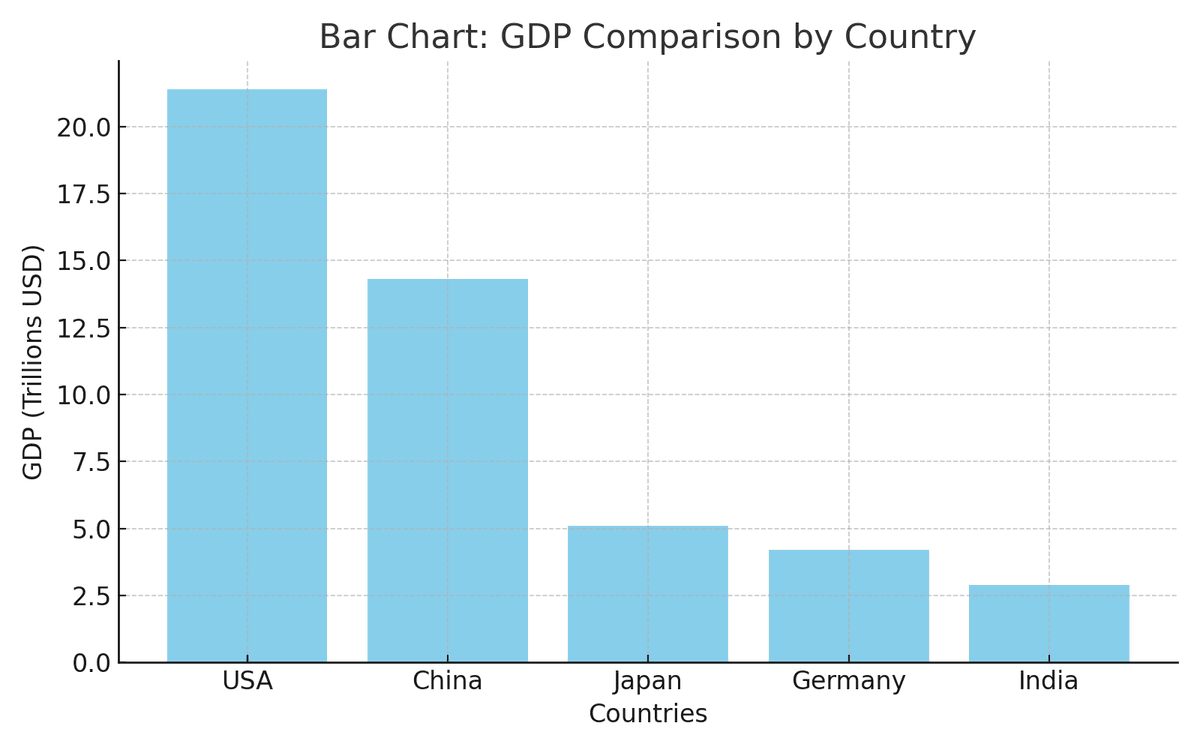
How to Write the Bar Chart Introduction
Paraphrase the question
The bar chart compares data across different categories, such as national GDP or consumer habits, over a specific time period.
Summarize the main features
Overall, the chart reveals noticeable variations among the categories, with some showing significant growth while others remained relatively stable.
Summary of key points for the bar chart introduction
When writing the introduction for a bar chart:
- Paraphrase the question: Use synonyms and restructure sentences flexibly to keep your writing fluent.
- Summarize the trends: Point out the most obvious changes, increases or periods of stability, without detailed figures.
- Use academic vocabulary: describe increases, decreases and stability in comparisons, adding adverbs for more expressive power.
Following these points ensures your introduction meets the IELTS Task 1 standard, shows a professional level of writing and lays the groundwork for a high score!
3. Sample question and pie chart (Pie Chart)
Writing focus for IELTS pie charts
- Paraphrase the question
- Goal: use synonyms and reorganize the sentence rather than copying the question directly.
- Tips:
- Show → Illustrate, Present, Compare
- Proportional distribution → Breakdown, Allocation, Share
- Categories → Sections, Segments, Divisions
- Example:
“The pie charts present a breakdown of budget allocation across six key categories, including housing, food, and healthcare.”
- Identify the main features Common sentence patterns:
- Key emphasis:
- The largest category (e.g. Housing).
- Clear differences or changes (e.g. the different shares for Food and Healthcare).
- Leave out detailed figures and describe only the overall trends.
- “Overall, [main category] accounted for the largest proportion, followed by [second-largest category].”
- “In contrast, [category with a smaller share] represented the smallest share of the distribution.”
- “Notable differences can be observed in [two categories], where one category significantly outweighed the other.”
- Key emphasis:
- Academic vocabulary and expressions
- Vocabulary for proportions:
- Largest:accounted for the largest proportion/share, dominated the chart
- Secondary: came second, followed by, represented a smaller portion
- Smallest: constituted the smallest percentage, made up a minor share
- Linking words:
- In comparison, Similarly, In contrast, However
- Vocabulary for proportions:
- Clear and concise
- Keep your introduction short and to the point: 2-3 sentences are enough.
- Key: Highlight the largest and smallest items to bring out the main differences.
Question:The pie charts show the overall proportional distribution, such as budget allocation or market share.
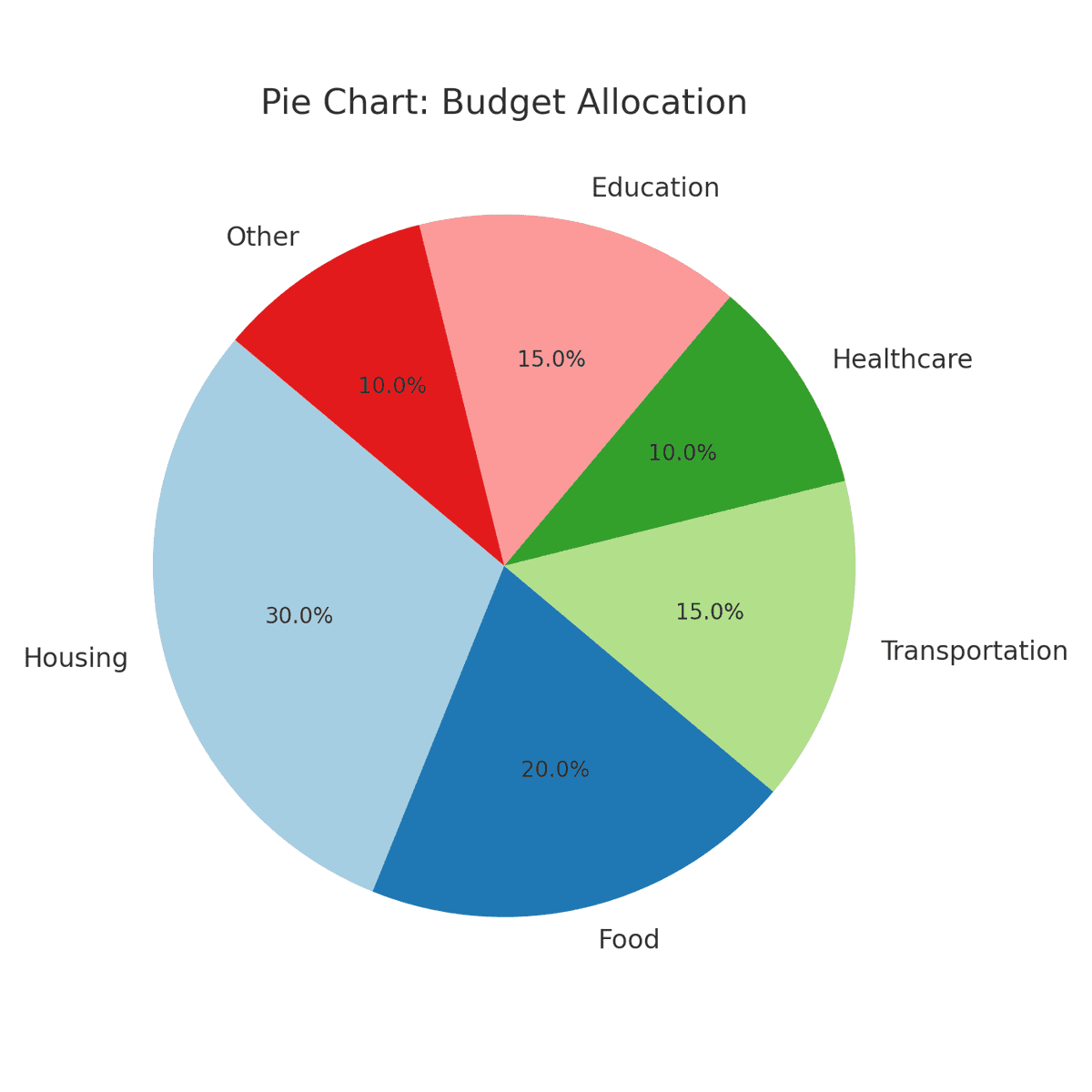
How to Write the Pie Chart Introduction
Paraphrase the question
The pie charts illustrate the proportional distribution of expenditures across six categories, including housing, food, transportation, healthcare, education, and other expenses.
Summarize the main features
Overall, housing accounted for the largest share of the budget, while other categories, such as food and healthcare, showed notable differences in their proportions.
Summary of key points for the pie chart introduction
- Paraphrase the question: use synonyms (e.g. proportions → distribution, allocation) to restate the question.
- Overview of main features: Highlight the most significant items (such as the largest or smallest proportions) and any other notable changes or trends.
4. Sample Question: Process Diagram
Writing focus for IELTS process diagrams
- Paraphrasing example:
“The diagram illustrates the stages involved in creating a mobile application, beginning with initial planning and ending with post-launch maintenance.”- Goal: avoid copying the original sentence; use synonyms and varied sentence structures.
- Tips:
- Process → Workflow, Stages, Steps
- Developing → Creating, Producing, Building
- Each step → Sequential steps, Key stages
- Overview of main features Key sentence patterns:
- Highlight the start of the process and its end point, and make the continuity of the whole process clear.
- Use concise language to point out that there are “multiple steps” and how they are “connected in sequence”.
- “Overall, the process involves a series of interconnected steps, starting with [Step 1] and concluding with [Step X].”
- “The workflow progresses logically from [starting point] to [end point], covering stages such as [intermediate steps].”
- Language accuracy
- Use sequencing words:
- Beginning: to begin with, initially, at the first stage
- During the process:next, subsequently, following this, after that
- Ending: finally, at the last stage, concluding with
- Vocabulary for describing flowcharts:
- Requirements analysis:requirement gathering, analysis
- Design stage:designing, planning phase
- Development stage: development, coding
- Testing stage: testing phase, quality assurance
- Release and maintenance:deployment, launch, updates
- Use sequencing words:
- Logical coherence and concise expression
- When describing a process, make sure the stages flow logically.
- The introduction should be brief and to the point, mentioning only the start and end points and the continuity of the process.
Question:The diagram shows the process of mobile app development, illustrating each step involved in the workflow.
Chart placement: place the process diagram here to show the steps of the production process.
How to Write the Process Diagram Introduction
Paraphrase the question
The diagram illustrates the workflow involved in mobile app development, outlining the key stages from requirement analysis to the final deployment and maintenance phase.
Summarize the main features
Overall, the development process comprises several sequential steps, beginning with requirement analysis, followed by design, coding, and testing, and concluding with the app’s launch and subsequent updates.
Sample process diagram content (steps in brief)
- Requirement Analysis: confirming client needs and planning features.
- UI/UX design (Design Phase): designing the user interface and experience.
- Coding/Development: Actually writing the app’s code.
- Testing: running functional tests and fixing bugs.
- Deployment: Releasing the app on the platform.
- Maintenance and Updates: Continually optimizing the app and updating its features.
Summary of Key Points for the Process Diagram Introduction
- Paraphrase the question: use synonyms and restructure sentences flexibly so you don’t copy the question.
- Overview of main features: Highlight the start and end of the process and the order of the steps.
- Use specialist vocabulary: Describe the specific tasks in each stage to make your language more precise.
- Clear logic: keep your description smooth and use sequencing words to improve coherence.
With these points, you can write a clear introduction that meets the requirements of an IELTS Task 1 flowchart, with sound logic and professional language that lay the foundation for a high score!
2. Task 1: General Training letter-writing templates
2.1 Opening paragraph: purpose of the letter
In General Training Task 1, your opening paragraph needs to state the purpose of the letter clearly. Formal and informal letters differ in tone and word choice, so choose the tone that fits the situation in the question.
Formal Letter
When to use: writing to people you don’t know well, such as companies, organizations, authorities or your boss.
Tone: formal and polite; avoid colloquial words.
Template sentences:
- “Dear Sir/Madam, I am writing to [clearly state the purpose of your letter].”
- “I am writing this letter to [explain why you are writing].”
- “I would like to express my [concern/interest/request] regarding [specific details].”
Example:
Dear Sir/Madam,
I am writing to request further information about the upcoming training program offered by your organization.
Informal Letter
When to use: Writing to someone you know well, such as a friend, family member or colleague.
Tone: More relaxed, with conversational vocabulary, but still clear and appropriate.
Template sentences:
- “Dear [Name], I hope this letter finds you well.”
- “I’m writing to let you know [purpose/reason for writing].”
- “I just wanted to tell you about [what it’s about].”
Example:
Dear John,
I hope you’re doing well! I’m writing to let you know that I’ll be visiting your city next month, and I’d love to catch up with you.
Writing focus for a letter’s opening paragraph
- Match the tone to the situation:
- Formal letters: complete sentences, professional vocabulary, objective tone.
- Informal letters: relaxed, natural and conversational language with a friendly tone.
- Get straight to the point:
- State the purpose of your letter clearly in the very first sentence; don’t be vague or long-winded.
- Provide details as the question requires:
- For example, asking for information, making a request, apologizing or extending an invitation. Make sure the opening connects logically with the body paragraphs.
Summary of key points for a letter’s opening paragraph
In General Training Task 1 letter writing, the opening paragraph is the foundation of the whole letter.
- Formal letters: stay professional and direct, stating your purpose clearly.
- Informal letters: keep the tone relaxed and friendly, but still give a clear reason for writing.
With templates and techniques like these, you can grab the examiner’s attention right from the opening paragraph, show an appropriate tone and clear expression, and lay a solid foundation for Task 1!
2.2 Body paragraphs: give specific details
Key points:
In the body paragraphs, give detailed content and explanations as the question requires, keeping your logic clear and coherent and avoiding vague or repetitive content.
Writing principles for a letter’s body paragraphs
- Clear paragraph structure: Focus each paragraph on one main point and open it with a “topic sentence”.
- Give details and examples: Explain your point specifically and back it up with examples or details to make it more convincing.
- Use linking words: keep a logical flow between sentences and between paragraphs.
Formal letter example (General Training Task 1)
Question: You recently ordered a product online, but it was delivered with some issues. Write a letter to the company to explain the problem and request a solution.
Sample body paragraph:
- Paragraph 1: Describe the problem
- “Firstly, I would like to inform you that the product I received was not in good condition. Specifically, the packaging was damaged, and the item itself had a visible scratch on the surface.”
- Paragraph 2: Give details and explanation
- “In addition, the product does not function as expected. When I attempted to use it, the device failed to start properly, which was quite disappointing considering its price and your company’s reputation.”
- Linking word examples:
- Firstly, Secondly, In addition, Moreover, Furthermore: to add points in sequence.
- As a result, Therefore, Consequently: to show results.
Informal Letter Example (General Training Task 1)
Question: Write a letter to your friend to invite them to your housewarming party.
Sample body paragraph:
- Paragraph 1: Reason for the invitation
- “First of all, I’m so excited to tell you that I’ve just moved into my new apartment! It’s cozy, beautifully decorated, and I can’t wait for you to see it.”
- Paragraph 2: Give details of the event
- “The party will be on Saturday evening, starting around 6 PM. There will be good food, drinks, and music, and I’ve invited a few of our close friends as well.”
- Linking word examples:
- First of all, Next, By the way, Also, Finally: add detail and flow to your writing.
Common linking words and sentence patterns for letters
Showing sequence or progression
- Firstly, Secondly, Finally
- Moreover, Furthermore, In addition
Expressing cause and effect
- As a result, Therefore, Consequently
Adding or contrasting
- However, On the other hand, Nevertheless
- For example, For instance, To illustrate
Tips for writing a letter’s body paragraphs
- Focus each paragraph on a single topic so your ideas don’t drift.
- Make good use of linking words to strengthen the logical connections between paragraphs.
- Give specific details or examples to make your content richer and more convincing.
2.3 Closing paragraph: sum up and state your expectations
Key points:
In the closing paragraph of your letter, briefly sum up the main points and clearly state the next step or what you expect. Choose sentence patterns and sign-offs that match the tone of the letter (formal or informal).
Formal letter closing templates
1. Expressing That You Hope for a Reply
- “I look forward to hearing from you at your earliest convenience.”
- “Please let me know if any further information is needed.”
- “I would appreciate your prompt response to resolve this matter.”
2. Express thanks
- “Thank you for your time and consideration.”
- “I appreciate your attention to this matter.”
3. Polite closing phrases
- “Yours faithfully,” (when you don’t know the recipient’s name)
- “Yours sincerely,” (when you know the recipient’s name)
Formal letter closing example
Question:Write a letter to a company regarding a faulty product and request a replacement.
How to write the closing paragraph:
“I would appreciate it if you could arrange for a replacement or a full refund at your earliest convenience. Thank you for addressing this issue promptly. I look forward to your response.”
Sign-off:
“Yours faithfully,
John Smith”
Informal letter closing templates
1. Expressing Anticipation and Invitations
- “Looking forward to hearing from you soon!”
- “Hope you can make it! Let me know what you think.”
2. Summarize Your Concern or Purpose
- “Take care, and I’ll see you soon.”
- “Let me know if you need any more details.”
3. Closing Phrases
- “Best wishes,”
- “Warm regards,”
- “Cheers,”
Informal Letter Closing Examples
Question: Invite your friend to a housewarming party.
How to write the closing paragraph:
“Let me know if you can make it, and feel free to bring anyone along. I’m sure it’s going to be a great night! Hope to see you soon.”
Sign-off:
“Best wishes,
Emily”
Tips for Writing a Letter’s Closing Paragraph
- Match your tone to the type of letter: formal letters should stay polite and professional, while informal letters can be natural and relaxed.
- Restate the purpose of the letter: Re-emphasize the reply or action you’re hoping for.
- Use an appropriate closing: Choose a sign-off that suits the recipient to round off the letter well.
3. Task 2: argumentative essay templates (common to Academic and General Training)
Task 2 is an argumentative essay that both Academic and General Training candidates must write: at least 250 words, with about 40 minutes officially recommended, and it is worth twice as much as Task 1. The common templates and examples below are organized by Introduction, body paragraphs and Conclusion; for a full explanation of the Task 1 and Task 2 exam requirements, see our complete IELTS Writing Task 1 & Task 2 guide.
3.1 Introduction: Introduce the Question and State Your Position
Writing focus:
The aim of a Task 2 introduction is to set out the background of the question clearly and state your position or the points you will discuss. Keep it concise and avoid too much detail, at around 40-50 words.
Standard Task 2 introduction structure
- Restate the question: rewrite it in your own words rather than copying it directly.
- Provide background: briefly introduce relevant background to give the topic proper context.
- State your position clearly: Make your own view clear (e.g. agree, disagree or neutral), or briefly outline what you are going to discuss.
Common template sentences for the Task 2 introduction
1. Introduce the background and restate the question
- “In recent years, [restate the background of the question].”
- “It is often argued that [paraphrased topic of the question].”
- “The issue of [topic of the question] has become increasingly important in today’s society.”
2. State your position clearly
- “I completely agree/disagree that [state your position].”
- “This essay will discuss both sides of the argument and explain why I believe that [your view].”
- “While some people believe that [view A], I firmly hold the opinion that [view B].”
Task 2 introduction examples
Example 1: Agree/Disagree Questions
Question: Some people believe that online education is more effective than traditional classroom teaching. Do you agree or disagree?
Introduction:
“In recent years, the popularity of online education has grown significantly. While some argue that it is more effective than traditional classroom teaching, I completely disagree and believe that in-person education provides greater benefits.”
Example 2: Advantages and disadvantages
Question:The use of mobile phones in schools has both advantages and disadvantages. Discuss both views and give your opinion.
Introduction:
“Nowadays, mobile phones have become an integral part of our lives, and their use in schools has sparked debate. This essay will discuss both the advantages and disadvantages of allowing mobile phones in schools and explain why a balanced approach is necessary.”
Example 3: Problem and solution
Question:Many cities around the world face serious traffic congestion problems. What are the causes, and what solutions can be implemented?
Introduction:
“Traffic congestion has become a pressing issue in many cities worldwide due to increasing urbanization. This essay will identify the main causes of traffic jams and propose practical solutions to address the problem.”
Tips for Writing the Task 2 Introduction
- Avoid opening with I think or I believe: use more professional phrasing instead, such as It is often argued that… or This essay will argue that….
- Paraphrase the question: Restate the question using synonyms and varied sentence structures to show your flexibility with the language.
- State your position clearly: the examiner should understand your view from the introduction (especially in agree/disagree questions).
With these templates and examples, you can quickly write a clear, logical Task 2 introduction and lay a solid foundation for the whole essay!
Body paragraphs: present points and examples
Key points of Body Paragraph 1:
- Present your first point: Sum it up in one sentence as the paragraph’s topic sentence.
- Further explanation: explain the reasons or logic behind the point in detail.
- Support with specific examples or data: use concrete examples, statistics or scenarios to make your argument more persuasive.
Standard structure of Body Paragraph 1
- Topic Sentence
- State your point clearly so readers understand what the paragraph is about.
- Sample sentence patterns:
- “One of the main reasons for [issue/topic] is that [point].”
- “A significant factor contributing to this issue is [point].”
- Further explanation
- Explain why this point matters and back it up logically.
- Sample sentence patterns:
- “This is because [explain the reason].”
- “To elaborate, [explain the reasoning behind your point further].”
- Support with specific examples or data
- Support your points with real examples, statistics or hypothetical scenarios.
- Sample sentence patterns:
- “For example, [specific example].”
- “A recent study showed that [supporting data or statistics].”
- “Take [someone/a situation] as an example…”
- Concluding sentence (optional)
- Briefly respond to the point or reinforce the paragraph’s conclusion.
- Sample sentence patterns:
- “Therefore, it is evident that [restate the point/sum up the paragraph].”
Body Paragraph 1 examples
Question: Some people believe that working from home improves productivity. Do you agree or disagree?
Body Paragraph 1: Present your first point and support it
Topic sentence:
“One of the main reasons why working from home enhances productivity is that it reduces commuting time.”
Further explanation:
“This is because employees no longer have to spend hours in traffic or public transportation, allowing them to start their workday earlier and with greater energy.”
Specific example:
“For example, a survey conducted by Stanford University revealed that remote workers saved an average of two hours daily, which they could instead use for focused tasks or personal development.”
Concluding sentence (optional):
“Therefore, eliminating commuting time significantly improves efficiency and work-life balance, leading to higher productivity.”
Question: Some people believe that governments should invest more in public transportation. Discuss the advantages.
Body paragraph 1: Present your first point and explain it
Topic sentence:
“One major advantage of investing in public transportation is that it helps reduce environmental pollution.”
Further explanation:
“This is because efficient public transport systems encourage people to rely less on private cars, which emit large amounts of carbon dioxide and other pollutants.”
Specific example:
“For instance, in cities like Tokyo and London, where public transportation is highly developed, carbon emissions have significantly decreased due to fewer private vehicles on the road.”
Concluding sentence (optional):
“Thus, improving public transport infrastructure can play a key role in addressing environmental challenges.”
Writing Tips for Body Paragraph 1
- Make your topic sentence clear: State your point right at the start so the examiner can see it at a glance.
- Explain logically: This makes your point more convincing.
- Use relevant, specific examples: support your points with real data, research findings or hypothetical scenarios, and avoid vague statements.
- Avoid repetition: vary your sentence structures and word choice to show your language ability.
Body paragraph 2: present a second point backed by specific examples
Writing focus:
The aim of body paragraph 2 is to present a second point, explain it logically and back it with specific examples to strengthen your argument, while keeping the paragraph coherent.
Standard structure of Body Paragraph 2
- Topic Sentence
- Introduce your second point to open a new paragraph.
- Sample sentence patterns:
- “Another significant reason is that [point].”
- “In addition, [point] also plays an important role in [topic].”
- “Furthermore, it can be argued that [point].”
- Further explanation
- Explain your second point in detail and support it logically.
- Sample sentence patterns:
- “This is because [explain the reason].”
- “To illustrate, [further explanation].”
- Support with specific examples or data
- Use real or hypothetical examples to make your argument more credible.
- Sample sentence patterns:
- “For instance, [specific example].”
- “A study conducted by [research institution/expert] showed that…”
- “Take [a situation] as an example…”
- Concluding sentence (optional)
- Sum up the paragraph’s point and link it back to your overall argument.
- Sample sentence patterns:
- “Thus, it is evident that [restate your point].”
- “This clearly demonstrates the importance of [point].”
Body Paragraph 2 examples
Question: Some people believe that working from home improves productivity. Do you agree or disagree?
Body paragraph 2: Present a second point backed by specific examples
Topic sentence:
“Another reason why working from home increases productivity is that it provides a more comfortable and less stressful working environment.”
Further explanation:
“This is because employees can customize their workspace according to their preferences, which can reduce distractions and increase focus.”
Specific example:
“For example, a recent study by Harvard Business Review found that 70% of remote workers reported higher job satisfaction and efficiency due to fewer office interruptions and a quieter working space.”
Concluding sentence:
“Therefore, a comfortable environment at home allows employees to maintain a better work rhythm, ultimately boosting their productivity.”
Question: Some people believe that governments should invest more in public transportation. Discuss the advantages.
Body paragraph 2: Present a second point backed by specific examples
Topic sentence:
“Another key benefit of improving public transportation is the reduction of traffic congestion in cities.”
Further explanation:
“When reliable and efficient public transit systems are available, more people choose buses or trains over private cars, which significantly reduces the number of vehicles on the road.”
Specific example:
“For instance, in Singapore, the government’s investment in a well-connected metro system has led to a 30% decrease in road traffic, making commuting faster and more efficient for everyone.”
Concluding sentence:
“This shows that investing in public transportation not only benefits individuals but also improves overall urban mobility.”
Techniques for Logical Coherence in Body Paragraph 2
- Use linking words to strengthen the logic of your paragraphs:
- Adding points: In addition, Furthermore, Moreover
- Result: As a result, Therefore, Consequently
- Examples: For instance, For example, To illustrate
- Avoid repeating points:
- Your second point should complement the first or support it from a different angle, keeping your paragraphs varied and logical.
- Tie back to the topic:
- Make sure your second point is relevant to the question, and reinforce the argument at the end of the paragraph.
Body paragraph 3 (optional): present a third point, or an opposing view and refute it
Writing focus:
For Body Paragraph 3, you can choose to:
- Present a third point: build on the points in the previous two paragraphs to add depth and breadth to your argument.
- Discuss the opposing view and rebut it:
- Present the opposing opinion, then explain further why it is weak or incomplete.
- Strengthen your position through refutation, making your essay more logical and persuasive.
Standard structure of Body Paragraph 3
- Introduce a third point or an opposing view
- Clearly present a view that differs from the one above, keeping the logic smooth.
- Sample sentence patterns:
- “Some people might argue that [opposing view].”
- “On the other hand, it is sometimes believed that [opposing view].”
- “While there is some merit to this perspective, I believe that [your view].”
- Explain the reasoning behind the opposing view
- Present the opposing view and its reasons objectively.
- Sample sentence patterns:
- “It is often claimed that [opposing view] because [explain the reason].”
- “For instance, [an example or background for the opposing view].”
- Refute it and reinforce your own view
- Point out the weaknesses of the opposing view and refute it with explanations or examples.
- Sample sentence patterns:
- “However, this argument overlooks the fact that [your rebuttal].”
- “While this may be true to some extent, it fails to consider that [add your own point].”
- “In reality, [give your rebuttal or a specific example].”
- Closing sentence: reinforce your position
- Restate your view or position once more to wrap up the paragraph’s argument.
- Sample sentence patterns:
- “Thus, it becomes clear that [restate your view].”
- “This demonstrates that [conclusion that reinforces your position].”
Body Paragraph 3 examples
Question: Some people believe that working from home improves productivity. Do you agree or disagree?
Body paragraph 3: Discuss the opposing view and refute it
Introduce the opposing view:
“On the other hand, some people argue that working from home can reduce productivity due to distractions at home, such as family responsibilities or household chores.”
Further explain the opposing view:
“This is because employees may struggle to separate their personal life from work when working remotely, leading to reduced focus on their tasks.”
Refute it and reinforce your own view:
“However, this argument overlooks the fact that remote workers can create dedicated home offices and establish a structured work schedule. For instance, many professionals have reported increased productivity after implementing time management techniques and creating boundaries with family members.”
Closing sentence:
“Therefore, while distractions at home may exist, they can be effectively managed, making working from home a highly productive option for most people.”
Question: Some people think public transport should be free. To what extent do you agree or disagree?
Body Paragraph 3: Present the opposing view and rebut it
Introduce the opposing view:
“Some critics argue that making public transport free would place an enormous financial burden on governments, leading to budget cuts in other crucial areas like education and healthcare.”
Further explain the opposing view:
“For example, implementing free transportation systems requires heavy subsidies, which could strain public funds, especially in developing countries.”
Refute it and reinforce your own view:
“While this concern is valid, the long-term benefits outweigh the costs. Free public transport can reduce traffic congestion, lower pollution levels, and increase economic productivity by improving mobility for workers. Countries like Luxembourg, where public transportation is free, have already demonstrated its feasibility and advantages.”
Closing sentence:
“Thus, despite the initial financial concerns, the societal and environmental benefits of free public transport make it a worthwhile investment.”
Techniques for Logical Coherence in Body Paragraph 3
- Use linking words to introduce the opposing view:
- On the other hand, However, Some people argue that
- Use linking words for rebuttals:
- However, Nevertheless, Despite this, In reality
- Restate your view to reinforce the conclusion:
- Thus, Therefore, This demonstrates that…
3.3 Conclusion: restate your position and sum up your points
Writing focus:
The conclusion should concisely summarize the essay’s main points, restate your position, and may offer a recommendation or an outlook on the future, giving the essay a sense of closure and persuasiveness.
Standard structure of the Task 2 conclusion
- Restate your position
- Clearly restate the view you set out in the introduction to stay consistent.
- Sample sentence patterns:
- “In conclusion, I firmly believe that [restate your position].”
- “To summarize, while some people may argue that [opposing view], I am convinced that [your view].”
- Summarize the essay’s main points
- Briefly recap the main points you made in the body paragraphs.
- Sample sentence patterns:
- “This essay has discussed that [point 1] and [point 2] are significant factors supporting [topic].”
- “As discussed, [point 1] and [point 2] clearly demonstrate that [overall conclusion].”
- Make a recommendation or look to the future (optional)
- Offer a solution, a recommendation or an outlook on the future to give your essay a more thoughtful ending.
- Sample sentence patterns:
- “It is recommended that [recommendation or solution].”
- “Looking ahead, it is crucial for [topic] to be addressed in order to [desired future outcome].”
- “In the future, [your view on the long-term impact, or your hopes].”
Task 2 conclusion examples
Question: Some people believe that working from home improves productivity. Do you agree or disagree?
How to write the closing paragraph:
“In conclusion, I strongly believe that working from home significantly enhances productivity. This is mainly because it eliminates commuting time and provides a more comfortable working environment. Looking ahead, companies should consider implementing flexible working arrangements to improve employee efficiency and work-life balance.”
Question: Some people think public transport should be free. To what extent do you agree or disagree?
How to write the conclusion:
“To summarize, while some argue that free public transport would be financially unsustainable, I believe its long-term benefits outweigh the costs. By reducing traffic congestion and improving air quality, free public transport can lead to more sustainable and livable cities. In the future, governments should prioritize such investments to address urban challenges.”
Question: Many cities face serious traffic congestion. What are the causes and solutions?
How to write the conclusion:
“In conclusion, traffic congestion is caused by factors such as the overuse of private vehicles and poor public transportation systems. However, solutions like improving public transport infrastructure and implementing carpooling initiatives can help alleviate this issue. It is essential for governments to act quickly to create smoother and more sustainable urban transport systems for the future.”
Tips for Writing the Task 2 Conclusion
- Keep it concise: 2-3 sentences are enough; avoid introducing new points or too much detail.
- Be firm: when restating your position, use persuasive phrases such as “I firmly believe”, “It is evident that…”.
- Look to the future: make a recommendation or offer an outlook to give your conclusion more depth and insight.
Five common IELTS Writing Task 2 question types
Common IELTS Writing Task 2 question types fall into five groups: Opinion, Discussion, Advantages and Disadvantages, Problem and Solution, and Two-part Question. This is a classification commonly used in teaching, not official IELTS terminology. Before you start writing, work out the question type from the question the prompt actually asks, then decide how to arrange your paragraphs; this helps you answer the question more completely than simply applying a template.
1. Opinion Essay (Agree / Disagree)
- How to identify it: the question asks To what extent do you agree or disagree? or Do you agree or disagree?, requiring you to take a position on a single view.
- Suggested structure: Introduction (paraphrase the question + state your position) → Body 1 → Body 2 → Conclusion (restate your position).
- Note: keep your position consistent from beginning to end; partly agreeing is fine, but make clear to what extent you agree.
2. Discussion Essay (Discuss Both Views and Give Your Opinion)
- How to identify it: the question presents two views and instructs: Discuss both views and give your own opinion.
- Suggested structure: Introduction → Body 1 (view A) → Body 2 (view B, or the side you support) → Conclusion (state your position clearly).
- Note: discuss both sides and also state your own position clearly; discussing without giving your view means leaving part of the question unanswered.
3. Advantages and Disadvantages Essay
- How to identify it: the question asks What are the advantages and disadvantages…? or Do the advantages outweigh the disadvantages?
- Suggested structure: Introduction → Body 1 (advantages) → Body 2 (disadvantages) → Conclusion.
- Note: if the question uses outweigh, you need to compare the two sides and judge which matters more, rather than simply listing the advantages and disadvantages once each.
4. Problem and Solution Essay
- How to identify it: the question asks you to explain causes / problems and to propose solutions / measures.
- Suggested structure: Introduction → Body 1 (causes or effects) → Body 2 (corresponding solutions) → Conclusion.
- Note: your solutions should match the problems you raised earlier, and you should explain why they would work; avoid listing slogan-like suggestions.
5. Two-part Question Essay
- How to identify it: the question asks two different questions at once, for example Why is this happening? Is this a positive or negative development?
- Suggested structure: Introduction (briefly respond to both questions) → Body 1 (answer the first question) → Body 2 (answer the second question) → Conclusion.
- Note: answer both questions fully, giving them roughly equal space; leaving one of them unanswered will directly affect your Task Response score.
If you often get stuck on developing your arguments, grammar or vocabulary when you actually write, find out more about our one-to-one online IELTS course, where a teacher corrects and analyses your actual essays.
4. Tips and Advice for Using Templates
In IELTS Writing, templates can help you build the structure of your essay quickly and write more efficiently, but using them flexibly is the real key to a high score. Here are some practical tips to help you use writing templates effectively:
4.1 Apply templates flexibly
- Adapt the content to the question:
- Every question has different requirements, so never just drop template sentences in as they are.
- Adapt the sentence patterns and vocabulary in the template to the specific question so your content is accurate and relevant.
- Avoid mechanical copying:
- Templates applied too rigidly make your writing sound less natural and fluent, and leave a negative impression on the examiner.
- Add flexibility: vary sentence structures and vocabulary or add details so the template fits how you express yourself.
- Example:
- Original template: “One of the main reasons is that [point].”
- Flexible rewrite: “A significant contributing factor to this issue is [point].”
4.2 Enrich Your Language
- Use academic vocabulary:
- Replace basic words with academic vocabulary to make your writing more formal and sophisticated.
- Example:
- Important → Significant, Crucial
- Problem → Issue, Challenge
- Increase → Rise, Surge, Climb
- Use synonyms:
- Avoid repeating the same words to add variety to your language.
- Example:
- “The graph shows an increase…” → “The graph illustrates a steady rise…”
- Use linking words to strengthen your logic:
- Keep sentences and paragraphs logically connected.
- Common linking words:
- Adding information:Furthermore, Moreover, In addition
- Contrast: However, On the other hand, Nevertheless
- Expressing results:As a result, Therefore, Consequently
- Giving examples: For example, For instance, To illustrate
4.3 Practise with Real Exam Questions
- Practise the templates repeatedly:
- Use the Cambridge IELTS past-paper series to practise applying templates to different question types, so you can use them flexibly.
- Complete one Task 1 or Task 2 practice at a set time every day until the templates become second nature.
- Time management practice:
- Task 1 (20 minutes): Templates help you draft your answer quickly, saving time for describing the details.
- Task 2 (40 minutes): use templates to write the introduction and conclusion quickly, and spend most of your time on the arguments and examples in the body paragraphs.
- Compare and analyse model essays:
- After writing, compare your work with high-scoring model essays, check whether your use of templates sounds natural, and identify areas for improvement.
Practical tips for using templates
- Get familiar with the template structure first: learn the standard framework for introductions, body paragraphs and conclusions.
- Build up high-scoring vocabulary and sentence patterns: Prepare alternative words in advance to avoid repetition.
- Personalize where appropriate: combine your own views and examples to give the template a personal touch.
Can you simply memorize IELTS Writing templates?
For IELTS Writing, you can memorize common essay structures and useful sentence patterns, but learning whole essays or whole paragraphs by rote is not recommended. What really determines your score is still whether you answer the question fully, develop your ideas clearly, organize your content properly and use vocabulary and grammar naturally.
What is worth memorizing
- The basic structure of the Introduction (paraphrase the question + state your position or outline the content)
- The logic of writing a Task 1 Overview (start with the overall trends and the most obvious differences)
- Topic Sentence structure
- Sentence patterns for comparisons, trends and changes
- Common linking expressions (for how to use them, see our guide to logic and transition words in English writing)
- The basic logic of the Conclusion
What not to memorize word for word
- A whole all-purpose Introduction paragraph
- Background sentences not directly related to the question
- Fixed examples
- Overly difficult words that you can’t use naturally yourself
- Exactly the same template for every question
According to the official IELTS Writing Band Descriptors, “inappropriate use of memorized phrases or formulaic language” appears in the Band 4 description for Lexical Resource, and if there is proof that an entire answer has been completely memorized, the criteria even list it as a score of 0. The role of a template should be to reduce the cognitive load of organizing an essay, not to replace thinking and analysing the question.
How do IELTS Writing Band 6, 7 and 8 differ?
Put simply: Band 6 means “the question is answered, but development and precision are lacking”; Band 7 means “all the main parts of the question are answered, the position is clear and the main ideas are extended”; and Band 8 means “the answer is thorough, the organization flows smoothly, and there are very few vocabulary or grammar errors”. The table below summarizes the main differences for Task 2, based on the official IELTS Writing Band Descriptors (updated May 2023); refer to the official document for the full definitions.
| Criterion | Band 6 | Band 7 | Band 8 |
|---|---|---|---|
| Task Achievement / Task Response | Addresses the main parts of the prompt Some ideas are underdeveloped Conclusions may be unclear or repetitive | Main parts of the prompt all addressed Clear, developed position Main ideas extended and supported but may be slightly too general | Prompt addressed appropriately and sufficiently Clear position, fully developed Ideas well extended and supported |
| Coherence & Cohesion | Generally coherent as a whole Cohesion may be faulty or mechanical Paragraphing not always logical | Logically organized Clear progression throughout Uses cohesive devices flexibly Occasional misuse, overuse or underuse | Easy for the reader to follow Cohesion well managed Paragraphing is sufficient and appropriate |
| Lexical Resource | Vocabulary generally adequate and appropriate Rather limited range or word choice lacks precision Some spelling or word-formation errors that do not impede communication | Some flexibility and precision Uses some less common vocabulary Aware of collocation and style but inappropriate choices still occur | Wide vocabulary, used fluently Expresses meaning precisely Uses less common words appropriately Word choice and collocation only occasionally inaccurate |
| Grammatical Range & Accuracy | Mix of simple and complex sentences but limited flexibility Complex sentences clearly less accurate than simple ones | Uses a variety of complex structures Grammar and punctuation generally good Error-free sentences are frequent | Wide range of structures Used flexibly and accurately Most sentences are error-free Only occasional slips |
Task 1 uses the same assessment framework, except that the first criterion is Task Achievement. Taking Academic Task 1 as an example, the official Band 7 description includes “a clear Overview that identifies the main trends or differences”, while Band 6 is “an attempt at a relevant Overview”.
The four criteria carry equal weight, so if any one of them clearly lags behind, it will pull down your score for that task. A high score does not mean using lots of difficult words; it requires “a complete answer to the question, clear logic, precise vocabulary and consistently accurate grammar”.
If you are not sure how far you currently are from your target Band, our one-to-one online IELTS preparation course can help you identify, from your actual Writing and Speaking performance, the skills you need to strengthen first.
Summary: using IELTS Writing templates
Using templates flexibly can make your writing much more efficient, but always adapt them to the question and avoid applying them mechanically. By enriching your language, swapping in synonyms and practising with real past papers, you’ll be able to write high-scoring IELTS essays that are rich in content, logically clear and linguistically varied!
OFFICIAL SOURCES
Official sources and references
The test format and assessment criteria in this article are based on information published by IELTS, including the minimum word counts for Task 1 / Task 2, the recommended time for each task, the weighting of Task 2 and the four assessment criteria; the templates, question-type classification and writing advice are Ambitious Learner’s own teaching material. If the test rules change, please refer to the latest announcements on the official IELTS website.FREQUENTLY ASKED QUESTIONS
FAQ
Q01How many words do you need to write for IELTS Writing Task 1?+
At least 150 words, and IELTS officially recommends taking about 20 minutes. In Academic, the task is usually to describe data such as charts, tables or process diagrams; in General Training, you write a letter. The word count is only the minimum: rather than writing a lot, what matters more is picking out the main features of the task, keeping your paragraphs clear and completing the task with accurate vocabulary and grammar.
Q02How many words do you need to write for IELTS Writing Task 2?+
At least 250 words, and IELTS officially recommends taking about 40 minutes. You need to take a position on the question, analyse views or answer the specific questions asked, and support your answer with clear paragraphs. A common structure is Introduction → Body 1 → Body 2 → Conclusion, but what affects your score is not the number of paragraphs; it is whether you answer the question fully and develop your ideas.
Q03Is IELTS Writing Task 2 more important than Task 1?+
Yes. IELTS officially states that Task 2 is worth twice as much as Task 1 in the Writing score, which is why about 40 minutes on Task 2 and about 20 minutes on Task 1 are recommended. However, both tasks must be completed and both affect your score, so stick to a fixed time split when you practise, to avoid spending too much time on whichever task you do first in the exam.
Q04Can you simply memorize templates for IELTS Writing?+
You can get familiar with the structure of templates, but learning whole paragraphs or whole essays by rote is not recommended. Things worth memorizing include how to organize the Introduction, how to write a Task 1 Overview, Topic Sentence structure, sentence patterns for comparisons and trends, linking expressions and the logic of the Conclusion; all-purpose Introduction paragraphs, background sentences unrelated to the question, fixed examples and difficult words you don’t know well are not worth forcing yourself to memorize.
Q05Do you have to write an Overview in IELTS Academic Writing Task 1?+
In practice, yes. In the official Band Descriptors, the Band 7 description for Academic Task 1 includes “a clear Overview that identifies the main trends or differences”, and Band 6 also requires an attempt at a relevant Overview. An Overview does not repeat every figure; instead, it sums up the overall trends, the highest or lowest values, clear differences and the most important changes.
Q06Do you need to use lots of difficult words to get Band 7 in IELTS Writing?+
No. The official Band 7 vocabulary description focuses on some flexibility and precision, the ability to use some less common vocabulary, and attention to collocation, not on using words that are as difficult as possible. Rather than forcing in words you don’t know well, it is better to use words such as increase, decline, remain stable, significant, gradual and approximately correctly, and to express yourself naturally with a variety of sentence structures.
Q07How many paragraphs should you write for IELTS Writing Task 2?+
The most common structure, and the easiest to master, is four paragraphs: Introduction, Body Paragraph 1, Body Paragraph 2 and Conclusion. The official assessment looks at whether paragraphing is appropriate and does not set a number of paragraphs; when a Discussion or Two-part Question essay has more points to cover, you can also add another body paragraph. The key is for each paragraph to focus on one main idea; don’t split the same point into overly small pieces just to add paragraphs.
Q08Should you write Task 1 or Task 2 first in IELTS Writing?+
IELTS does not officially specify the order in which you answer Task 1 and Task 2. Because Task 2 carries more weight in the Writing score, some candidates choose to complete Task 2 first, but the actual order should depend on your own time management and practice habits. Both tasks must be completed within 60 minutes, so it is a good idea to compare the two orders in full practice tests and stick with the one that makes you least likely to run out of time.
Q09Are IELTS Writing templates suitable for beginners?+
Yes, but it is best to treat templates as a tool for building an essay structure. Beginners most often get stuck because they don’t know which paragraph content belongs in, or how to begin and end; templates can first establish a thinking process of “question analysis → paragraph planning → Topic Sentence → Explanation → Example → Conclusion”. Once you are familiar with it, gradually rely less on fixed sentence patterns so your writing reads more naturally.
Q10Why is my score not improving even though I know lots of IELTS Writing templates?+
Because IELTS Writing assesses more than essay format. Even with the right structure, your score can stall if you don’t answer the question fully, don’t develop your arguments, use examples unrelated to your points, repeat the same vocabulary, overuse linking words, make too many errors in complex sentences, only list figures without summarizing the main features in Task 1, or don’t make your position clear in Task 2. The next step is usually not memorizing more templates but finding the actual weaknesses in your own writing.

