
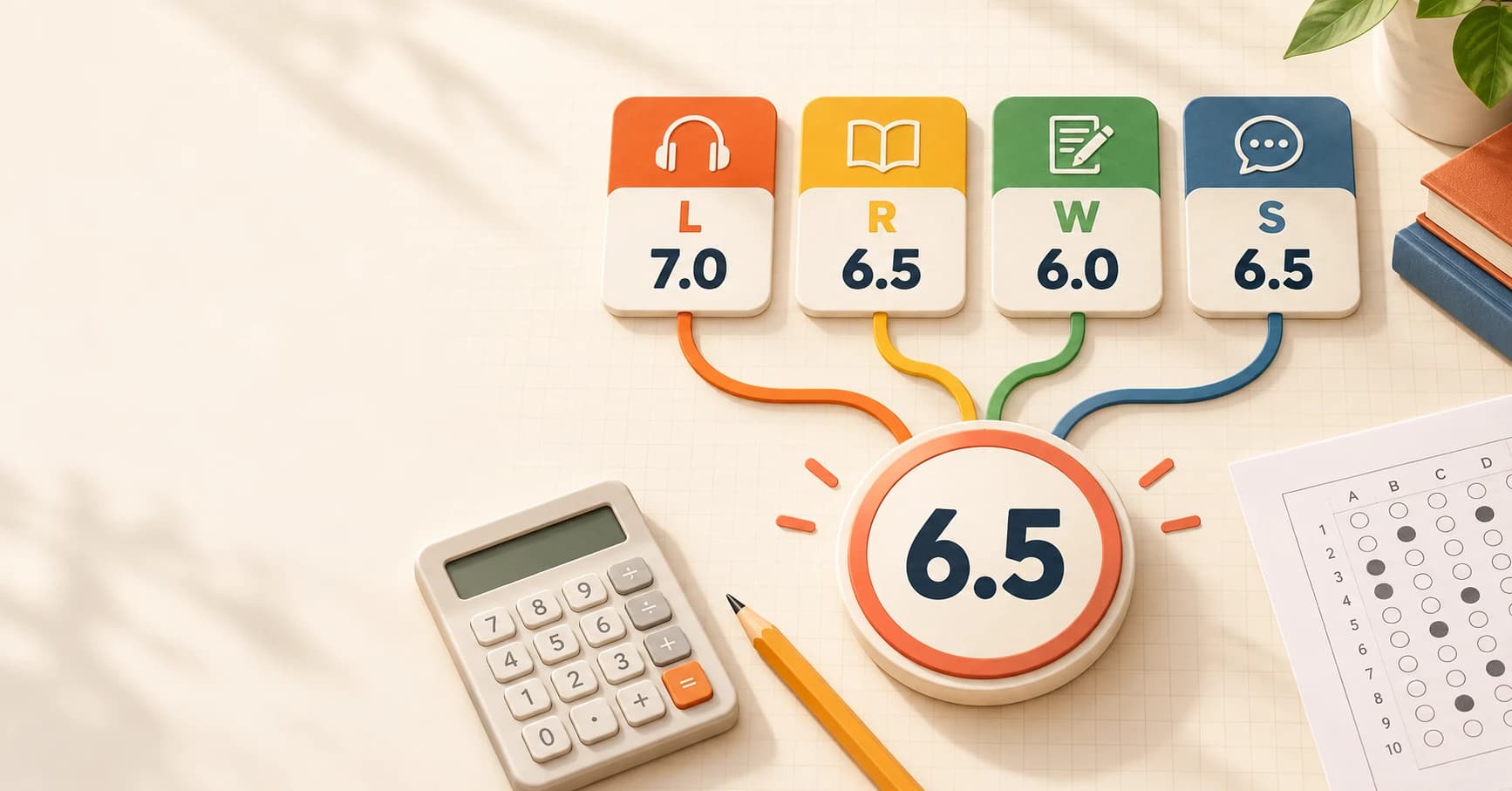
Each of the four IELTS skills is scored 0–9, and the Overall Band is the average rounded to the nearest half band (.25 rounds up to .5, .75 rounds up to the next whole band). This guide covers what each band means, official rounding examples, Listening and Reading raw score conversions, the four Writing and Speaking criteria, and how to turn a target score into a study plan.
Quick answer: how is IELTS scored?
When you get your IELTS results, or a school asks for “Overall 6.5, no band below 6.0”, the first question is usually: where does this score come from, and how far am I from it? This guide breaks down IELTS scoring using the official rules, then shows how to turn your target score into a study plan. If you are not yet familiar with the test itself, start with IELTS test format and question types.
- Listening, Reading, Writing and Speaking are each scored from 0 to 9 (Band), in 0.5 steps.
- Overall Band = the average of the four skills, rounded to the nearest half band: an average ending in .25 rounds up to .5, and .75 rounds up to the next whole band.
- Listening and Reading have 40 questions each, and your number of correct answers is converted to a band; Writing and Speaking are scored by examiners against four criteria.
- IELTS recommends that results are valid for 2 years from the test date.
What does each IELTS band from 0 to 9 mean?
Short answer: the higher the band, the more accurately and flexibly you can use English in real situations; Band 6 is “competent” and Band 7 is “good”. The official band descriptors are as follows (the last column is our plain-English summary):
| Band | Official name | In plain terms |
|---|---|---|
| 9 | Expert user | Expert |
| 8 | Very good user | Very good |
| 7 | Good user | Good |
| 6 | Competent user | Competent |
| 5 | Modest user | Modest but usable |
| 4 | Limited user | Limited |
| 3 | Extremely limited user | Extremely limited |
| 2 | Intermittent user | Intermittent |
| 1 | Non-user | Cannot use the language |
| 0 | Did not attempt the test | Did not attempt |
How it relates to the CEFR: IELTS says the two scales do not map one-to-one. What can be confirmed is that 8.5 and above is regarded as C2, and the C1 threshold falls between 6.5 and 7. For other levels, refer to the official comparison chart rather than relying on unofficial conversion tables.
How is the IELTS Overall Band calculated? Rounding rules explained
Short answer: add up your four skill scores, divide by 4, then round to the nearest 0.5. These three examples come from IELTS:
| Listening | Reading | Writing | Speaking | Average | Overall |
|---|---|---|---|---|---|
| 6.5 | 6.5 | 5.0 | 7.0 | 6.25 | 6.5 |
| 4.0 | 3.5 | 4.0 | 4.0 | 3.875 | 4.0 |
| 6.5 | 6.5 | 5.5 | 6.0 | 6.125 | 6.0 |
Our take: the first example is worth noting — Writing is only 5.0, yet the Overall Band is still 6.5. But many schools also set a minimum score for each skill, so if you meet the overall requirement but miss a skill minimum, you still don't qualify.
How many correct answers do you need in Listening and Reading?
Short answer: each Listening and Reading question is worth 1 mark, out of 40, and the raw score is converted to a band. The table below shows the official IELTS figures for the average number of correct answers needed for each band. IELTS only publishes these bands; scores outside the table (such as 6.5, 7.5 or 9) are not published, so we have not filled them in.
| Band | Listening | Academic Reading | General Training Reading |
|---|---|---|---|
| 8 | 35 | 35 | — |
| 7 | 30 | 30 | 35 |
| 6 | 23 | 23 | 30 |
| 5 | 16 | 15 | 23 |
| 4 | — | — | 15 |
Two key points:
- General Training (GT) Reading needs more correct answers for the same band, because the texts are easier.
- These are average figures; the conversion is adjusted slightly for each test depending on difficulty. When assessing yourself before the test, it is safer to allow a buffer of one or two extra questions.
Once you know your raw score and want to push it higher, read tips for IELTS Reading Band 7 next.
How are Writing and Speaking scored?
Short answer: both are assessed against four criteria of equal weight, and the average becomes your score for that skill.
| Skill | Four assessment criteria |
|---|---|
| Writing | Task Achievement (Task 1) / Task Response (Task 2), Coherence and Cohesion, Lexical Resource, Grammatical Range and Accuracy |
| Speaking | Fluency and Coherence, Lexical Resource, Grammatical Range and Accuracy, Pronunciation |
One point about Writing that is often overlooked: IELTS states that Task 2 carries more weight than Task 1. So when managing your time in the test, don't let Task 1 eat into your Task 2 time. For sentence patterns you can use for each task type, see IELTS writing templates and sample essays.
In Speaking, the difference often comes down to whether you fully develop your answer. Compare these two:
- More basic: In my opinion, public transport should be free.
A clear opinion, but with no reason or development. - More developed: I'd argue that making public transport free would ease traffic congestion, although it would put pressure on government budgets.
Gives a position, a reason and a concession in one sentence.
The second sentence has a position, a reason and a concession, while showing a range of vocabulary and grammar — exactly what Lexical Resource and Grammatical Range assess. For more practice ideas, see how to practise the four IELTS Speaking criteria.
Putting it into practice: turn your target score into a study plan
Say your target is Overall 6.5, with no band below 6.0:
- Work out acceptable combinations first: for example, Listening 7.0, Reading 6.5, Writing 6.0 and Speaking 6.5 average 6.5, which meets the target.
- Identify your most reliable skills: most Taiwanese test-takers find it easier to raise Listening and Reading first, so aim to consistently get 30 or more Listening questions right (about Band 7).
- Protect the minimum in your weakest skill: if Writing is stuck at 5.5, you may be blocked by the skill minimum even when your overall score is high enough, so make it a priority.
When confirming requirements with a school or agency, you can write:
- I need an overall band score of 6.5, with no individual band below 6.0.
Use this to state your target clearly. - Could you confirm whether you accept IELTS results that are more than two years old?
Use this to check the institution's validity policy. - My overall score is 6.5, but my writing score is 5.5. Am I still eligible?
Use this when one skill falls below the minimum.
Common mistakes and how to fix them
| Common mistake | How to fix it |
|---|---|
| Thinking the Overall Band is the total of the four skills, or that it is always rounded down | Remember: average, then round to the nearest half band — .25 and .75 both round up |
| Looking only at the overall score and ignoring skill minimums | Check your target school's minimum for each skill before booking, and prioritise your weakest skill |
| Using the Academic conversion table to estimate General Training Reading | The two conversions differ; GT needs more correct answers for the same band |
| Spending most of the Writing time on Task 1 | Task 2 carries more weight, so plan your time around Task 2 |
| Waiting too long to apply after the test | Most organisations follow a 2-year rule, so factor this into your application timeline |
Results information for test-takers in Taiwan
- In Taiwan, IELTS has been offered on computer only since February 2026, and results are issued as an electronic Test Report Form (eTRF).
- Results release: IDP Taiwan states that computer-delivered results are released within 1 to 3 working days after the test; always check the official information from the organisation you booked with.
- If you have doubts about your result, you can apply for an Enquiry on Results (EOR): IDP Taiwan lists the fee as NT$4,100 (regardless of how many skills are remarked), and you must apply within 6 weeks of the test date. If you booked with the British Council, follow British Council Taiwan's announcements (checked 2026/10/31; fees and rules may change).
- If you want to retake a single skill, see IELTS on computer and One Skill Retake.
Want to raise your IELTS score more efficiently?
Once you understand how scoring works, the next step is finding which skill — and which criterion — is most worth investing in. Ambitious Learner's online one-to-one IELTS course starts with a personalised study plan based on your target score and current level, and works through the Writing and Speaking criteria one by one.
Sources
- IELTS | IELTS scoring in detail (band descriptors, overall rounding, Listening/Reading raw scores, Writing/Speaking criteria)
- IELTS | Your results (result validity)
- British Council | IELTS scores explained
- IELTS | IELTS and the CEFR
- IDP Taiwan | Computer-delivered IELTS (results release times)
- IDP Taiwan | Enquiry on Results (fee and application deadline)
- British Council Taiwan | IELTS results
The scoring rules in this article are based on publicly available official IELTS information; for test fees, EOR fees and results release times, refer to the latest announcements from the organisation you booked with.
FREQUENTLY ASKED QUESTIONS
FAQ
Q01What is a good IELTS score?+
There is no single answer; it depends on what you need it for. On the official scale, Band 6 is a Competent user and Band 7 is a Good user. For university or visa applications, go by the overall and per-skill requirements the institution publishes.
Q02What level is IELTS 6.5?+
It sits between competent and good. IELTS states that the threshold for CEFR C1 falls between 6.5 and 7, but the two scales do not map one-to-one.
Q03What does an IELTS average of 6.25 round to?+
6.5. Under the official rule, an average ending in .25 rounds up to the next half band, and .75 rounds up to the next whole band.
Q04How long are IELTS results valid?+
IELTS recommends a validity period of 2 years from the test date; individual organisations may decide whether to accept older results.
Q05What band is 30 correct answers in IELTS Listening?+
Based on the official IELTS average figures, about 30 correct answers in Listening corresponds to Band 7; the conversion is adjusted slightly for each test depending on difficulty.


