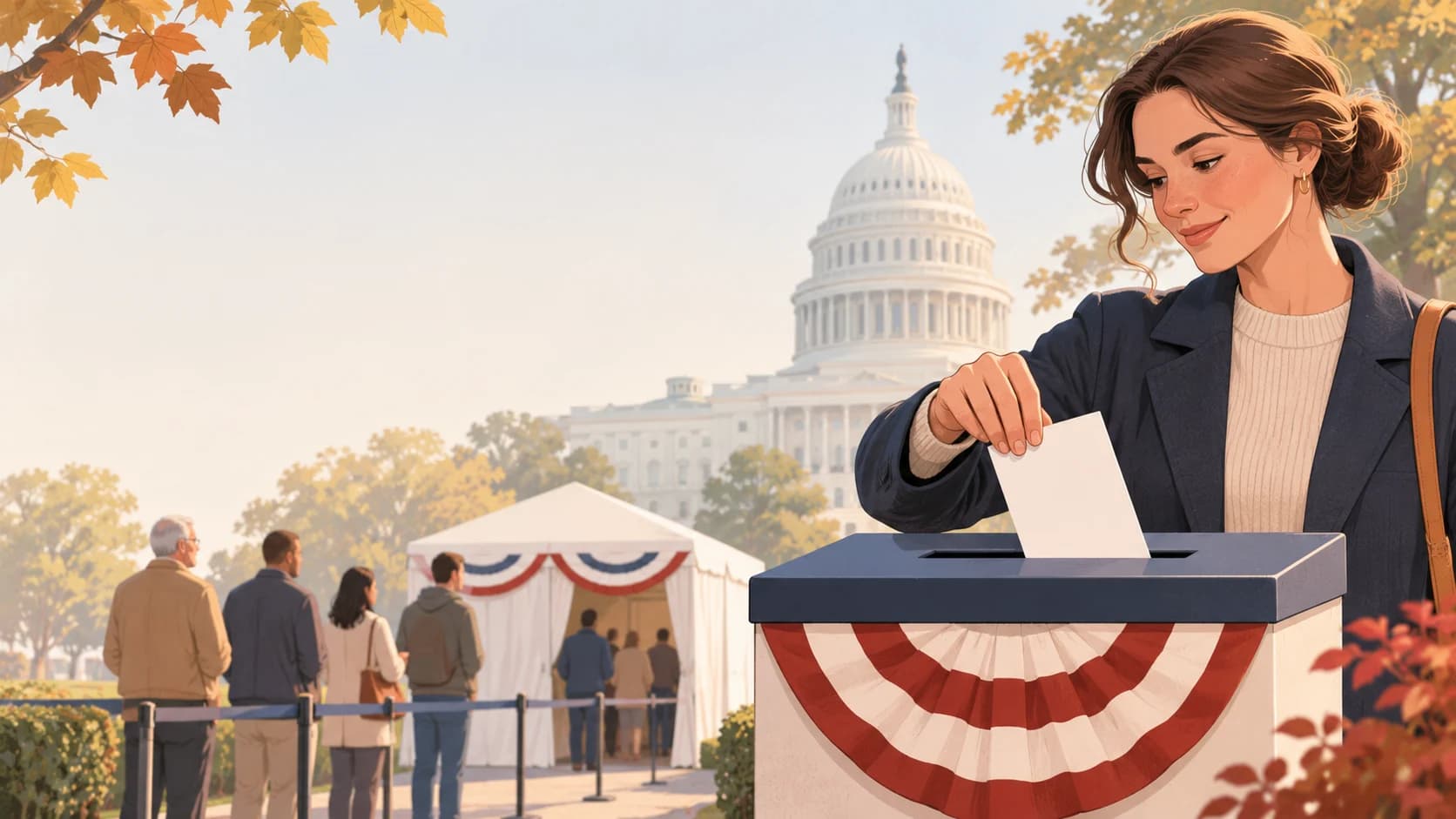
The US holds its midterm elections on 3 November 2026: all 435 House seats are up for election (218 for a majority), 35 Senate seats (including 2 special elections) and 36 governors. More than 53 million people voted early before Election Day. This lesson uses an original English passage and a plain-English summary to teach 12 election words and phrases such as midterm, on the ballot, up for election and cast a ballot, plus vote / ballot / poll compared, 3 sentence patterns, a dialogue and a 4-question quiz.
The 2026 US midterm elections: understand the election vocabulary first
News date: 3 November 2026 (US local time) | English level: B1–B2 | Topics: international news, election vocabulary
If you follow international news, you have probably seen the word "midterms" everywhere. Voting in the US takes place on Tuesday, 3 November. These US midterm elections decide which party will hold a majority in each chamber of Congress for the next two years, which is why they are such a common topic in the news.
When you read election news in English, the hardest part is often not difficult words but election-specific terms such as ballot, up for election and special election. This article uses a short, simple English passage to explain what is being decided in this election, and clears up the meaning of midterm and the different ways to say "vote" in English. It only explains the election system and the English used to describe it; it does not comment on any party or candidate.
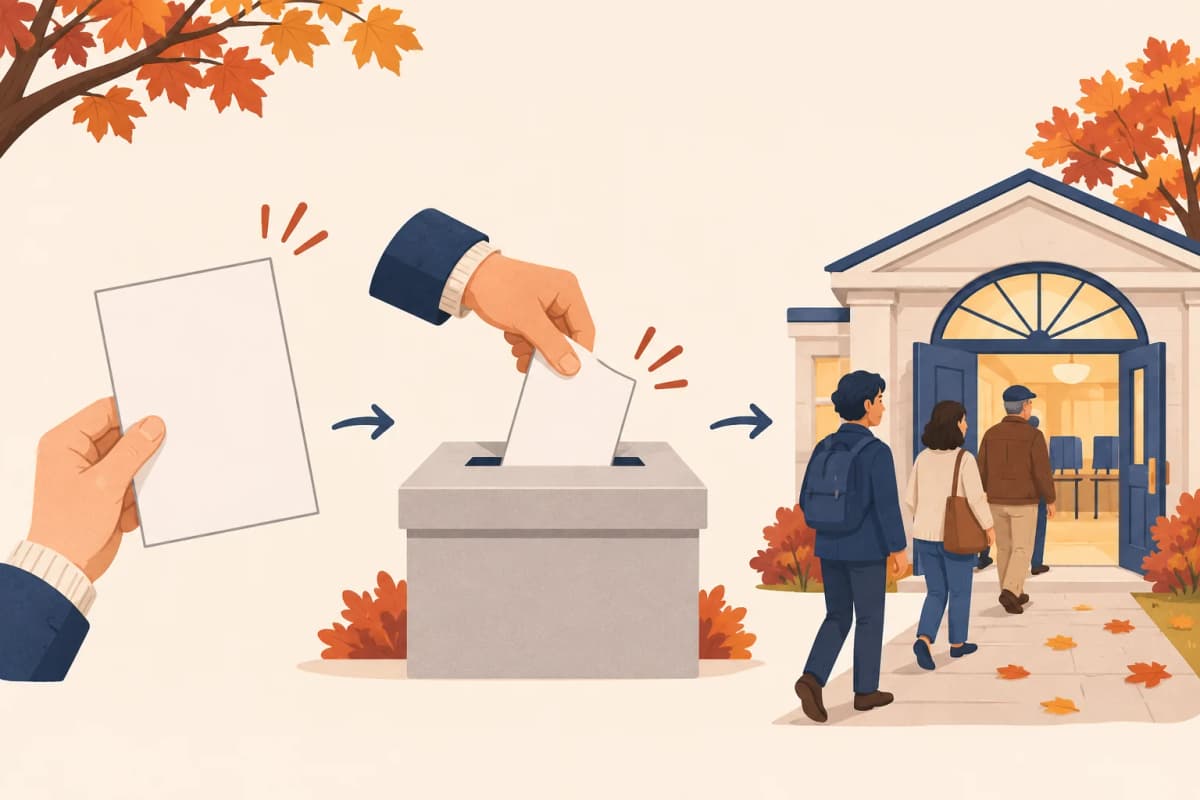
Before you read: what is being decided in the 2026 midterms?
The US Congress has two parts: the House of Representatives and the Senate. Members of the House serve two-year terms, so all 435 seats are up for election every two years. Senators serve six-year terms and are elected in groups, with roughly one third up for election every two years. The president serves a four-year term, so the congressional elections held in the middle of that term are called midterm elections. Midterms often include elections for governors, state legislatures and local offices too, but what is on the ballot differs from state to state.
When you read about "control" of Congress, it means whether a party holds a majority of seats in a chamber. With 435 seats in the House, a party needs at least 218 for a majority. With this background, phrases like control of Congress and both chambers become much easier to follow.
| Item | 2026 midterm elections |
|---|---|
| Election day | 3 Nov 2026 (Tuesday), US local time |
| House of Representatives | All 435 seats up for election; 218 needed for a majority |
| Senate | 35 of 100 seats up for election (including 2 special elections, in Florida and Ohio) |
| Governors | Elections in 36 states |
| Before the vote | Republicans hold majorities in both the House and the Senate |
| New Congress begins | 3 Jan 2027 |
Note: This article was written with information available before voting on 3 November 2026 and does not include any results. When you read live coverage, check when it was published and which time zone it uses.
Reading passage
Try reading the passage once without the summary and look for three key points: which seats are up for election? How many people voted before Election Day? When do the first polls close? Then compare with the plain-English summary in the next section.
English Level: Intermediate (B1–B2) | Topic: Politics, Elections
Americans Head to the Polls in the 2026 Midterm Elections
On Tuesday, 3 November 2026, voters across the United States are taking part in the midterm elections. They are called "midterms" because they take place in the middle of a president's four-year term. The president is not on the ballot this time, but control of Congress is.
All 435 seats in the House of Representatives are up for election, and a party needs 218 seats to win a majority. In the Senate, 35 of the 100 seats are being contested, including two special elections. Voters in 36 states will also choose their governors. Going into the vote, Republicans hold a majority in both chambers.
Many people did not wait for Election Day. According to an analysis by the University of Florida, more than 53 million Americans had already cast their ballots by mail or in person by 1 November. In the 2022 midterms, about 46 million people voted early.
The first polls close at 6 p.m. Eastern Time, which is 7 a.m. on 4 November in Taiwan. Some close races may take days to count, so final results could come later. The new Congress is scheduled to begin its term on 3 January 2027.
The English passage above is an original learning text written using information reported by Al Jazeera and other sources. It is not a word-for-word copy of any news article.
Plain-English summary
On Tuesday, 3 November 2026, people all over the US are voting in the midterm elections. They are called "midterms" because they happen halfway through a president's four-year term. The president is not running this time, but the vote will decide which party controls Congress.
Every one of the 435 seats in the House of Representatives is being voted on, and a party needs 218 seats to have more than half. In the Senate, 35 of the 100 seats are being fought over, and two of these are special elections. People in 36 states will also pick their governors. Before the election, Republicans have more seats than any other party in both the House and the Senate.
Lots of people voted before Election Day. A University of Florida analysis found that more than 53 million Americans had already voted, by post or in person, by 1 November. In the 2022 midterms, about 46 million people voted early.
The first polling stations close at 6 p.m. Eastern Time (23:00 GMT on 3 November). Counting the votes in some very close contests could take several days, so the final results may come later. The new Congress is due to start work on 3 January 2027.
Three key sentences to understand first
- The president is not on the ballot this time, but control of Congress is.
on the ballot literally means "listed on the voting paper". The point of this sentence is that the election will decide control of Congress; it does not mean the president is running. - All 435 seats ... are up for election.
In political news, a seat is a position in a lawmaking body. up for election means the seat is being voted on this time; it does not mean someone has already won it. - Some close races may take days to count.
A race is an election contest, and close means the gap between candidates is small. may shows possibility; it does not say that every contest will be delayed.
12 must-know election words and phrases
1. midterm election (n.) an election held in the middle of a president's term
In the news: voters … are taking part in the midterm elections
Example: My American coworker took a day off to vote in the midterm election.
(My American colleague took a day off work to vote.)
Note: On its own, midterm can also mean a mid-semester exam, as in I have a midterm tomorrow.
2. term (n.) the fixed period someone holds an office
In the news: in the middle of a president's four-year term
Example: Our club president's term ends in June.
(Our club president's time in the role finishes in June.)
3. on the ballot (phr.) listed on the voting paper; standing for election
In the news: The president is not on the ballot this time.
Example: There are five candidates on the ballot for city mayor.
(Voters can choose between five people for mayor.)
4. be up for election (phr.) to be voted on in this election
In the news: All 435 seats … are up for election.
Example: Half of the student council seats are up for election this semester.
(Students will vote for half of the council this semester.)
5. majority (n.) more than half
In the news: a party needs 218 seats to win a majority
Example: The majority of our team prefers online meetings on Fridays.
(Most people on our team like online meetings on Fridays.)
6. contest (v.) to compete for something
In the news: 35 of the 100 seats are being contested
Example: Three companies are contesting the contract for the new MRT line.
(Three companies are competing to win the contract for the new metro line.)
7. special election (n.) an election held outside the normal schedule to fill an empty seat
In the news: including two special elections
Example: A special election was held after the councilor moved to another city.
(An extra election filled the seat after the councilor left.)
8. chamber (n.) one of the two parts of a parliament or congress
In the news: Republicans hold a majority in both chambers
Example: The US Congress has two chambers: the House and the Senate.
(Congress is made up of two separate bodies.)
9. cast a ballot (phr.) to vote
In the news: more than 53 million Americans had already cast their ballots
Example: Many young people go back to their hometowns to cast their ballots.
(Many young people travel home to vote.)
10. head to the polls (phr.) to go and vote
In the news: Americans Head to the Polls (headline); see also The first polls close at 6 p.m. (here polls means polling stations)
Example: Voters headed to the polls early in the morning before work.
(People went to vote early, before starting work.)
Note: poll can also mean an opinion survey, so check the context.
11. close race (n.) an election contest where the result is very tight
In the news: Some close races may take days to count
Example: The class election was a close race, decided by just two votes.
(Only two votes separated the winner from the runner-up.)
12. be sworn in (phr.) to officially start a job by making a formal promise
In the news: News reports often use be sworn in when newly elected officials take office; our passage uses begin its term instead.
Example: The new mayor will be sworn in next month.
(The new mayor will officially take office next month.)
Easily confused election words: vote, ballot, poll
| Word | Common meaning | Example |
|---|---|---|
| vote | verb: to choose in an election; noun: a choice made in an election | Many people voted early. |
| ballot | the paper or form used to vote | She cast her ballot by mail. |
| the polls | in head to the polls: the places where people vote, or the act of voting | Voters headed to the polls. |
| poll | an opinion survey | A recent poll asked voters about the economy. |
| count / recount | counting votes / counting them again | Officials are still counting ballots. |
Collocation tip: You can say cast a ballot or cast a vote; vote for a candidate means to choose that person. A ballot measure is a proposal that voters decide on directly, so on the ballot does not only refer to candidates.
Sentence patterns: 3 structures for reading the news
Pattern 1: S + be called + name + because… (explaining where a name comes from)
From the passage: They are called "midterms" because they take place in the middle of a president's four-year term.
Key point: Use the passive be called to introduce a name, then because to explain its origin. It is a handy pattern for explaining your own culture in English.
Try it: It is called "bubble tea" because of the bubbles on top when it is shaken.
(The drink gets its name from the foam that forms when it is shaken.)
Pattern 2: A is not …, but B is. (contrasting two things)
From the passage: The president is not on the ballot this time, but control of Congress is.
Key point: The second half drops the repeated words on the ballot and keeps only is, which makes the sentence short and punchy.
Try it: The price is not the problem, but the delivery time is.
(The issue is how long delivery takes, not the cost.)
Pattern 3: S + had already + past participle + by + time (something finished before a point in the past)
From the passage: More than 53 million Americans had already cast their ballots … by 1 November.
Key point: The past perfect with by stresses that something was completed before a certain point in the past.
Try it: I had already finished the report by the time my manager asked for it.
(The report was done before my manager asked.)
Dialogue practice: chatting with a colleague about the US midterms
English Conversation
- Grace: Did you see the news? The US midterm election is today.
- Kevin: Yes. My American client said she already cast her ballot by mail.
- Grace: Wow, early. What exactly is up for election?
- Kevin: All the seats in the House, about a third of the Senate, and many governors.
- Grace: So the president isn't on the ballot?
- Kevin: Right. That's why it's called a midterm — it's in the middle of his term.
- Grace: When will we know the results?
- Kevin: The first polls close around 7 a.m. our time, but close races may take longer.
What they mean
- Grace: Have you heard? The US midterm election is happening today.
- Kevin: Yes. My American client told me she had already voted by post.
- Grace: That's early! So what is actually being voted on?
- Kevin: Every seat in the House, around a third of the Senate, and a lot of governors.
- Grace: So the president isn't running?
- Kevin: Correct. That's why it's called a midterm: it falls halfway through his term.
- Grace: When will we find out the results?
- Kevin: The first polling stations close at about 7 a.m. Taiwan time (6 p.m. Eastern), but tight contests could take longer.
Try reading an election news flash on your own
Early voting has ended in several states, but voters can still cast their ballots on Election Day. Officials say some close races may not be decided tonight.
Reading it clause by clause:
- Early voting has ended in several states: in some states, the period for voting early is over. has ended describes the situation up to now.
- but voters can still cast their ballots on Election Day: people can still vote on the main voting day. cast their ballots means much the same as vote.
- some close races may not be decided tonight: the winners of some tight contests might not be known tonight. may not means "might not"; it is not a confirmed outcome.
Try it: Cover the notes above and rewrite the whole passage in your own words. Then find two ways of saying "vote" and one word that shows uncertainty.
Quiz: can you use on the ballot and cast a ballot?
Try not to look back at the article. Choose your answer and confirm it to see the explanation.
Understand the news, then talk about it
Understanding international news and keeping up when colleagues from other countries talk about current events takes more than memorising vocabulary. It helps to have someone who reads the news with you and helps you say it out loud.
Ambitious Learner's one-to-one online English lessons can include news reading and discussion practice matched to your level and goals. If you are planning to study in the Philippines or a working holiday in Australia, you are also welcome to tell us about your plans through our LINE account.
Further reading
- France's Protests Turn Violent: learn riot, protest and loot.
- BBC News Channel Goes Live on YouTube: learn livestream, trial and impartial.
- UK HPI visa 2026 university list: learn eligible, qualification and switch to.
Sources
- USA.gov: Congressional elections and midterm elections | How midterms and congressional elections work
- US House of Representatives: The House Explained | The 435 seats and how the House works
- US Senate: Class II senators | How Senate seats are elected in groups
- NCSL: 2026 Elections Put Statehouses, Ballot Measures in the Spotlight | Governor elections in 36 states
- Al Jazeera: US midterms 2026: All you need to know in maps and charts | 26 Oct 2026
- Al Jazeera: More than 50 million votes cast in US midterm elections | 1 Nov 2026 (citing a University of Florida analysis)
Facts checked on 3 Nov 2026. This article is a pre-vote explainer and does not include any results. The English reading passage, example sentences, dialogue and quiz are original teaching content created by Ambitious Learner and are not word-for-word copies of any news article.
FREQUENTLY ASKED QUESTIONS
FAQ
Q01What are the US midterm elections, and why are they called midterms?+
A US president serves a four-year term, and the congressional and local elections held in the middle of that term are called midterm elections. The president is not up for election, but all House seats, about one third of Senate seats and many governors are elected at the same time.
Q02What are the different ways to say vote in English?+
The most common word is vote. News reports also often use cast a ballot and head to the polls (go and vote). Voting before Election Day is early voting, and voting by post is mail-in voting or vote by mail.
Q03What time do polls close in the US midterm elections?+
According to media reports, the first polls close at 6 p.m. Eastern Time on 3 November, which is 23:00 GMT. Counting then begins state by state. Because the US spans several time zones, full results may take longer.
Q04What is the difference between a midterm election and a presidential election?+
A presidential election chooses the president. A midterm election happens in the middle of the president's four-year term, and the presidency itself is not on the ballot in this regular election. Congressional and local elections can take place at the same time as either one.
Q05Is on the ballot only used for candidates?+
No. Candidates, offices and proposals that voters decide on can all be on the ballot. When reading the news, you can ask: What is on the ballot in this state?
Q06How do you say a result is not yet known in English?+
You can say The race has not been called yet, or Ballots are still being counted. To call a race means the media declares a winner based on available information; it is not the same as an officially certified result.