On 17 October 2026, about 550,000 people (official estimate) took to the streets across France to protest against the rising cost of living. In some cities the day ended in looting and arson, and by 19 October nearly 2,400 people had been arrested. Using an original news English story, an audio recording and a plain-English version, this article covers 12 news words and phrases such as protest, riot, loot, unrest and address the nation, with a comparison of easily confused words, 3 sentence patterns, a look at news headlines, a dialogue and a 5-question quiz.
Learn Protest, Riot, Loot and Unrest from the France Protests
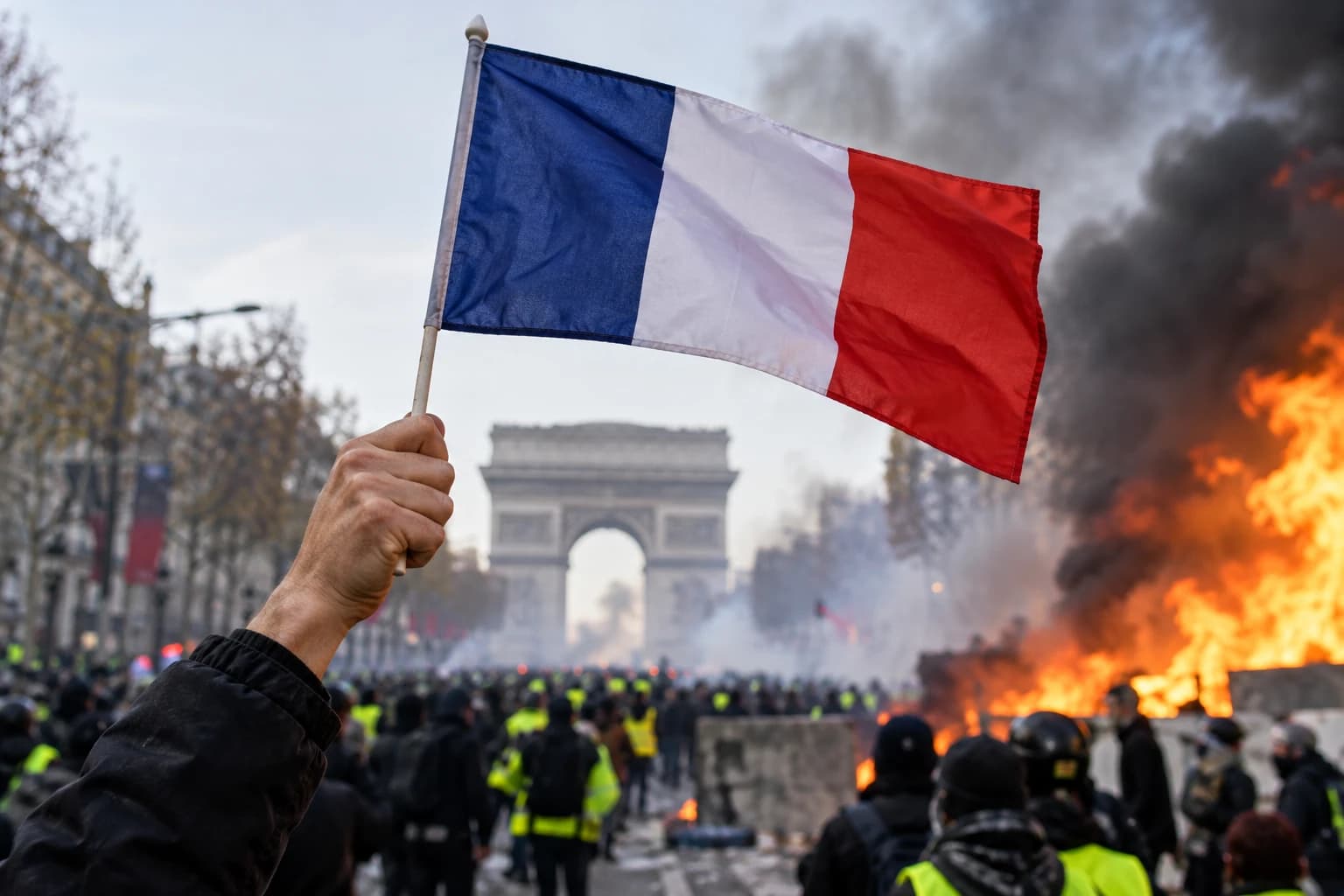
Prices keep rising but pay doesn't — a feeling many workers share. On Saturday, 17 October 2026, hundreds of thousands of people took to the streets across France to protest against the rising cost of living, and many secondary school and university students joined them, calling for better learning conditions. But by the evening, marches in some cities had turned into riots: shops were looted and public buildings were set on fire. By 19 October, nearly 2,400 people had been arrested nationwide, and the Interior Ministry said about 1,000 police officers and gendarmes had been injured. On the evening of the 18th, President Macron addressed the nation on television, saying that everyone felt "anger and shame" (Al Jazeera report).
This story has been making international headlines for days, and it is great material for learning news English. Words such as protest, riot, loot, unrest and arrest come up again and again in the reports. These words — especially the riot vs protest distinction — are very common in international news. Once you understand them, BBC and CNN reports on social issues become much easier to follow.
We start with an original rewritten English news story to give you the key facts, then cover 12 key words, a comparison of easily confused words, 3 news sentence patterns, a look at news headlines, a travel dialogue and a quiz. If you're planning a trip or a study trip to Europe soon, you'll also learn how to talk about travel safety in English.
News Background: What Happened?
- When: The main protests took place on Saturday, 17 October 2026; President Macron gave a televised address to the nation on the evening of Sunday, 18 October.
- Why: People were angry about the rising cost of living, and their demands also included fuel prices and low wages. Before this, France had already seen weeks of student protests calling for better learning conditions. DW (AFP, dpa) also reported calls online to revive the "yellow vests" movement, which began in 2018 over a rise in fuel taxes.
- Turnout: The Interior Ministry estimated about 550,000 people nationwide (about 110,000 in Paris); the CGT union put the figure at about 800,000.
- Arrests and injuries: Nearly 2,400 people were arrested nationwide, including 855 by Paris police, which the police called a record; the Interior Ministry said about 1,000 police officers and gendarmes were injured.
- Damage: The Interior Minister said hundreds of shops were looted in cities such as Paris, Marseille, Lyon and Bordeaux; in Limoges, a 19th-century town hall was deliberately set on fire and its roof collapsed.
- The government's view: Officials blamed some of the violence on radical far-left groups and on people who looted amid the chaos.
- What next: Macron drew a distinction between protesters with legitimate concerns and those who smashed and looted, said looters must pay for the damage, and promised full transparency over how the police acted. France holds a presidential election next spring (2027), and the events have become a major political issue.
Figures are based on AP, AFP, DW and Al Jazeera reports as of 19 October 2026. The story is still developing, and figures may be updated.
News English Story: Cost-of-Living Protests Turn Violent in France
We suggest listening once first with the player at the top of the article, without reading the text, and trying to catch three key points: Why did people take to the streets? In which cities was there looting? How did President Macron respond? Then read the English story below (an original rewrite based on AP, AFP and other wire reports).
Hundreds of thousands of people marched across France on Saturday, October 17, to protest against the rising cost of living. Many school and university students also joined, calling for better learning conditions. Authorities estimated that about 550,000 people took part, while organisers put the number at around 800,000.
Most of the marches were peaceful, but the day ended in chaos in several cities. Masked groups set fires, attacked public buildings and looted hundreds of shops in cities such as Paris, Marseille, Lyon and Bordeaux. In Limoges, a 19th-century town hall was largely destroyed by a fire that officials said was started on purpose.
By October 19, nearly 2,400 people had been arrested nationwide, and the Interior Ministry said about 1,000 police officers and gendarmes were injured. Officials blamed radical far-left groups and opportunistic looters for some of the violence.
On Sunday evening, President Emmanuel Macron addressed the nation on television. He drew a line between protesters with real concerns and those who destroyed property, and he promised that looters would pay for the damage. With a presidential election coming next spring, the unrest has become a major political issue in France.
The Story in Plain English
On Saturday, 17 October, hundreds of thousands of people marched through towns and cities all over France. They were unhappy that everyday things keep getting more expensive. Many school and university students joined them and asked for better conditions for learning. The government said about 550,000 people took part; the groups that planned the marches said it was about 800,000.
Most people marched peacefully, but in several cities things got out of control by the end of the day. Groups of people with their faces covered started fires, attacked public buildings and stole from hundreds of shops in cities like Paris, Marseille, Lyon and Bordeaux. In Limoges, a town hall built in the 1800s was almost completely destroyed by a fire. Officials said someone started it deliberately.
By 19 October, police had arrested nearly 2,400 people across the country. The Interior Ministry said about 1,000 police officers and gendarmes had been hurt. Officials said some of the violence was caused by extreme left-wing groups and by people who took the chance to steal.
On Sunday evening, President Emmanuel Macron spoke to the whole country on TV. He said that people with real problems were different from people who damaged property, and he promised that those who stole from shops would pay for the damage. France has a presidential election next spring, so the trouble has become a big political issue.
Key Words and Phrases
| Word / phrase | Part of speech | Meaning | In the news | Everyday example |
|---|---|---|---|---|
| protest against / protest | phr. v. / n. | to show publicly that you object to something; an event where people do this | … to protest against the rising cost of living | Many parents protested against the new school bus fees. |
| cost of living | n. phr. | the amount of money people need for basics such as food, housing and transport | … the rising cost of living | The cost of living in Taipei is much higher than in Tainan. |
| take part (in) | phr. v. | to join in an activity or event | … about 550,000 people took part | Over 300 employees took part in our company's charity run. |
| chaos | n. | a state of complete confusion and disorder | … the day ended in chaos in several cities | The MRT station was in chaos after the concert ended. |
| loot / looter | v. / n. | to steal from shops or buildings during a riot, war or disaster; a person who does this | … looted hundreds of shops / opportunistic looters | Police are still looking for the people who looted the electronics store. |
| on purpose | phr. | deliberately, not by accident | … a fire that officials said was started on purpose | Sorry, I didn't delete your file on purpose. |
| arrest | v./n. | (of the police) to take someone away because they may have broken the law; the act of doing this | … nearly 2,400 people had been arrested nationwide | The man was arrested for drunk driving last night. |
| nationwide | adv./adj. | across the whole country; happening across the whole country | … had been arrested nationwide | The new invoice lottery app is now available nationwide. |
| blame A for B | phr. | to say that A is responsible for B (something bad) | Officials blamed radical far-left groups and opportunistic looters for some of the violence. | Don't blame the intern for the mistake. It was my fault. |
| address the nation | phr. | to give an official speech to the whole country | President Emmanuel Macron addressed the nation on television. | The president will address the nation on New Year's Day. |
| draw a line between A and B | phr. | to treat A and B as clearly different; to keep them separate | He drew a line between protesters with real concerns and those who destroyed property … | It's important to draw a line between work and personal life. |
| unrest | n. (uncountable) | a period of anger, protest or disorder in a society | … the unrest has become a major political issue | Some travellers changed their plans because of the unrest in the city. |
Easily Confused Words: protest, demonstration, rally, riot, unrest
| Word | Meaning and nuance | Example |
|---|---|---|
| protest | The broadest word for showing opposition: it can be a march, a sit-in or a petition, and it does not suggest violence in itself | a peaceful protest |
| demonstration | A crowd gathering or marching in public to make its demands known; more formal and common in the news | a student demonstration |
| rally | A gathering, often to support a person or cause, such as a campaign event | an election rally |
| riot | Violent behaviour by a crowd, with damage, arson or clashes | The protest turned into a riot. |
| unrest | Social disorder or tension over a period of time; a more general word, often seen in headlines | political unrest |
Tip: news reports carefully distinguish between protesters and rioters / looters, and this story is a good example: most people protested peacefully, and only some turned to violence. Choose your words carefully and don't call everyone who took part a rioter.
Sentence Patterns
1. A estimated that…, while B put the number at…
- Original: Authorities estimated that about 550,000 people took part, while organisers put the number at around 800,000.
- Explanation: here while means "whereas" and contrasts two different claims; put the number at… is a natural way to say "estimate the number to be…".
- Try it: The company estimated that 2,000 people visited the booth, while the organiser put the number at 3,500.
2. Most of the + plural noun + verb…, but…
- Original: Most of the marches were peaceful, but the day ended in chaos in several cities.
- Explanation: first say what happened in most cases, then use but to point out the exception — a common way for news reports to stay balanced.
- Try it: Most of the feedback was positive, but a few customers complained about the delivery time.
3. With + noun + V-ing, main clause
- Original: With a presidential election coming next spring, the unrest has become a major political issue in France.
- Explanation: With + noun + present participle means "because / as something is happening" and sets the background for the main clause.
- Try it: With the TOEIC test coming next month, I'm practising listening every morning.
Reading English News Headlines
International news headlines often leave out the verb be and articles, and use the present simple for things that have already happened. Here are some typical headlines from this story:
- Protests turn violent in France: turn + adjective = "become…". The headline uses the present tense turn, even though the event has already happened.
- Riots and looting lead to 1,800 arrests: lead to = "cause". (1,800 was an early figure from 18 October; it was later updated to nearly 2,400.)
- Macron to address nation: to + base verb = "is going to…", so this means Macron is going to address the nation.
Learn these three rules and you'll read English news headlines much faster.
Dialogue Practice
Scenario: After work, Vivian and her colleague Leo talk about a trip to Paris next month.
- Vivian: Did you see the news? There was a lot of unrest in France this weekend.
- Leo: Yes. People were protesting against the cost of living, but some shops were looted.
- Vivian: I'm flying to Paris next month. Do you think it's still safe?
- Leo: Most of the marches were peaceful, but I'd check the travel advisory before you go.
- Vivian: Good idea. I'll also avoid big crowds and keep my plans flexible.
- Leo: And buy travel insurance, just in case there's chaos at the airport.
- Vivian: Right. I heard the president addressed the nation on Sunday.
- Leo: He did. Let's see what happens before your trip.
(In plain English)
- Vivian: Have you seen the news? Things in France were very tense this weekend.
- Leo: Yes. People were marching because everyday life is getting so expensive, but some shops were broken into and robbed.
- Vivian: I'm going to Paris next month. Do you think it's safe to go?
- Leo: Most people marched peacefully, but it's a good idea to read the official travel warnings before you leave.
- Vivian: Good idea. I'll also stay away from big crowds and keep my plans easy to change.
- Leo: And get travel insurance, in case things go wrong at the airport.
- Vivian: True. I heard the president gave a speech to the whole country on Sunday.
- Leo: Yes, he did. Let's wait and see how things develop before you go.
Quiz
Once you've read the story and the vocabulary, try the 5 questions below. Choose an answer and confirm it to see the explanation.
Can You Understand the News but Struggle to Give Your Own Views in English?
Understanding the news is only the first step. Being able to say it in your own words is how you really learn.
Book a 20-minute one-to-one trial English lesson via our official LINE and practise reading the news, using new vocabulary and discussing issues in English at your own level.
Further Reading
Sources
- French police arrest more than 1,800 people after violent protests erupt across country (CBS News / AP, 18 Oct 2026)
- Macron to address nation after riots and looting lead to 1,800 arrests across France (ABC News / AP, 18 Oct 2026)
- 'Anger and shame': Macron denounces France's nationwide rioting, looting (Al Jazeera, 18 Oct 2026)
- France: Some 2,400 arrested after looting, arson during protests (DW / AFP, dpa, 18 Oct 2026)
- France reels from protests, violence as 1,800 arrested (ABC News Australia / AFP, 19 Oct 2026)
Facts checked on 19 Oct 2026. The story is still developing; please refer to the latest official announcements for figures.
FREQUENTLY ASKED QUESTIONS
FAQ
Q01What's the difference between riot and protest?+
A protest is any action that shows disagreement, and it can be completely peaceful; a riot is when a crowd turns violent, with arson, damage or looting. News reports often say a protest turned into a riot. Be careful to tell them apart when you describe events, and don't call everyone at a peaceful protest a rioter.
Q02What does loot mean, and how is it different from rob and steal?+
Loot means to steal from shops or buildings amid the chaos of a riot, war or disaster. Rob means to take something from a person or place, as in rob a bank or rob someone of something. Steal means to take something that isn't yours, usually without anyone noticing. For example: Shops were looted. / He was robbed. / My bike was stolen.
Q03Why did protests break out in France in October 2026?+
Mainly because of the rising cost of living; demands also included fuel prices and low wages. Before this, France had already seen weeks of student protests calling for better learning conditions. On 17 October, about 550,000 people (official estimate) took to the streets nationwide. Most marches were peaceful, but there was looting and arson in some cities, and by 19 October nearly 2,400 people had been arrested.
Q04I'm travelling or studying in France soon. What should I keep in mind?+
This article does not give safety advice. Please follow your government's (foreign ministry's) latest travel advisory and local official announcements. In general, before you go you can check the travel advisory, avoid large gatherings and crowds, keep your plans flexible and buy travel insurance. Learning words such as unrest, protest and travel advisory will also help you understand local English news and notices.
Q05Does address in "address the nation" mean a street address?+
No. As a verb, address means to give a speech to someone or to deal with a problem, as in address the nation (give a speech to the whole country) and address the issue (deal with the issue). Only as a noun does it mean a street address, or a formal speech.