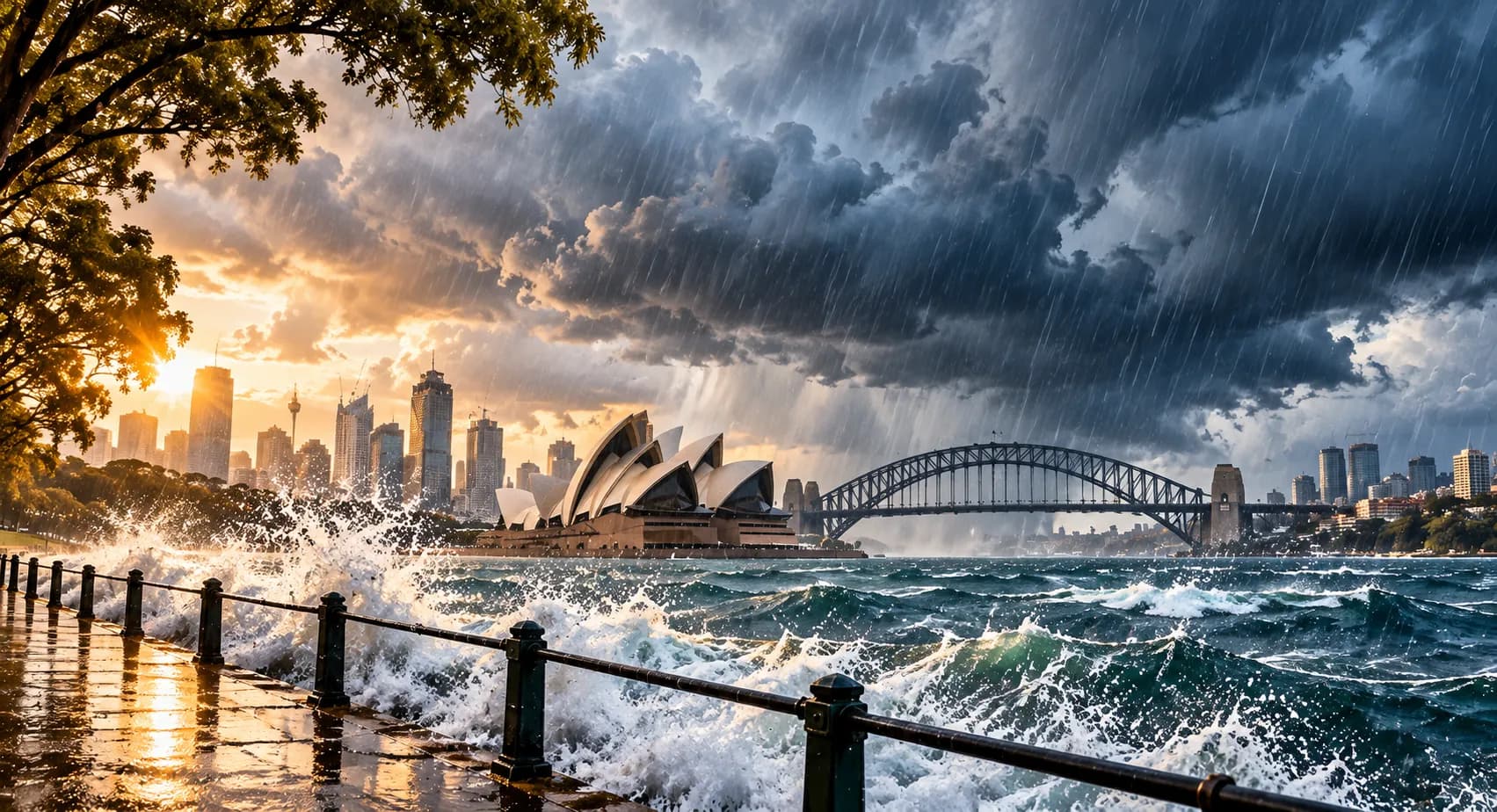
ABC News reported on 17 October 2026 that 2026 could become Australia's wettest El Niño year on record: this winter was the wettest El Niño winter in 35 years, and none of the 27 El Niño years since 1900 had above-average national rainfall across winter and spring. Using a short original news story, an English audio reading and a plain-English retelling, this article covers 11 weather news words and phrases, including El Niño, on record, above average, flash flooding and outlook, plus 3 sentence patterns, a dialogue and a 5-question quiz.
Learn Weather News English from Australia's “Wettest El Niño Year”
When people hear “El Niño”, many think first of drought, heatwaves and bushfires. For Australia, an El Niño year has usually meant less rain. But 2026 has brought a rare reversal: according to a 17 October report from the Australian Broadcasting Corporation's ABC News, this year could become Australia's wettest El Niño year on record.
If you are preparing for a working holiday or a study trip in Australia, or simply want to practise reading with news English, this story is well worth your time. It uses words you will meet in weather forecasts, climate science and everyday life, such as on record, above average, flash flooding and outlook. Once you know them, English weather news and Australian weather reports on the radio become much easier to follow.
This article pairs a short, originally rewritten English story with a plain-English retelling, key vocabulary, sentence patterns, a dialogue and a quiz, so you can learn how to talk about El Niño in English and get clear on the meaning of above average and how it is commonly used.
News English Story: Australia's Surprisingly Wet El Niño Year
Start with the audio player and listen once without reading along. Try to catch three key points: what record could 2026 set? How much rain fell in Sydney this week? What does the outlook for November say? Then read the English story below (an original rewrite based on ABC News reporting).
Australia could be heading for its wettest El Niño year on record. El Niño usually brings dry weather to the country, and this one began in the Pacific Ocean in June. But this year, storms and heavy rain have soaked large parts of the nation instead.
According to ABC News, Australia had its wettest El Niño winter in 35 years. None of the 27 previous El Niño years since 1900 recorded above-average national rainfall across the combined winter–spring period. If the rest of spring stays wet, 2026 may become the first. ABC News reported on October 17, 2026, that Sydney had already received more than 100 millimetres of rain that week, while parts of central Queensland were hit by flash flooding.
One possible factor behind Australia’s unusually wet El Niño is a large area of warm water in the Indian Ocean, which is supplying extra moisture to the atmosphere. Meanwhile, the current spell of wet weather along the east coast is also being supported by a stalled high-pressure system over the Tasman Sea.
The Bureau of Meteorology's latest outlook suggests November will be wetter than usual for much of Australia, especially Western Australia. For travellers and working holiday makers, it is a good idea to check the forecast before planning a road trip or outdoor work.
The Story in Plain English
El Niño usually makes Australia dry. This El Niño started in the Pacific Ocean in June. But this year, storms and heavy rain have made large parts of the country very wet, so 2026 could be Australia's wettest El Niño year since records began.
ABC News says this winter was Australia's wettest El Niño winter in 35 years. There have been 27 earlier El Niño years since 1900, and in none of them was the country's rainfall above average for winter and spring together. If the rest of spring stays wet, 2026 could be the first. On 17 October 2026, ABC News reported that Sydney had already had more than 100 mm of rain that week, and that parts of central Queensland had sudden floods.
Why is this happening? One possible reason is a big area of warm sea water in the Indian Ocean, which is putting extra moisture into the air. On top of that, a high-pressure system that has stopped moving over the Tasman Sea is helping to keep the east coast wet.
The Bureau of Meteorology's latest outlook says November will probably be wetter than normal in much of Australia, especially Western Australia. If you are travelling or on a working holiday, check the forecast before you plan a road trip or outdoor work.
Why Does This Story Matter?
El Niño years in Australia tend to bring drier, hotter weather, but 2026 looks very different. The Bureau of Meteorology points out that El Niño is not the only influence on Australian weather: the Indian Ocean Dipole, sea temperatures around Australia, seasonal changes (such as the northern wet season) and long-term climate change can all change how much rain actually falls.
For anyone heading to Australia to travel, study or start a working holiday, it is a useful reminder that “El Niño” does not automatically mean drought. When you plan farm work, a road trip or outdoor activities, keep checking the latest BOM forecasts and warnings.
Key Words and Phrases
| Word / phrase | Part of speech | Meaning | In the news | Everyday example |
|---|---|---|---|---|
| El Niño | n. | a climate pattern in the Pacific Ocean that affects weather in many countries | El Niño usually brings dry weather to the country. | Some farmers in Taiwan worry that El Niño will change the rainy season this year. |
| on record | phr. | since records began | … its wettest El Niño year on record | This summer was one of the hottest on record in Taipei. |
| be heading for | phr. | to be moving towards; to look likely to reach | Australia could be heading for its wettest El Niño year on record. | If you keep practising every day, you are heading for a higher TOEIC score. (= your score will probably go up) |
| soak | v. | to make completely wet | … storms and heavy rain have soaked large parts of the nation | I forgot my umbrella, and the afternoon rain soaked my shirt. (= my shirt got completely wet) |
| above average | adj. phr. | higher than average | … recorded above-average national rainfall | Rent in Taipei is well above average compared with other cities in Taiwan. Tip: add a hyphen when it comes before a noun (above-average rain), but not after a verb (Rain was above average.). |
| rainfall | n. | the amount of rain that falls | … national rainfall across the combined winter–spring period | Rainfall in northern Taiwan is usually high in winter. |
| flash flooding | n. | sudden flooding that builds up very quickly | … parts of central Queensland were hit by flash flooding | The hiking trip was cancelled because of a flash flood warning. (= a warning that sudden floods could happen) |
| moisture | n. | water in the air; dampness | … supplying extra moisture to the atmosphere | Use a dehumidifier to take moisture out of the room during plum rain season. |
| high-pressure system | n. | an area of high air pressure | … a stalled high-pressure system over the Tasman Sea | A high-pressure system usually brings sunny and dry weather. |
| outlook | n. | a forecast of what is likely to happen | The Bureau of Meteorology's latest outlook suggests November will be wetter than usual … | The job outlook for English-speaking engineers looks good next year. (= their job prospects) |
| working holiday maker | n. | someone who travels and works abroad on a working holiday | For travellers and working holiday makers … | Many working holiday makers from Taiwan pick fruit on Australian farms. |
Sentence Patterns
1. None of the + plural noun + verb (not a single one of …)
- Original: None of the 27 previous El Niño years since 1900 recorded above-average national rainfall across the combined winter–spring period.
- How it works: None of the + plural noun means “not a single one of …”. The verb after it can be singular or plural, and you will see both in the news and in exams. The original uses the past tense recorded, so you can't tell which one it is.
- Try it: None of my coworkers have been to the Philippines. (= not one of the people I work with has been there)
2. If + present simple, S + may / will + base verb (first conditional)
- Original: If the rest of spring stays wet, 2026 may become the first.
- How it works: use it to talk about something that could happen in the future. The if clause takes the present simple, not will; the main clause uses may (it is possible) or will (it is expected).
- Try it: If it rains tomorrow, the outdoor class may move online. (= rain could turn it into an online class)
3. It is a good idea to + base verb + before + V-ing
- Original: It is a good idea to check the forecast before planning a road trip or outdoor work.
- How it works: It is a good idea to... gives a gentle piece of advice, and before is followed by a gerund (V-ing) to mean “before doing something”.
- Try it: It is a good idea to practise speaking before going to Australia. (= practise speaking first, then go)
Dialogue Practice
Scene: Amy is getting ready for a working holiday in Australia and is on a video call with her friend Ben in Brisbane.
- Amy: I'm flying to Brisbane next month. How's the weather there?
- Ben: Honestly, it's been really wet. Heavy rain has soaked the whole city this week.
- Amy: Really? I thought El Niño meant dry weather in Australia.
- Ben: Usually, yes. But the news says this could be the wettest El Niño year on record.
- Amy: Wow. Should I worry about flash flooding?
- Ben: Just check the Bureau of Meteorology's outlook before you plan a road trip.
- Amy: Good idea. I'll pack a raincoat, too.
- Ben: Smart move. Rainfall here has been well above average!
(In plain English)
- Amy: I'm going to Brisbane next month. What's the weather like there?
- Ben: To be honest, it's been raining a lot. The whole city got very wet this week.
- Amy: Really? I thought El Niño made Australia dry.
- Ben: It usually does. But the news says this year might be the wettest El Niño year since records began.
- Amy: Wow. Do I need to worry about sudden floods?
- Ben: Just look at the weather bureau's forecast before you plan a road trip.
- Amy: Good idea. I'll bring a raincoat as well.
- Ben: Good thinking. It's been raining much more than normal here!
Quick Quiz
Once you have read the story and the vocabulary, try the 5 questions below. Choose an answer and confirm it to see the explanation.
Ready to Turn News English into Your Own English?
Understanding the news is only the first step. You have really learned it when you can say it in your own words.
Want to build practical English before you go abroad? Book a 20-minute one-to-one trial English lesson via our official LINE and practise English for travel, work and everyday conversation.
Planning to study English overseas? See our study-in-the-Philippines programmes to find the courses and schools that suit you.
Further Reading
Sources
- El Niño set to be wettest on record as storms soak Australia's east (ABC News, Tom Saunders, 17 Oct 2026)
- Australia Records Unusually Wet El Niño as Storms and Heavy Rain Sweep the Nation (IBTimes Australia, 17 Oct 2026)
- El Niño strength doesn't always match impact on Australia (Bureau of Meteorology, published 15 Sep 2026, updated 28 Sep 2026)
- flash flooding (Bureau of Meteorology, Australian Water Information Dictionary)
Information checked on 19 Oct 2026. Weather conditions and outlooks are updated constantly, so check the Bureau of Meteorology's latest forecast before you travel or plan outdoor work.
FREQUENTLY ASKED QUESTIONS
FAQ
Q01What is El Niño, and what is the opposite called?+
El Niño is the name used in English for this Pacific climate pattern. It is Spanish for “the boy” and is pronounced roughly /el ˈniːnjoʊ/. The opposite pattern is called La Niña. In the news you will also often see phrases such as an El Niño event or a strong El Niño.
Q02What does above average mean, and when does it need a hyphen?+
Above average means “higher than average”. After a verb it has no hyphen, e.g. Rainfall was above average. Before a noun that it describes, it takes a hyphen, e.g. above-average rainfall. The opposite is below average.
Q03Do I need to understand English weather forecasts for a working holiday in Australia?+
It helps a lot. Australia is huge and the weather varies widely from place to place, and outdoor jobs on farms, building sites and in warehouses often change their rosters because of the weather. When you drive around the country, you also need to watch for flooding and road closures. Knowing words such as forecast, outlook, warning and flash flooding helps you pick up important information faster.
Q04What does on record mean, and how is it different from record?+
On record often follows a superlative and means “since records began”, as in the wettest year on record. On its own, record can be a noun (a record) or a verb (to record), while on record is a common fixed phrase.
Q05What's the difference between a flash flood and a flood?+
Flood is the general word for flooding or water covering land. Flash flood stresses that the flooding builds up very quickly; it is usually more local, is often caused by short bursts of heavy rain, and can happen in cities as well, not only in hilly areas. The Bureau of Meteorology defines it as flooding with rapidly rising water that occurs within about six hours of rain.