

For Anderson, learning English was never only about reaching a certain score. It was about having the chance to talk with people from different countries, encounter different perspectives, and learn from each other along the way.
This IELTS student story from a National Taiwan University Department of Civil Engineering student begins with how he sees English, then moves into the practice and changes that happened along the way.
Going from a 5.0 placement test average to 6.5 on the in-school mock test is the concrete progress this journey left behind. Beyond the scores, what he values is the international outlook English brings.
English lets me connect with people from different countries, encounter different ideas through those interactions, and learn from one another.
From National Taiwan University, English opened the door to a bigger world
For me, one of the most important things about English is that it stops conversation from being limited to the language and surroundings I already know. When I can interact with people from different countries in English, I gain another way to understand them, and they gain another chance to get to know me.
This kind of exchange is more than swapping a Chinese sentence for an English one. People from different backgrounds may see the same thing differently, or have life experiences I have never encountered. Being able to share and learn from one another through English is a big part of how I think about learning the language.
So when I look back on this period of learning English, I hope what remains is more than "from this score to that score." Grades can show how you performed at a certain stage, but using English to connect with people gives learning a meaning beyond the exam.

An IELTS starting point of 5.0: understanding the gap between the four skills first
Anderson's initial scores were not all around 5.0. Listening 6.5, Reading 5.0, Writing 3.5, Speaking 4.5: looking at the average alone makes it easy to miss how much the four skills differed.
Writing was the lowest of the four at the start. For anyone planning their IELTS preparation, this record offers a practical reminder: before setting an overall target, look clearly at where each skill stands. Stronger skills need to be maintained, while weaker ones need a concrete direction for practice, rather than spending all your time on the question types you already know best.
This does not mean a single test defines someone's English ability. It gives the preparation a starting point to compare against later. When you look at your scores again, you can tell which skill the progress came from and where more work is still needed.
Starting from a 3.5 in writing: Anderson's practice and progress
In the classroom photos Anderson shared, the whiteboard shows common IELTS writing question types such as "To what extent", "Discuss", and "Advantages and disadvantages", along with paragraph elements such as topic sentences, explanations, examples, and results, and how to state a position, add supporting reasons, and address the opposing view.
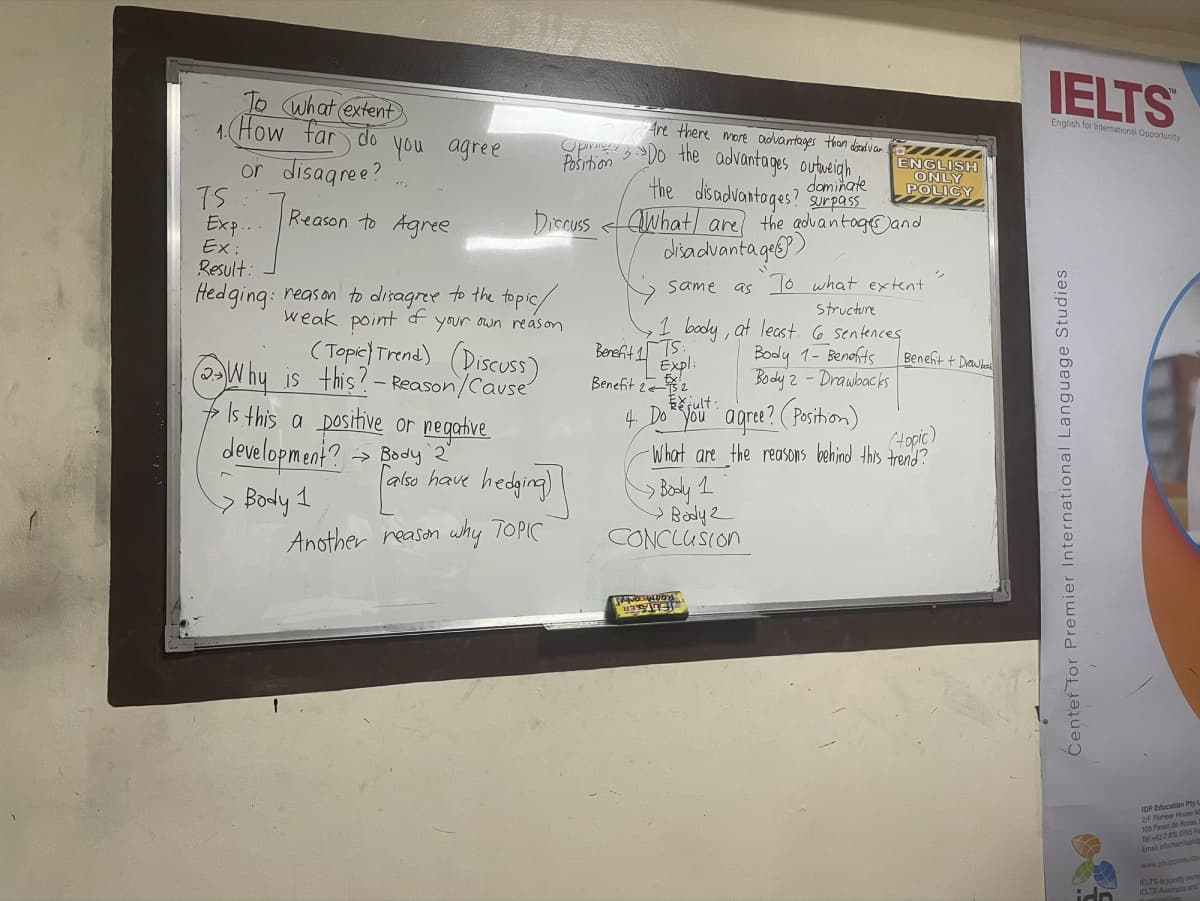
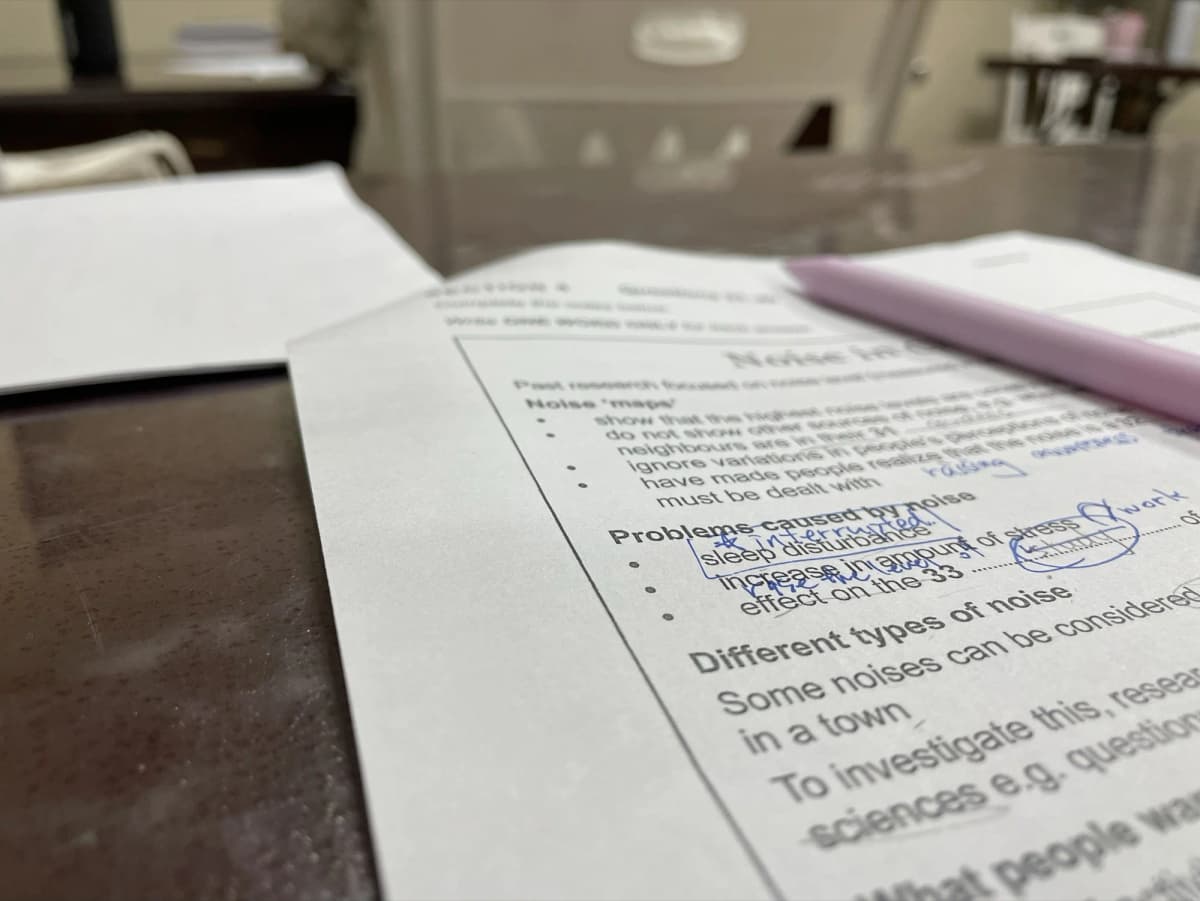
These classroom snapshots make "practicing writing" much more concrete. Facing a prompt is not only about how many words you know. You also need to read the question properly, decide on a position, and give every paragraph a clear job. Examples have to support the argument, and explanations have to keep the reader with you; writing longer sentences does not count as finishing the task.
According to the test records, Anderson's writing rose from 3.5 on July 1 to 4.5 on July 12, and then to 6.0 on July 26. The classroom photos show what the practice looked like, and the score sheet records the changes at each stage. Together, they make this IELTS writing journey more than a single final score. How much each individual exercise contributed to the score, however, cannot be determined from photos and a score sheet alone.
From 5.0 to 6.5 in 25 days: the full CPILS IELTS in-school test record
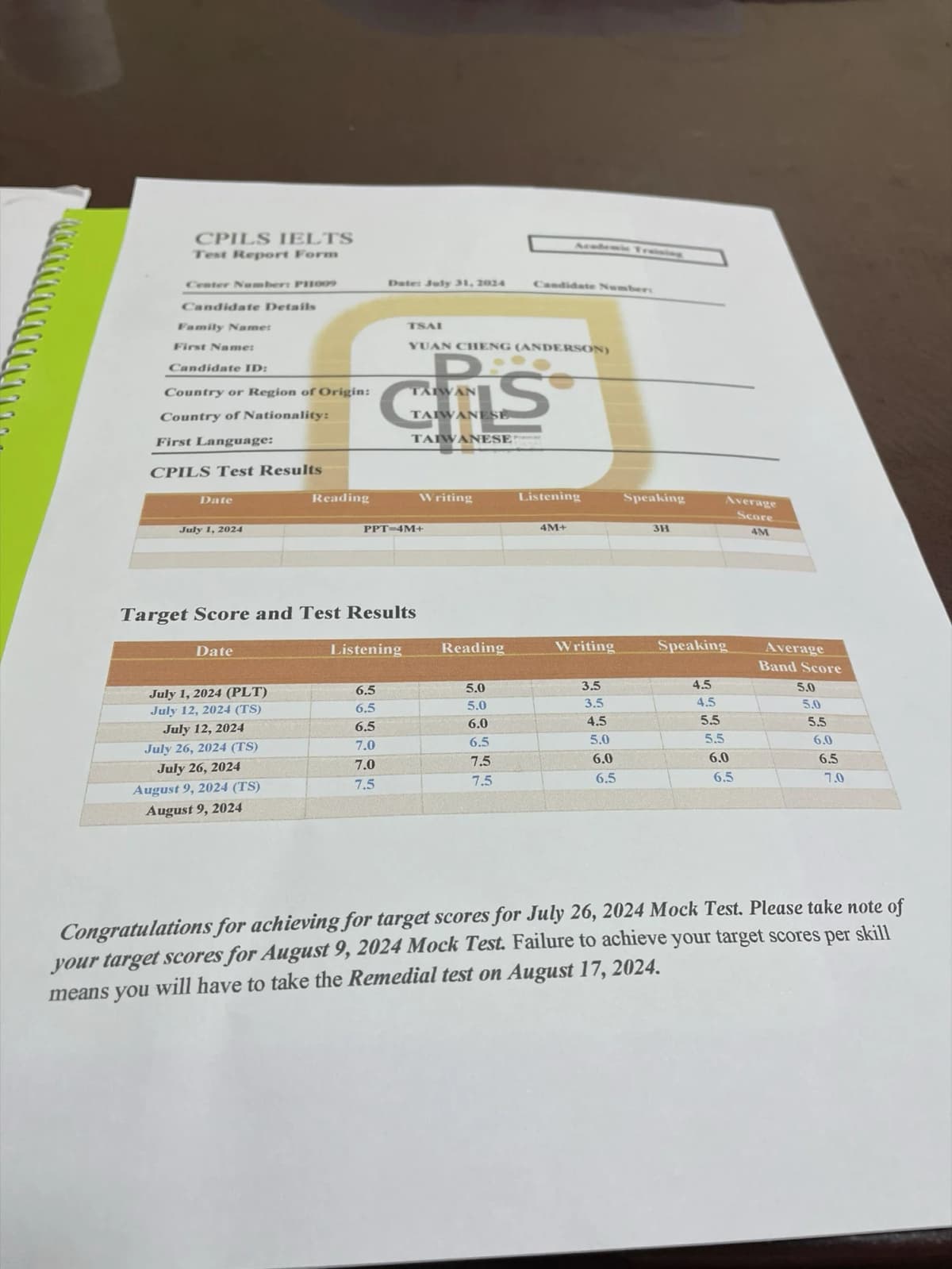
According to CPILS test records, Anderson's placement test average on July 1, 2024 was 5.0, and his mock test average on July 26 was 6.5. Within 25 days, his average rose 1.5 Band, with all four skills improving; Reading and Writing each went up 2.5 Band.
The table below lists stage targets and actual test results separately, so that planned scores are not mistaken for scores already achieved.
All scores in this article come from CPILS in-school training tests and mock tests in 2024. They are not official IELTS exam results. The 7.0 average for August 9 is the target for the next stage, not a score that was achieved.
| Date | Record type | Listening | Reading | Writing | Speaking | Average |
|---|---|---|---|---|---|---|
| 7/1 | Placement test (PLT) | 6.5 | 5.0 | 3.5 | 4.5 | 5.0 |
| 7/12 | Target score (TS) | 6.5 | 5.0 | 3.5 | 4.5 | 5.0 |
| 7/12 | Test result | 6.5 | 6.0 | 4.5 | 5.5 | 5.5 |
| 7/26 | Target score (TS) | 7.0 | 6.5 | 5.0 | 5.5 | 6.0 |
| 7/26 | Mock test result | 7.0 | 7.5 | 6.0 | 6.0 | 6.5 |
| 8/9 | Next target (TS) | 7.5 | 7.5 | 6.5 | 6.5 | 7.0 |
Not just a higher overall score: the weaker skills improved too
From the placement test to the July 26 mock test, Listening rose from 6.5 to 7.0, Reading from 5.0 to 7.5, Writing from 3.5 to 6.0, and Speaking from 4.5 to 6.0.
The changes in Writing and Speaking deserve particular attention. Writing, the lowest of the four skills at the start, climbed from 3.5 to 6.0, and Speaking went from 4.5 to 6.0. This result did not come from his already-strong Listening pulling the average up; all four skills improved, moving his overall performance forward.
Two stage targets exceeded, but 7.0 is still the next step
His actual average on July 12 was 5.5, above the 5.0 target for that test; his July 26 mock test average was 6.5, also above the 6.0 target for that test. The CPILS report also notes that the July 26 mock test target was achieved.
As for the 7.0 average for August 9, the report lists it as the next stage target and gives no actual result for that date. This story therefore treats the confirmed July 26 mock test average of 6.5 as the stage outcome. It does not extend that into a 7.0 already achieved, and it is not equivalent to an official IELTS exam score.

Beyond the classroom, English also gave me the chance to connect with people from different countries
If you only look at the score sheet, this experience could be summed up in a few numbers. But for me, what English has given me also includes a broader international outlook, and the chance to connect with and learn from people from different countries.
Learning a language gave me one more doorway into different perspectives. Exchange is not only about how much I say; it is also about whether I can understand what others think and see the differences between our backgrounds. When English becomes the tool we communicate with, people who were strangers have a chance to share and get to know each other.
This is also the ability I hope to keep building. Scores help me see progress at a given stage, while the ability to connect with people lets English extend beyond the classroom and become part of how I get to know the world.

For anyone preparing for IELTS: three things to take from this record
1. Look at each skill's starting point, not only the average
The same 5.0 average can hide very different combinations of listening, speaking, reading, and writing. Anderson's record reminds anyone preparing to first understand the gaps between their own skills and then plan where to strengthen, which is far more concrete than focusing on a single overall score.
2. Break the big goal into stages you can check
From July 12 to July 26, the report keeps both the target and the actual result. Comparing the two helps learners check their current progress, instead of waiting until the final test to discover which skills still need work.
3. Treat a personal story as a reference, not a guarantee
Anderson improved by 1.5 Band in this record, but everyone's starting point, practice effort, and learning situation are different. The 25 days are the observation window between two known tests; they do not represent the full course length, and they are not a score-improvement timeline everyone can replicate. When planning your own IELTS study, adjust according to your actual level and goals.
Snapshots from Anderson's time at CPILS




My IELTS Learning Timeline
Starting point
A first-year civil engineering student at National Taiwan University, hoping to broaden his international outlook through English, heads to CPILS in Cebu to prepare for IELTS.
July 1 placement test
In-school placement test average 5.0: Listening 6.5, Reading 5.0, Writing 3.5, Speaking 4.5.
Classroom practice
Practicing question-type identification, stating a position, and paragraph structure in writing class, and taking notes question by question in reading class.
July 12 in-school test
Average 5.5, above the 5.0 target for that test; Writing reached 4.5.
July 26 mock test
Average 6.5, above the 6.0 target for that test; Reading 7.5, Writing and Speaking 6.0 each.
Next stage
The report lists a target of a 7.0 average for August 9; the documents do not include an actual result for that test.
Frequently Asked Questions
How much did Anderson's IELTS in-school test scores improve?
According to in-school records, his placement test average on July 1, 2024 was 5.0, and his mock test average on July 26 was 6.5, a 1.5 Band increase in 25 days. Reading and Writing each rose 2.5 Band, Speaking rose 1.5 Band, and Listening rose 0.5 Band.
Is the 6.5 in this article an official IELTS exam score?
No. This article cites CPILS in-school training test and mock test records. They cannot be treated as official IELTS results, and they do not mean he has obtained the formal language certification required for university applications or other purposes.
Did Anderson go on to reach IELTS 7.0?
The available information cannot confirm this. The 7.0 average for August 9 in the report is the next-stage target, and no actual result for that test is attached. The confirmed stage outcome is the July 26 in-school mock test average of 6.5.
If my IELTS writing is weak, what can I take from this story?
Anderson's classroom photos show practice in identifying question types, stating a position, and structuring paragraphs. If you are preparing, start by checking whether you have understood the question, whether each paragraph has a clear main idea, and whether your reasons and examples support your argument, then adjust based on your actual essays and your teacher's feedback. This one case cannot be used to estimate how much your own score will improve.
Besides scores, what else can university students focus on when preparing for IELTS?
Anderson's story also emphasizes an international outlook and connecting with and learning from people from different countries. Beyond test targets, think about how you want to use English, so that practice connects to real communication rather than stopping at answering questions.
Your IELTS preparation can also start with a clear look at each skill
Whether your goal is studying abroad, an exchange program, or simply using English in a bigger world, start by understanding your level and the gaps between your skills, then choose a way of learning that fits. If you would like to learn about the IELTS course at CPILS, or start with one-on-one online English, come talk with us.