
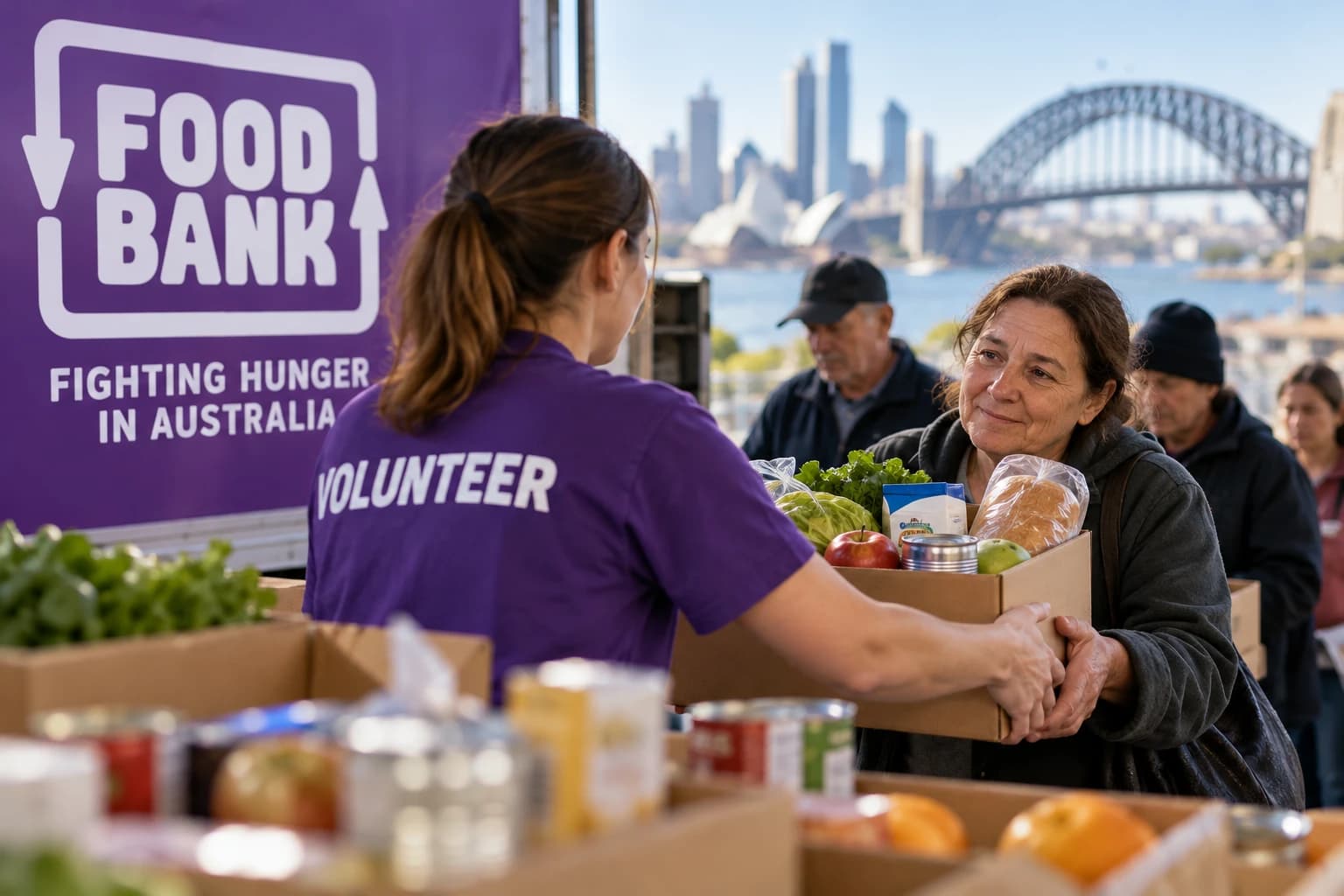
On 26 October 2026, Foodbank Australia released its annual Hunger Report: in the past 12 months about 3.6 million households, or one in three, experienced food insecurity, around 100,000 more than last year, and 69% of them faced it for the first time. Households aged 18–34, renters, single parents and households with casual workers were hit hardest. This lesson uses an original English passage with audio to teach 12 words and phrases such as food insecurity, cost of living, cut back on and make ends meet, plus 3 sentence patterns, a working holiday dialogue, a 7-question quiz and an FAQ.
The "Lucky Country" where one in three households goes hungry?
News date: 26 October 2026 | English level: B1–B2 | Topic: life in Australia, cost of living
Australia is often called "the Lucky Country", but the annual Foodbank Hunger Report 2026, released by Foodbank Australia on 26 October 2026, found that about 3.6 million households across the country experienced food insecurity in the past 12 months, around 100,000 more than last year.
Why read this? The report shows that young households aged 18–34, renters and households with part-time or casual workers were hit especially hard. Many working holiday makers share some of these conditions, but the survey looked at Australian households, so it does not describe working holiday makers directly. If you are planning an Australian working holiday or study trip, understanding this story will give you a better feel for local prices and budgets.
First, get the key points of the report in 30 seconds. Then read an original English passage and learn words you will meet in the news and in daily life, such as food insecurity, cost of living and make ends meet.
Foodbank Hunger Report 2026 in 30 seconds
| Question | Answer |
|---|---|
| Who released it? | Foodbank Australia, a food relief charity. Released in Canberra on 26 October 2026; it is the 14th annual report |
| How many households? | About 3.6 million in the past 12 months, roughly one in three, around 100,000 more than last year |
| First-time experience? | 69% of food-insecure households experienced it for the first time in the past year |
| Who is hit harder? | Households aged 18–34: 48%; renters: 51%; single-parent households: 60%; households with part-time or casual workers: 42%; people who fully own their homes: 12% |
| Possible causes? | Foodbank chief executive Kylea Tink suggests the cost-of-living crisis and rising interest rates may be part of the reason |
| What does Foodbank want? | For the federal government to work with the states and territories on a national minimum standard for school breakfast programs, so every child can get a healthy breakfast at school by 2030 |
Sources: Foodbank Australia media release and ABC News report (26 Oct 2026). The report is a nationally representative survey commissioned by Foodbank; see the report page for the full method.
Read the story in English
Use the player at the top of the article and listen once without reading. Try to catch three points: about how many households are affected? Which groups are hit hardest? What does Foodbank want the government to do? Then read the passage below in full, and check the plain-English summary in the next section.
English Level: Intermediate (B1–B2) | Topic: Australia, Cost of Living
One in Three Australian Households Faced Food Insecurity
A new report from Foodbank Australia, a food relief charity, shows that about 3.6 million Australian households experienced food insecurity in the past 12 months. In simple terms, they did not always have enough food, or they worried about running out. That is roughly one in three households, and around 100,000 more than last year.
For many families, this is a new experience. Of the households that faced food insecurity, 69 per cent went through it for the first time in the past year. Foodbank's chief executive, Kylea Tink, says the cost-of-living crisis and higher interest rates could be part of the reason. When money is tight, people try to keep paying for housing, power and transport, so food is often the first thing they cut back on.
Some groups are hit harder than others. Almost half of households aged 18 to 34 were food insecure. The rate for renters was 51 per cent, compared with 12 per cent for people who fully own their homes. Single-parent households and households with part-time or casual workers were also more likely to struggle.
Ms Tink warned that the "Lucky Country" is becoming the "Hungry Country." Foodbank is asking the federal government to work with the states and territories on a national minimum standard for school breakfast programs, so that every child in Australia can get a healthy breakfast at school by 2030.
The English passage above is an original learning text written from information in the Foodbank Australia media release and the ABC News report. It is not a word-for-word copy of any news article.
Key points in plain English
About 3.6 million Australian households, roughly one in three, did not always have enough food in the past year.
For 69 per cent of them it was the first time, and Foodbank says the cost of living and higher interest rates may be part of the reason.
Young households, renters, single parents and families with casual workers had the hardest time.
Foodbank wants a national standard for school breakfast programs so that every child can eat a healthy breakfast at school by 2030.
12 useful words for news and the cost of living
Here are 12 words and phrases from the passage. You will use them when reading the news, planning a budget for life overseas, or chatting with flatmates and landlords.
1. food insecurity (n.) — not having reliable access to enough food
Pronunciation: /ˌfuːd ɪnsɪˈkjʊərəti/
It does not always mean having no food at all; often worrying about the next meal counts too. The adjective is food-insecure. Do not confuse it with food safety, which is about whether food is clean and safe to eat.
In the story: 3.6 million Australian households experienced food insecurity
Example: Many international students face food insecurity when rent goes up.
2. household (n.) — all the people living together in one home
Pronunciation: /ˈhaʊshəʊld/
Statistics often count households rather than people. One in three households means one out of every three homes.
In the story: roughly one in three households
Example: In Taiwan, many households spend a big part of their income on housing.
3. charity (n.) — an organisation that helps people in need
Pronunciation: /ˈtʃærəti/
In the story: a food relief charity
Example: She volunteers at a local charity every Saturday.
4. run out (of) (phr. v.) — to use all of something so none is left
Add of when you say what is gone: run out of money / food / time.
In the story: they worried about running out
Example: I always run out of money before payday.
5. cost of living (n.) — how much money you need for everyday life
Before a noun, add hyphens: cost-of-living crisis. Living costs is similar but usually refers to the actual bills you pay.
In the story: the cost-of-living crisis
Example: The cost of living in Sydney is much higher than in Taichung.
6. interest rate (n.) — the percentage you pay to borrow money
When a central bank raises rates, mortgage and loan rates go up, which squeezes household budgets further.
In the story: higher interest rates could be part of the reason
Example: Interest rates went up again this year.
7. cut back on (phr. v.) — to spend or use less of something
In the story: food is often the first thing they cut back on
Example: I'm trying to cut back on bubble tea to save money.
8. be hit hard (phr.) — to be badly affected
The comparative form be hit harder than… is common in news reports.
In the story: Some groups are hit harder than others.
Example: Small restaurants were hit hard by the rising price of eggs.
9. renter (n.) — a person who pays rent to live in a home
Pronunciation: /ˈrentə(r)/
The opposite is homeowner. To fully own a home means the mortgage is completely paid off.
In the story: The rate for renters was 51 per cent
Example: As a renter in Melbourne, he shares a house with four people.
10. casual work / casual job (n.) — work paid by the hour with no fixed hours
In Australia, casual is a common type of employment: usually no fixed hours and no paid leave, but a higher hourly rate. Working holiday makers hear this word a lot.
In the story: households with part-time or casual workers
Example: Many working holiday makers start with casual jobs on farms or in cafés.
11. struggle (v.) — to find life or a task very difficult
Pronunciation: /ˈstrʌɡl/
Struggle to + verb means it is very hard to do something.
In the story: were also more likely to struggle
Example: I struggled to understand the Australian accent in my first month.
12. make ends meet (idiom) — to have just enough money to live on
It does not appear in the passage, but it is one of the most common phrases when people talk about the cost of living.
Example: Some students work two part-time jobs just to make ends meet.
Food insecurity vs food safety: what's the difference?
These words look alike but mean very different things, and they are easy to mix up in the news:
| English | In short | Meaning | Example |
|---|---|---|---|
| food insecurity | not enough food | Can't get or afford enough food | Food insecurity is rising among renters. |
| food security | enough food | Reliable access to enough food (the opposite) | The program improves food security for children. |
| food safety | safe food | Food is clean and won't make you sick | Food safety rules are strict in restaurants. |
| food poisoning | illness from food | Getting sick from eating bad food | He got food poisoning from street food. |
More: Australian news often uses cost-of-living crisis and cost-of-living pressures. For another story on the same topic, read cost-of-living protests in France.
Grammar: 3 useful sentence patterns
All three patterns come from the passage. Use them to report numbers, and in writing and speaking.
Pattern 1: one in + number + plural noun (one out of every…)
From the story: That is roughly one in three households.
Key point: This shows a proportion. As a subject it usually takes a singular verb (one in five people is…), though a plural verb is also common in speech.
Try it: One in four students in my class wants to study abroad.
Pattern 2: A is often the first thing (that) + subject + verb
From the story: Food is often the first thing they cut back on.
Key point: the first thing + a relative clause stresses what comes first; the relative pronoun that can be left out.
Try it: Travel is often the first thing people give up when money is tight.
Pattern 3: The rate for A was X, compared with Y for B
From the story: The rate for renters was 51 per cent, compared with 12 per cent for people who fully own their homes.
Key point: compared with introduces the group you are comparing against. News reports use it all the time with numbers.
Try it: My listening score was 400, compared with 300 for reading.
Working holiday dialogue: talking about living costs in Australia
Situation: Amy is getting ready for a working holiday in Australia. She is on a video call with her friend Ken, who has lived in Brisbane for a year.
English Conversation
- Amy: I read that one in three households in Australia are facing food insecurity. Is the cost of living really that high?
- Ken: Rent is the biggest problem. As a renter, I pay almost half my income for a shared room.
- Amy: Wow. How do you make ends meet?
- Ken: I cut back on eating out and cook at home. I also pick up extra casual shifts at a café.
- Amy: Did you ever run out of money?
- Ken: Once, in my first month. I struggled because I didn't have a job yet. Bring enough savings!
- Amy: Good tip. I'll also practise my English so I can find a job faster.
For what to sort out in your first week and how to save money, see the Australia working holiday first-week checklist. To estimate city living costs, see the Melbourne cost of living guide.
Reading and vocabulary quiz
Now test how well you understood the passage. Try not to look back at the article. Choose an answer and press confirm to see the explanation.
Build the confidence to speak everyday English
Understanding the news is the first step. Once you are actually in Australia, you will need English most when you discuss a lease with a landlord, interview for a casual job and sort out shifts with co-workers.
Ambitious Learner's one-to-one online English lessons are planned around your level and goals, and you can practise interviews, work and daily-life situations. For more on preparing before you go, see How to prepare your English for an Australian working holiday.
For course details and trial lessons, contact us on our official LINE account.
Further reading
- Australian workplace burnout survey: another Australian story, with workplace words like burnout and workload.
- Cost-of-living protests in France: a cost-of-living story from another country.
- How to prepare your English for an Australian working holiday: English prep from before you leave to your first job.
- Melbourne cost of living guide: a reference for rent, transport and food budgets.
Sources
- Foodbank Australia: Hunger Report 2026 media release (2026/10/26)
- ABC News: Annual Foodbank Hunger Report finds 100,000 more households going hungry (2026/10/26)
- Foodbank Hunger Report 2026 report page
Facts checked on 28 Oct 2026. The figures for each group come from the Foodbank media release; the link to the cost-of-living crisis and rising interest rates is the view of Foodbank's chief executive as reported by ABC. The English passage, example sentences, dialogue and quiz are original teaching content by Ambitious Learner, not a word-for-word translation of any news article.
FREQUENTLY ASKED QUESTIONS
FAQ
Q01What does food insecurity mean, and how is it different from food safety?+
Food insecurity means not having reliable access to enough nutritious food, or often worrying about the next meal. Food safety is about whether food is clean and will not make people sick. The two terms sound similar but mean very different things.
Q02How many Australian households are food insecure?+
According to the Hunger Report released by Foodbank Australia on 26 October 2026, about 3.6 million Australian households experienced food insecurity in the past 12 months, roughly one in three and about 100,000 more than last year.
Q03Are cost of living and living costs the same?+
They are similar and both refer to how much it costs to live. Cost of living is more often used for the general level of prices in a place, as in the cost of living in Sydney, and often appears as cost-of-living crisis. Living costs more often means the actual bills a person or family has to pay.
Q04What does make ends meet mean?+
Make ends meet means to have just enough money to pay for what you need, for example: Some students work two part-time jobs just to make ends meet.
Q05Is the cost of living really high for working holiday makers in Australia?+
The report shows that young people, renters and households with casual workers are under more pressure, and many working holiday makers are in similar situations, so planning a budget before you go is important. Actual costs depend on the city, your accommodation and your job.