
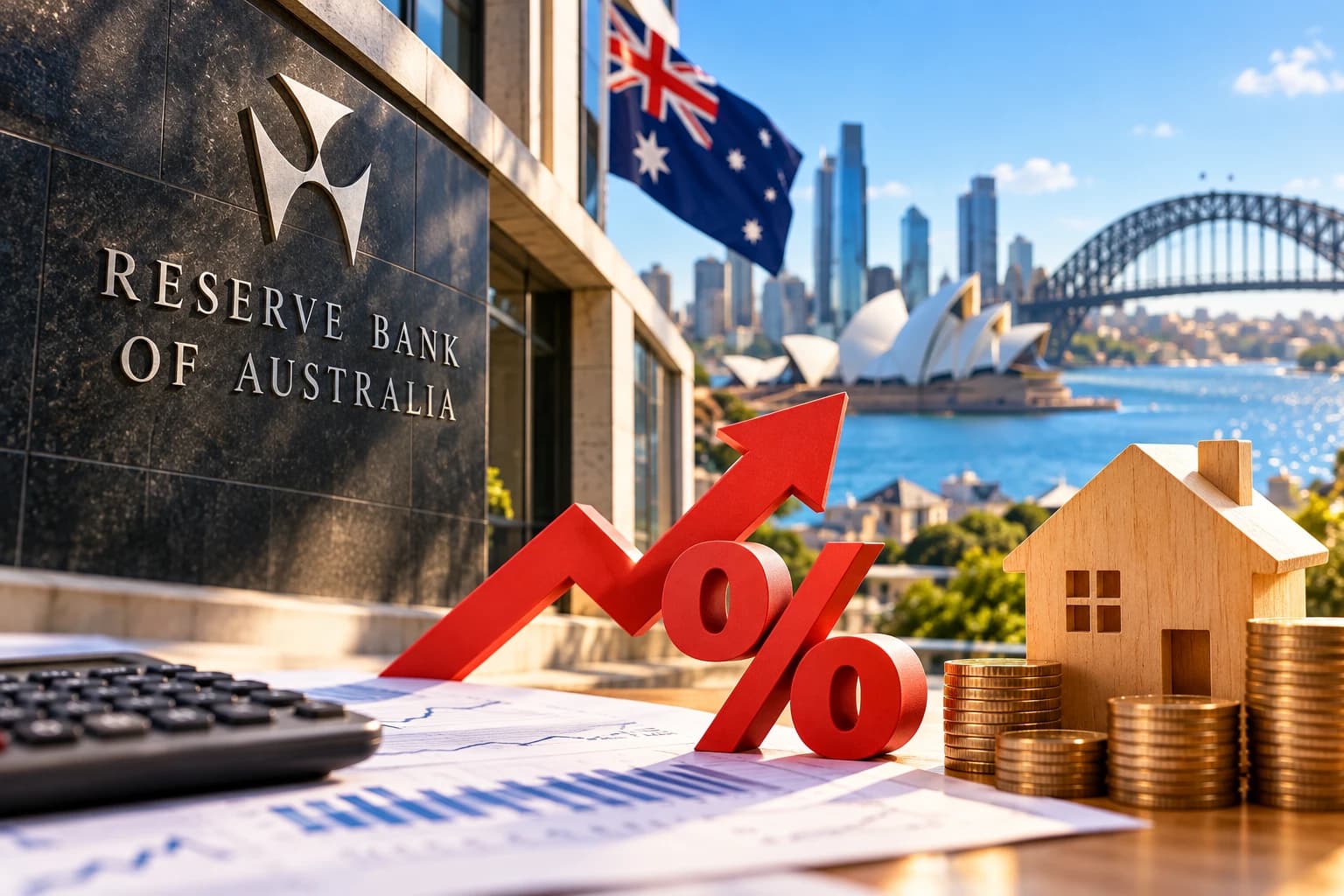
The Reserve Bank of Australia (RBA) has raised rates four times in 2026, and the cash rate reached 4.6% in late September. On 26 October, markets put the chance of a November hike at more than 60%, with the decision due on 3 November. This lesson uses an original English passage with audio to teach 11 finance words such as rate hike, cash rate, inflation, price in and mortgage, plus a comparison of rate rise and rate cut terms, 3 sentence patterns, a working holiday dialogue, a 6-question quiz and an FAQ.
Is Australia raising rates again?
News date: 26 October 2026 | English level: B1–B2 | Topic: economy, life in Australia
If you are planning an Australian working holiday or study trip, the latest economic news is worth watching: the Reserve Bank of Australia (RBA) has already raised interest rates four times this year, and on 26 October markets started betting on a possible fifth rise in November.
What is the English for an interest rate increase? The most common term is rate hike. This lesson uses an original English passage to help you understand key words such as rate hike, cash rate, mortgage and price in, with sentence patterns, a dialogue and a quiz, so you don't have to look up every word the next time you read about interest rates.
Even if you are not interested in finance, interest rates affect daily life: they influence loans and the rental market, and indirectly the cost of living in Australia.
Timing note: This article reflects information up to 27 October 2026. For the September-quarter inflation figures released by the Australian Bureau of Statistics on 28 October and the RBA's interest rate decision on 3 November, please rely on the official announcements.
The rate hike story in 30 seconds
| Question | Answer |
|---|---|
| What is the rate now? | The RBA cash rate is 4.60% (raised by 0.25 percentage points on 29 September 2026, the fourth hike this year) |
| Will rates rise in November? | Not decided yet. ABC News reported on 26 Oct that markets put the chance of a November hike above 60% |
| When is the decision? | The RBA announces its decision on Tuesday, 3 November 2026 |
| Key data? | The Australian Bureau of Statistics was scheduled to release September-quarter CPI on 28 October; before the release, markets expected annual inflation of about 3.9% |
| Why raise rates? | The RBA says inflation is still too high; annual inflation was 4.0% in August, above the 2%–3% target range |
Sources: ABC News (26 Oct, 29 Sep), the RBA cash rate page, the RBA calendar and the ABS CPI page. Market odds are only forecasts, not RBA decisions.
Read the story in English
Use the player at the top of the article and listen once without reading. Try to catch three points: how many times has the RBA raised rates this year? What is the rate now? What data is everyone waiting for? Then read the passage below in full, and check the plain-English summary in the next section.
English Level: Intermediate (B1–B2) | Topic: Economy, Australia
Will Australia Raise Interest Rates Again?
Australia may soon see its fifth interest rate rise this year. On Monday, 26 October, financial markets put the chance of a rate hike in November at more than 60 per cent, ABC News reported. The Reserve Bank of Australia, the country's central bank, will announce its next decision on Tuesday, 3 November.
The RBA has already raised its cash rate four times in 2026. After the latest increase in late September, the rate reached 4.6 per cent, its highest level in about 15 years. The bank says inflation is still too high. Annual inflation was 4.0 per cent in August, well above the RBA's target range of 2 to 3 per cent.
All eyes are on new inflation data. The Australian Bureau of Statistics was scheduled to release consumer price index figures for the September quarter on Wednesday, 28 October. Before the release, economists expected annual inflation of around 3.9 per cent. If the numbers come in higher than expected, traders may price in an even bigger chance of a hike.
Higher rates mean bigger monthly repayments for people with a mortgage, and they make borrowing more expensive in general. RBA Governor Michele Bullock has said that rate rises take time to feed through to the economy. For students and working holiday makers planning a trip to Australia, it is a good idea to follow the news and budget carefully.
The English passage above is an original learning text written from the ABC News report and public information from the RBA and the Australian Bureau of Statistics. It is not a word-for-word copy of any news article.
Key points in plain English
Markets think there is a more than 60 per cent chance that Australia's central bank will raise rates again in November, and it will decide on 3 November.
The RBA has already raised its cash rate four times this year, to 4.6 per cent, because inflation is still above its 2 to 3 per cent target.
New inflation figures due on 28 October could make a hike more or less likely.
Higher rates make loans more expensive, so people planning to study or work in Australia should follow the news and budget carefully.
11 useful words for interest rates and finance
Here are 11 words and phrases from the passage. You will use them when reading business news and planning a budget for life overseas.
1. rate hike (n.) — an increase in interest rates
The most common term. Australian and British media also often say rate rise. The opposite is rate cut.
In the story: the chance of a rate hike in November
Example: My bank sent me an email about the rate hike this morning.
2. cash rate (n.) — the main interest rate set by Australia's central bank
It affects the mortgage and savings rates banks offer. When the news says the RBA raised the cash rate, it means Australia's central bank raised interest rates.
In the story: raised its cash rate four times
Example: Many Australians check the cash rate before they buy a house.
3. central bank (n.) — the bank that manages a country's money and interest rates
In the story: the country's central bank
Example: Taiwan's central bank also meets regularly to decide on interest rates.
4. inflation (n.) — a general rise in prices
Pronunciation: /ɪnˈfleɪʃn/
Annual inflation is how much prices have risen compared with the same time last year.
In the story: The bank says inflation is still too high.
Example: Because of inflation, my lunch now costs NT$150 instead of NT$120.
5. target range (n.) — the range a number is supposed to stay within
The RBA's inflation target range is 2 to 3 per cent.
In the story: the RBA's target range of 2 to 3 per cent
Example: Our team's target range for monthly sales is 200 to 250 orders.
6. consumer price index (CPI) (n.) — a measure of changes in everyday prices
It tracks how the prices of goods and services that households buy change over time, and it is the most common measure of inflation.
In the story: release consumer price index figures
Example: The news said the consumer price index rose again last month.
7. price in (phr. v.) — when markets build an expected event into prices
A common phrase in business news: markets expect something to happen, so prices change before it actually does.
In the story: traders may price in an even bigger chance of a hike
Example: Investors have already priced in the bad news, so the stock didn't fall much.
8. repayment (n.) — money you pay back on a loan
In the story: bigger monthly repayments
Example: My student loan repayment is about NT$5,000 a month.
9. mortgage (n.) — a loan used to buy a home
Pronunciation: /ˈmɔːɡɪdʒ/
Note that the t is silent. A mortgage is only a loan secured on a home; a loan for a car is a car loan.
In the story: people with a mortgage
Example: My parents finally paid off their mortgage last year.
10. feed through (to) (phr. v.) — to slowly have an effect on something
Often used for policies whose effects show up gradually in the economy or prices; similar to take time to work.
In the story: rate rises take time to feed through to the economy
Example: Higher fuel prices will feed through to food prices.
11. budget (v. / n.) — to plan how to spend your money; a spending plan
In the story: budget carefully
Example: If you go to Australia on a working holiday, you need to budget for your first month's rent.
Rate hike, rate rise and rate cut: what's the difference?
Interest rate news uses lots of verbs and nouns. Here they are in one table:
| English | Meaning | Example |
|---|---|---|
| rate hike | an increase in rates (noun) | Markets expect a rate hike in November. |
| rate rise | an increase in rates (common in Australia and the UK) | It was the fourth rate rise this year. |
| rate cut | a decrease in rates | Many homeowners are hoping for a rate cut. |
| raise / lift rates | to increase rates (verb) | The RBA raised rates in September. |
| cut / lower rates | to decrease rates (verb) | The central bank may cut rates next year. |
| hold / keep rates on hold | to leave rates unchanged | The central bank decided to keep rates on hold. |
Tip: a percentage point is not the same as a per cent. If a rate goes from 4.35% to 4.60%, it has risen by 0.25 percentage points (25 basis points), not by 0.25%.
To review basic finance words like inflation and interest rate, read the Nobel Prize in Economics article.
Grammar: 3 useful sentence patterns
All three patterns come from the passage. They are useful for reporting numbers, making predictions and writing.
Pattern 1: put the chance of + event + at + number (to estimate how likely something is)
From the story: Markets put the chance of a rate hike at more than 60 per cent.
Key point: Here put means to estimate, and at is followed by a percentage. News reports use it a lot for odds and polls.
Try it: The weather app puts the chance of rain at 70 per cent tomorrow.
Pattern 2: the + superlative + level in + time period
From the story: The rate reached 4.6 per cent, its highest level in about 15 years.
Key point: A superlative with in + a period of time (or since + a year) shows that a record for that period has been broken. It is more specific than just saying very high.
Try it: This is the hottest October in ten years.
Pattern 3: If + present simple, subject + will / may + base verb (first conditional)
From the story: If the numbers come in higher than expected, traders may price in an even bigger chance of a hike.
Key point: For a possible future situation, use the present simple in the if clause. Come in higher is a common business-news phrase meaning the figures turn out higher than expected.
Try it: If my TOEIC score comes in higher than 750, I will apply for the job.
Working holiday dialogue: do rate hikes affect me?
Situation: Amy is getting ready for a working holiday in Australia. She is on a video call with her friend Ben, who works in Sydney.
English Conversation
- Amy: I saw a headline about another rate hike in Australia. Should I be worried?
- Ben: Not too much. The central bank hasn't decided yet. The meeting is next week.
- Amy: But the markets have already priced it in, right?
- Ben: Partly. Everyone is waiting for the new inflation numbers first.
- Amy: I don't have a mortgage, so does it even matter to me?
- Ben: Not directly, but living costs here are high. You should budget for at least two months.
- Amy: Good point. I'll work on my budget and my English this month.
- Ben: Smart. Both take time to work!
For setting up a bank account and finding a place to live when you arrive, see the must-have apps for life in Australia and the Australia working holiday first-week checklist.
Reading and vocabulary quiz
Now test how well you understood the passage. Try not to look back at the article. Choose an answer and press confirm to see the explanation.
From understanding the news to speaking with confidence
You don't need to memorise a whole dictionary to understand business news. The key is practising again and again in real situations.
Ambitious Learner's one-to-one online English lessons are planned around your level and goals. You can practise speaking with news topics, or focus on job interviews and daily life for an Australian working holiday. For more on preparing before you go, see How to prepare your English for an Australian working holiday.
For course details and trial lessons, contact us on our official LINE account.
Further reading
- Australian workplace burnout survey: another Australian story, with workplace words like burnout and workload.
- Nobel Prize in Economics: review finance words like inflation and interest rate.
- Cost-of-living protests in France: learn English for talking about the cost of living.
- Melbourne cost of living guide: a reference for planning your Australian budget.
Sources
- ABC News: Markets put chance of RBA rate hike above 60pc (2026/10/26)
- ABC News: RBA hikes cash rate to 4.6 per cent in fourth rate rise of 2026 (2026/09/29)
- Reserve Bank of Australia: Cash Rate Target
- Reserve Bank of Australia: Calendar
- Australian Bureau of Statistics: Consumer Price Index, Australia
Facts checked on 28 Oct 2026. The rate hike odds are market estimates (the ABC report of 26 Oct describes them as "more than 60%", "about 61%" and "about two-thirds"), not RBA decisions; "about 3.9%" was the market consensus forecast before the release. This article is not financial advice. The English passage, example sentences, dialogue and quiz are original teaching content by Ambitious Learner, not a word-for-word translation of any news article.
FREQUENTLY ASKED QUESTIONS
FAQ
Q01What is the English for an interest rate increase? Are rate hike and rate rise the same?+
Yes, they mean the same thing. Rate hike is very common in US and international media, while Australian and British media also often say rate rise. The opposite is rate cut.
Q02What is the cash rate in Australia?+
The cash rate is the policy interest rate set by the Reserve Bank of Australia (RBA). It affects the mortgage and savings rates banks offer. On 29 September 2026, the RBA raised the cash rate to 4.60%, its fourth hike this year.
Q03When is the RBA's next interest rate decision?+
According to the calendar on the RBA website, the next decision will be announced on Tuesday, 3 November 2026. Please rely on the RBA's official announcement for the actual result.
Q04What does price in mean?+
Price in means markets build an expected event into prices before it happens, for example: Investors have already priced in the rate hike.
Q05Do Australian rate hikes affect working holiday makers?+
For working holiday makers without loans the effect is more indirect, but interest rates are linked to prices, the rental market and living costs. Before you go, follow the news and budget conservatively. This article is not financial advice.